

On This Day in Politics: February 17, 1801
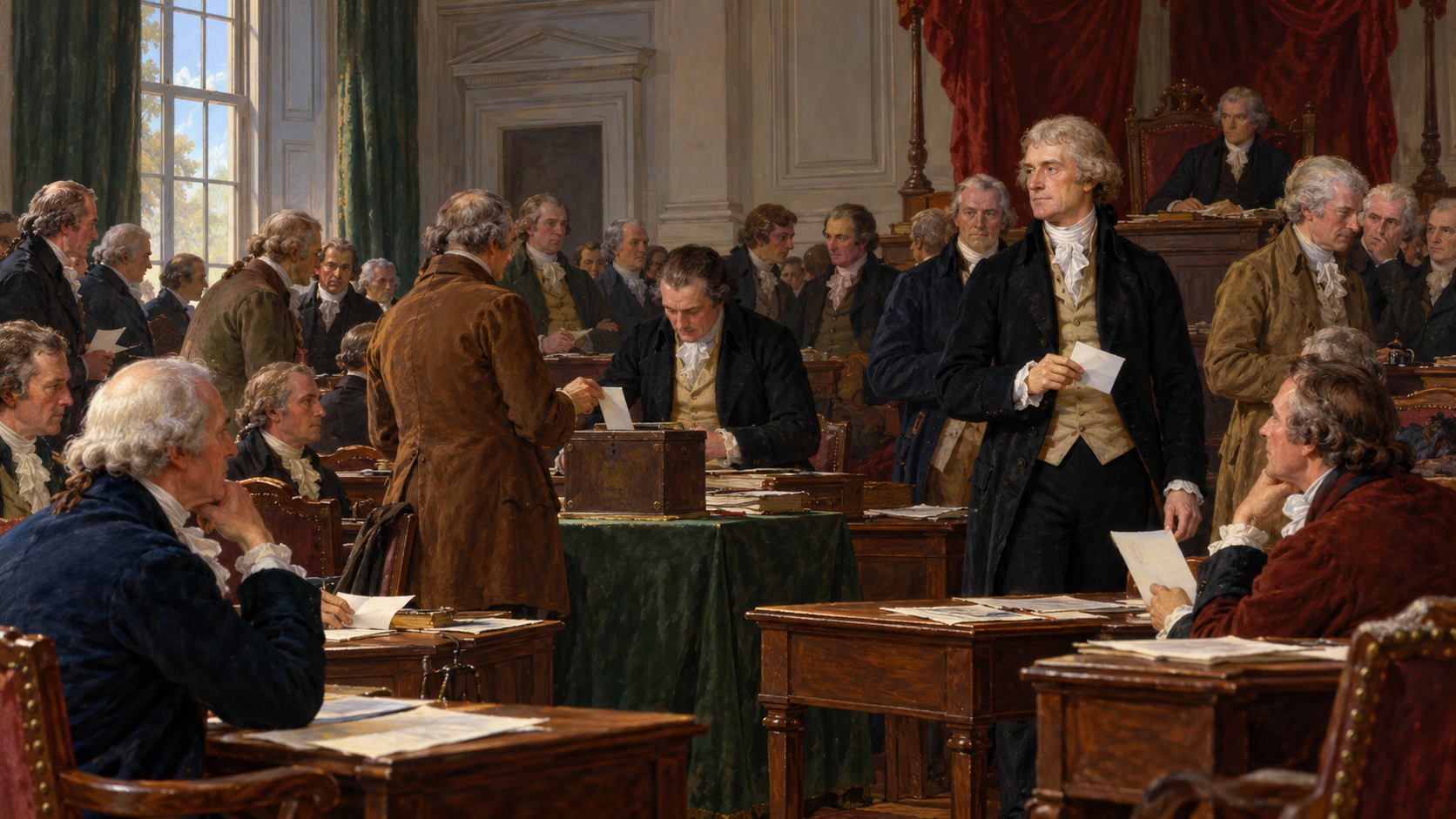
On February 17, 1801, the United States House of Representatives elected Thomas Jefferson president on its thirty-sixth ballot. The decision ended an extraordinary deadlock following the election of 1800, in which Jefferson and his intended running mate, Aaron Burr, had received the same number of electoral votes. What voters and party organizers had understood as a presidential ticket became a constitutional contest between two candidates from the same political alliance. The House’s resolution allowed a transfer of power to proceed, but the episode revealed that the original presidential election system did not fit comfortably with the emerging practice of organized party competition.
The Constitution then required electors to cast votes without separate designations for president and vice president. Jefferson and Burr each received seventy-three votes, leaving the House to choose the president under the constitutional procedure for a tie. The decision fell to the outgoing House, which remained under Federalist control, even though the election had strengthened the Democratic-Republicans. Representatives voted by state delegations rather than as one undifferentiated national body. This arrangement gave the contest a different political structure from an ordinary House vote and meant that repeated ballots could fail to produce the required agreement even while members’ individual preferences were well known.
Many Federalists strongly opposed Jefferson and considered supporting Burr as a way to block him. Alexander Hamilton, however, urged fellow Federalists to regard Jefferson as the safer choice. The struggle continued through thirty-five unsuccessful ballots before the decisive vote on February 17. Jefferson emerged as president and Burr as vice president. The result was achieved through the existing constitutional machinery, but only after intense political bargaining and uncertainty. The episode showed that a written procedure could provide a route out of a crisis without preventing the crisis itself. Institutions depended on how officeholders interpreted their choices and on whether enough of them would permit a workable outcome.
The lasting constitutional response came with the Twelfth Amendment, ratified in 1804, which established separate electoral votes for president and vice president. That change addressed the particular problem exposed by the Jefferson-Burr tie, while preserving a role for Congress when electoral results fail to produce a winner. February 17 therefore matters both as the day Jefferson secured the presidency and as evidence of a young republic adapting to political realities its original rules had not fully anticipated. The peaceful transfer that followed was significant, but it should not obscure the fragility revealed by the deadlock. Constitutional design and political conduct had to work together to make an election result governable.
The original electoral system did not distinguish presidential votes from vice-presidential votes. Party coordination therefore produced an unintended tie.
The outgoing Federalist House had to choose between Jefferson and Burr, both associated with the rival Democratic-Republican ticket.
The House voted through state delegations, a different method from ordinary legislation. Thirty-five ballots failed to settle the contest.
The thirty-sixth ballot on February 17 resolved the deadlock. Jefferson became president and Burr vice president.
The Twelfth Amendment introduced separate electoral ballots for the two offices in 1804, responding directly to the system’s demonstrated weakness.
The episode shows why constitutional procedures need both workable rules and political actors willing to let those rules produce a legitimate outcome.
Explore more of "On This Day ..."
Discover more events from the same date across news, politics, technology, sports, and other fields. Each link highlights significant moments that shaped history on different fronts.