

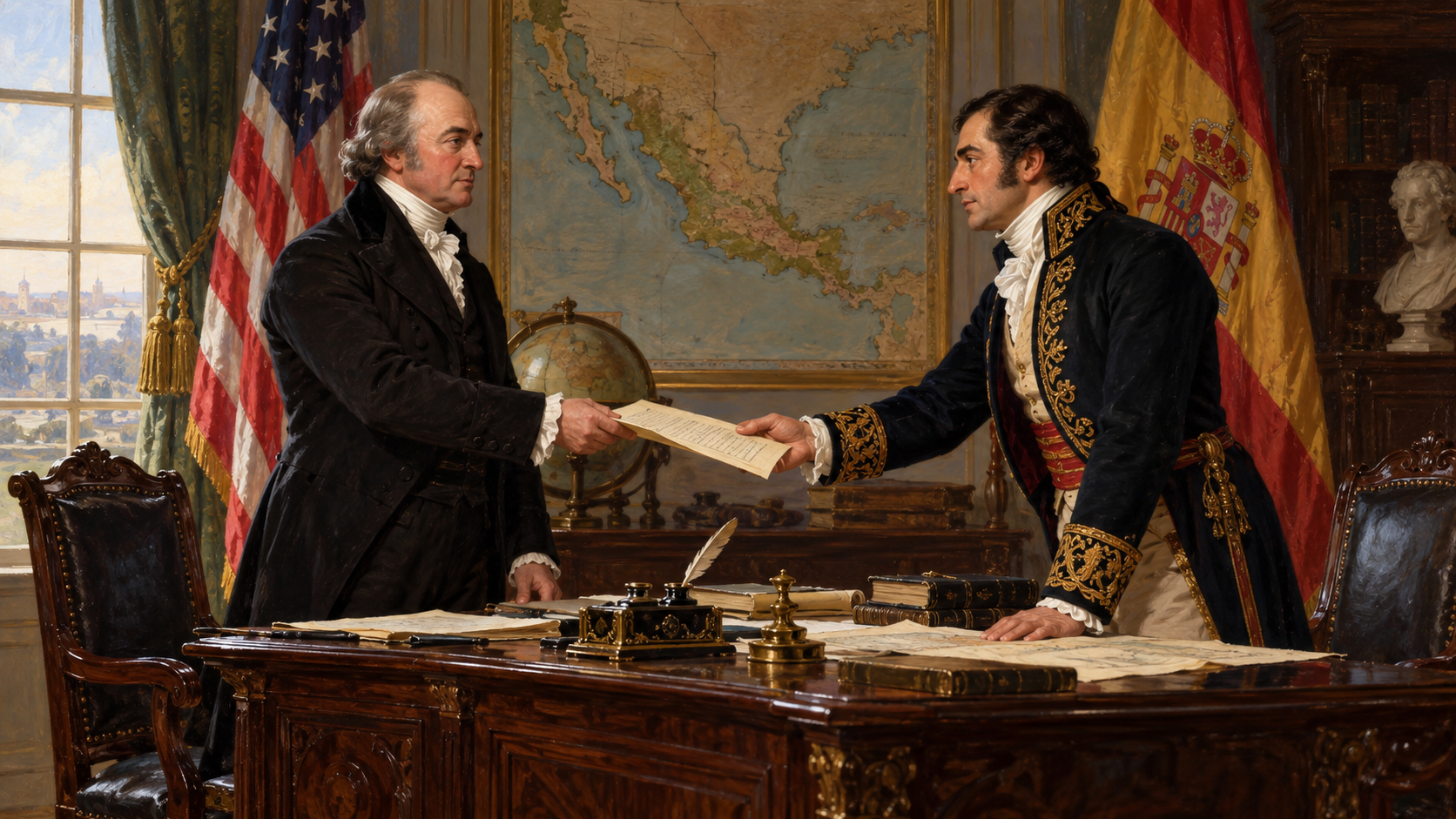
On This Day in Politics: February 22, 1819
On February 22, 1819, Secretary of State John Quincy Adams and Spanish minister Luis de Onís signed a treaty in Washington that reshaped the boundaries of the United States and Spain’s North American possessions. Spain agreed to cede East Florida and relinquish its claim to West Florida, while the two governments settled a continental boundary dispute. The agreement is known as the Adams–Onís Treaty or Transcontinental Treaty. Signing was not the same as an immediate transfer of administration: ratification and implementation followed, with the treaty taking effect in 1821. The February date marks the diplomatic agreement that made those later changes possible.
Florida had long been a source of tension. American expansion, disputed boundaries, and conflict along the frontier placed pressure on Spanish authority. Negotiations developed over several years, and Andrew Jackson’s military actions in Florida strengthened the pressure Adams could bring to bear. The treaty was therefore the product of both diplomacy and an unequal balance of power. Its provisions addressed more than one contested province. By establishing a boundary across the continent, the negotiators tried to resolve uncertainties left by earlier territorial arrangements and to reduce the number of disputes that might lead to renewed confrontation between their governments.
The terms connected Florida to a broader exchange of claims. Spain surrendered claims in the Pacific Northwest, while the United States recognized Spanish sovereignty over Texas. The United States also undertook to settle certain claims by its citizens against Spain up to five million dollars. That arrangement should not be described as a simple cash purchase paid directly to the Spanish government. The distinction matters because treaties often settle several kinds of obligations at once: territory, private claims, and the legal standing of borders. Adams regarded the agreement as a major achievement, but the compact still required the formal consent and follow-through that turn a negotiated text into an operative international settlement.
The treaty’s consequences reached people who had not participated in the negotiations. A line agreed by two governments could change administration, land claims, and the setting in which communities defended their interests. Indigenous nations were not merely empty spaces between imperial boundaries, and the diplomatic map did not erase their presence or rights. February 22 is consequently both a milestone in American territorial expansion and an example of how international agreements translate power into legal geography. The event is best understood by keeping its stages distinct: a treaty was signed in 1819, became effective in 1821, and then shaped a much longer history of settlement, conflict, and government across the affected regions.
Florida’s unsettled position and frontier conflicts gave the negotiations urgency. Military pressure and diplomacy operated together.
Adams and Onís addressed a continental boundary, not only the transfer of Florida. The treaty linked several territorial claims in one settlement.
Spain agreed to relinquish Florida, and the United States gave up its claim to Texas under the agreement.
The financial provision concerned claims against Spain up to five million dollars. It was not a direct purchase-price payment to Spain.
The treaty became effective in 1821, after its 1819 signature. Separating those dates avoids confusing agreement with implementation.
The diplomatic settlement changed political boundaries without including every community affected, especially Indigenous peoples with their own territorial rights.
Explore more of "On This Day ..."
Discover more events from the same date across news, politics, technology, sports, and other fields. Each link highlights significant moments that shaped history on different fronts.