

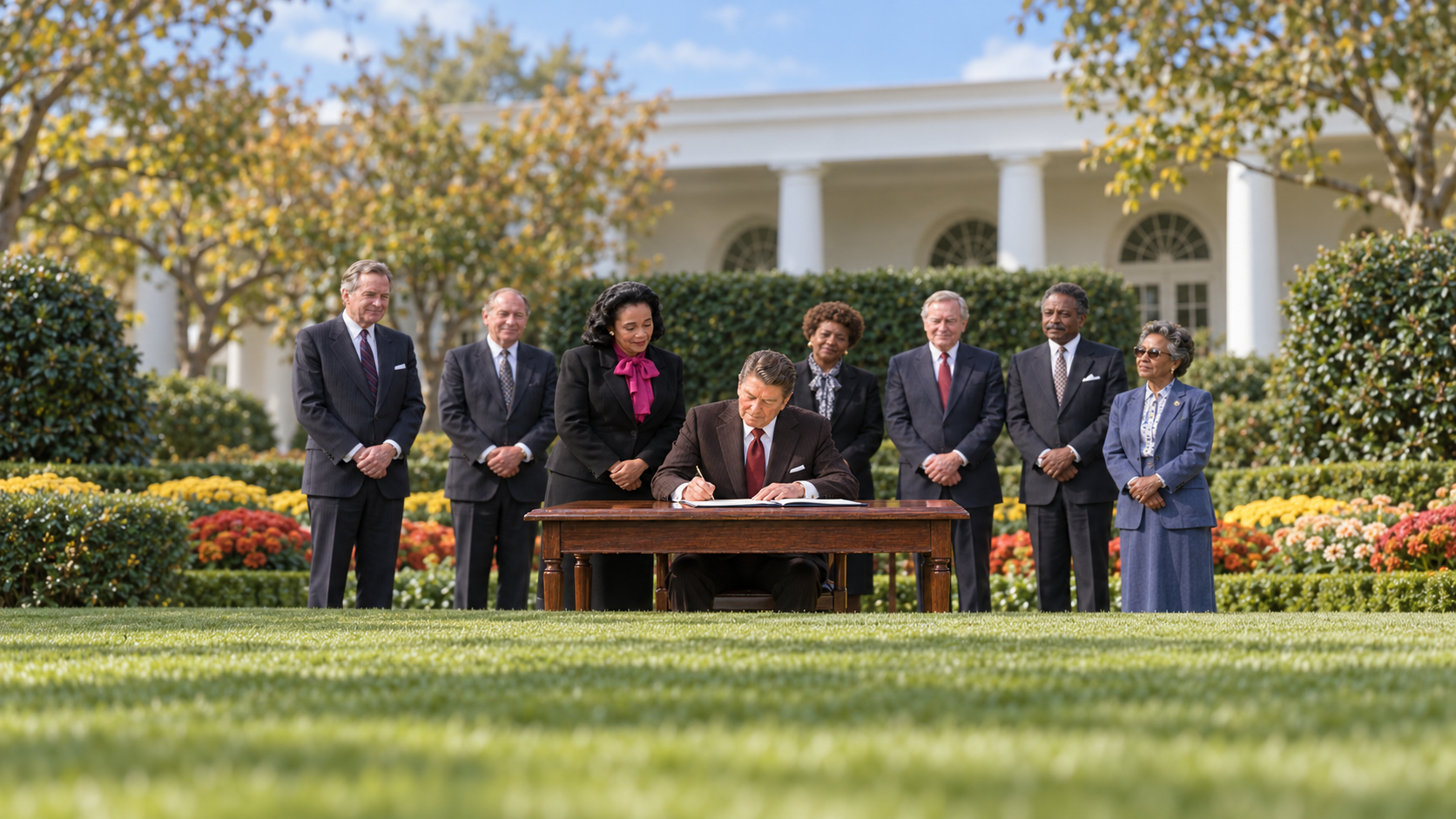
On This Day in Politics: November 2, 1983
On November 2, 1983, President Ronald Reagan signed legislation at the White House in Washington, D.C., establishing a federal holiday honoring Martin Luther King Jr. Coretta Scott King, members of the King family, and congressional supporters attended the Rose Garden ceremony. The law designated the third Monday in January as the observance, rather than fixing it to King's January 15 birthday. Its enactment concluded a long campaign to place the civil rights leader on the federal holiday calendar. The first federal observance would follow on January 20, 1986, giving the government time to prepare for the change.
The proposal had taken years to become law. Representative John Conyers began introducing holiday legislation soon after King's assassination in April 1968. Coretta Scott King continued to press the cause, supported by civil rights organizations, labor advocates, and other campaigners. The effort linked public remembrance to King's leadership against segregation and racial discrimination. By 1983, Representative Katie Hall of Indiana played a central legislative role. As a member of the House Post Office and Civil Service Committee, she helped move a proposal through the institution responsible for the federal calendar. The campaign therefore depended on both sustained public advocacy and the practical work of congressional procedure.
Hall introduced H.R. 3706 in July 1983, and the House approved the measure in August after contentious debate. Supporters had chosen a Monday observance that followed the pattern of several existing federal holidays. The Senate also approved the legislation before it reached Reagan. His administration had earlier opposed creating a paid federal holiday, including on grounds of cost, and had examined alternative commemorations. By signing the bill, Reagan accepted the observance that Congress had passed. At the ceremony, he discussed King's challenge to racial discrimination, while Coretta Scott King emphasized the meaning of national recognition. The signature turned a commemorative proposal into a change in federal law.
The new holiday carried limits as well as symbolic importance. Federal recognition did not automatically establish matching holidays in every state or require every private employer to close. Nor did honoring King resolve the inequalities against which he had organized. Those distinctions matter when assessing the event: the law changed the nation's official calendar, rather than completing the civil rights movement's work. Its delayed first observance also separates the November signing from the January celebrations that later became familiar. The achievement demonstrated how campaigners could sustain a legislative objective across many years and political administrations. It made the memory of a leader who challenged government policy part of the government's own recurring public commemoration.
John Conyers's early proposals followed King's assassination in 1968. The eventual law emerged from a campaign that outlasted several presidential administrations.
Coretta Scott King combined public organizing with direct appeals to government. Katie Hall's role in Congress connected that campaign to committee work and floor debate.
The law chose the third Monday in January, rather than requiring the observance to fall on January 15. The first federal holiday took place in 1986.
A federal holiday governs the federal calendar. State recognition and the decisions of private workplaces followed their own legal and institutional processes.
The administration's earlier opposition is part of the legislative history. The final signing should not be read as evidence that the proposal had always enjoyed unanimous support.
The anniversary concerns enactment of the holiday law. King's civil rights achievements, his assassination, and the first holiday observance are separate historical milestones.
Explore more of "On This Day ..."
Discover more events from the same date across news, politics, technology, sports, and other fields. Each link highlights significant moments that shaped history on different fronts.