

On This Day in Pop: January 17, 1929
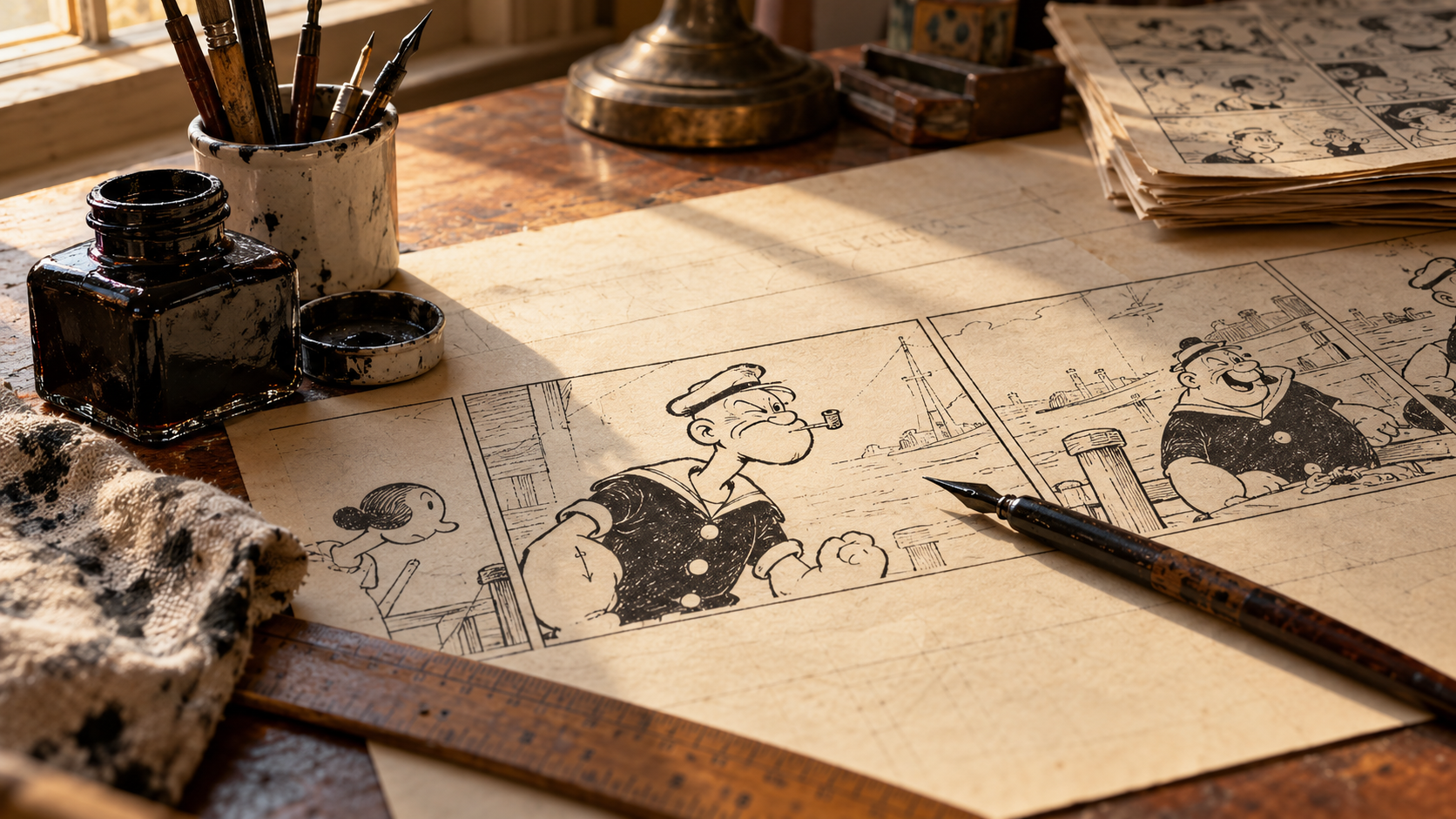
Popeye made his first appearance on January 17, 1929, in E. C. Segar’s newspaper comic strip Thimble Theatre. The strip was already nearly a decade old and centered on Olive Oyl, her brother Castor and a rotating cast of eccentric adventurers. In a new storyline, Castor needed a sailor to take him to Dice Island, where he hoped to exploit the supernatural luck of the Whiffle Hen. When Castor asked the weathered newcomer whether he was a sailor, the character answered with the gruff joke that supplied his name and attitude. Popeye was meant to serve the plot, not replace the established cast. Yet his squint, battered face, enormous forearms and blunt moral code immediately gave readers a figure unlike the polished heroes common in popular entertainment.
Audience response changed the strip. Popeye left after the Dice Island adventure but readers demanded his return, and Segar gradually moved him to the center of Thimble Theatre. His romance with Olive Oyl, rivalry with Bluto and friendship with Wimpy helped create a comic world built on slapstick, loyalty and surreal invention. The sailor’s strength was part of the joke, but so was his stubbornness: he could be quarrelsome and grammatically mangled while remaining protective of people being bullied. Spinach became his best-known source of power during the 1930s, rather than arriving as a fully formed element in the debut strip. That distinction matters because Popeye’s identity developed through repeated newspaper stories before animation simplified his traits into a fast, recognizable formula.
The transition to theatrical cartoons made Popeye one of the most recognizable characters of the twentieth century. Fleischer Studios introduced him to movie audiences in 1933, where music, motion and Jack Mercer’s muttered voice expanded the appeal of Segar’s drawings. Radio, television, advertising and merchandise followed, while the spinach gag became so influential that the character was often credited with encouraging children to eat the vegetable. Popeye’s success also illustrates the unpredictable nature of serialized popular culture: a temporary supporting player can eclipse the property that introduced him when audiences recognize a stronger personality. Later adaptations changed details, softened rough edges and sometimes reduced Olive Oyl to a prize in a rivalry, but the original strips remain inventive records of a character evolving in public. January 17 therefore marks more than a cartoon birthday. It is the point at which an accidental sailor stepped into an existing story and began steering an international franchise.
Popeye entered a long-running strip as a hired sailor, not as its planned star.
Reader enthusiasm persuaded Segar to bring the character back and enlarge his role.
The spinach-powered formula developed after the debut as Popeye’s traits became more standardized.
Animation broadened the audience but compressed the stranger, more complex world of the newspaper strip.
Popeye became a durable symbol of resilience, rough humor and defense of the underdog.
His rise remains a classic example of a supporting character transforming an established property.
Explore more of "On This Day ..."
Discover more events from the same date across news, politics, technology, sports, and other fields. Each link highlights significant moments that shaped history on different fronts.