

On This Day in Pop: July 9, 2001
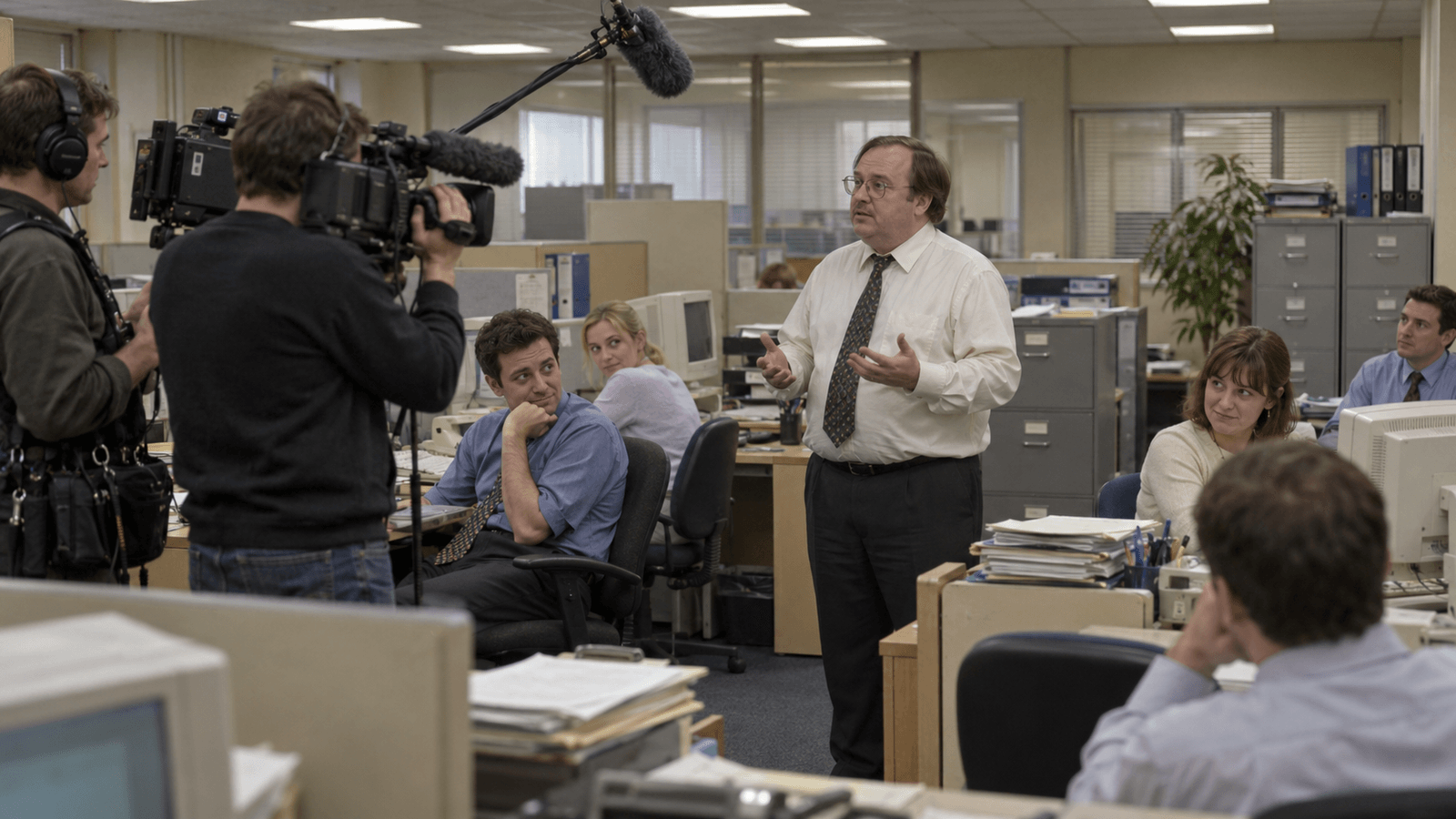
On July 9, 2001, BBC Two broadcast the first episode of The Office, created, written and directed by Ricky Gervais and Stephen Merchant. Set at the fictional Wernham Hogg paper company in Slough, the series presented ordinary workdays as footage captured by an unseen documentary crew. Gervais played manager David Brent, a man desperate to appear funny, compassionate and important whenever the camera turned toward him. Martin Freeman’s Tim, Lucy Davis’s Dawn and Mackenzie Crook’s Gareth supplied quieter reactions that often carried more meaning than dialogue. There was no studio audience or laugh track. Fluorescent light, beige partitions and awkward silences allowed embarrassment to expand until a glance at the camera released it.
The premiere mattered because the format made self-presentation the subject of sitcom comedy. Brent is not merely foolish; he performs an imagined version of himself for future viewers, then fails to recognize what the recorded evidence shows. The employees around him also understand the lens and use it differently—seeking sympathy, hiding boredom or sharing a silent joke with the audience. That relationship gave small gestures unusual weight and helped define the mockumentary style for twenty-first-century television. Initial ratings were modest, but reviews and repeat broadcasts grew the audience, demonstrating that a short, uncomfortable series could develop through discovery rather than an immediate launch campaign.
The original ran for two six-episode seasons and a pair of Christmas specials, ending before its central tensions became routine. Its format traveled through adaptations in many countries, most famously the long-running American version, and influenced workplace comedies from Parks and Recreation to Abbott Elementary. The show’s legacy includes debate about whether later programs softened the cruelty and stillness that made the British series distinctive. It also preserved an early-2000s office just before email, mobile devices and social platforms changed how employees perform themselves at work. July 9 marks the arrival of a comedy whose camera never needed to tell a joke. By simply remaining present, it exposed the distance between how people wish to be seen and what everyone else can already see.
Remembering the british version of the office premieres on bbc two on July 9 is valuable because anniversaries turn a familiar cultural object back into a specific decision, release or broadcast. The surrounding technology, business and audience conditions explain why the moment could happen then, while its later uses show that meaning never stops changing. Seen at that scale, the date is not trivia. It is a checkpoint between creation and memory: a place to separate what occurred from the legend accumulated around it and to ask why the work still attracts attention. That perspective also restores the labor of collaborators, distributors and audiences whose choices helped a single event travel beyond its first setting. Cultural history becomes clearer when the remembered icon is reconnected to the systems and people that made it visible.
The Office first aired on BBC Two on July 9, 2001.
The remembered moment placed The Office Opens inside the technology, audience habits and creative choices of 2001. Those conditions explain why it could happen then and why contemporary reactions differed from later memory.
Ricky Gervais and Stephen Merchant used a documentary style, natural lighting and no laugh track.
Its immediate importance came from the way audiences, distributors and other creators responded. The event gained force beyond its first release or appearance as people repeated, debated and reinterpreted it.
The short British series inspired international adaptations and a generation of mockumentary comedies.
Over time, the event became a reference point for later work in popular culture. Its legacy includes both the achievement itself and the changing arguments about what should be celebrated, questioned or rediscovered.
Explore more of "On This Day ..."
Discover more events from the same date across news, politics, technology, sports, and other fields. Each link highlights significant moments that shaped history on different fronts.