

On This Day in Pop: July 17, 1955
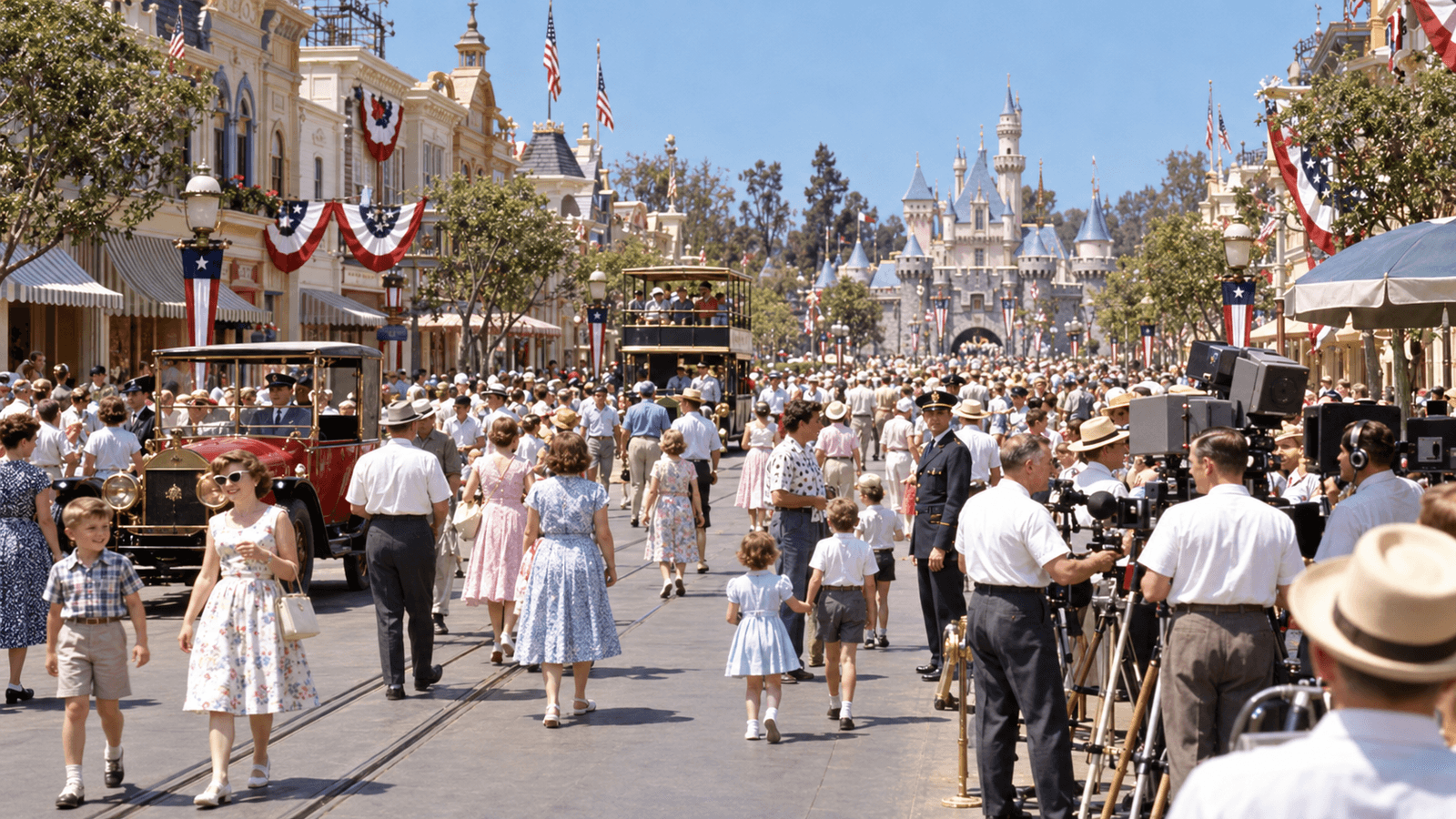
On July 17, 1955, Disneyland opened in Anaheim, California, with an invitation-only preview carried live on ABC television. Walt Disney dedicated the park as cameras moved among Main Street, U.S.A., Adventureland, Frontierland, Fantasyland and Tomorrowland. The broadcast reached a national audience, but conditions inside were chaotic. Counterfeit tickets contributed to crowding, the temperature exceeded 100 degrees, fresh asphalt softened underfoot, food ran short and several attractions failed. A plumbers’ strike had forced a choice between working drinking fountains and restrooms, and a gas leak closed part of the park. Employees later called the difficult preview Black Sunday, although the television images emphasized ceremony, celebrities and optimism.
The opening mattered because Disneyland treated an amusement park as a coherent narrative environment rather than a collection of unrelated rides. Architecture, music, landscaping, costumes, traffic flow and merchandise supported distinct worlds, while a central hub let visitors choose among them. The park also linked film and television stories to physical experience. ABC’s investment helped finance construction, and the weekly Disneyland program built anticipation while promoting the attractions. That integration of media, place and retail became a model far beyond Disney, influencing museums, shopping centers, resorts and urban entertainment districts.
Disneyland opened to the paying public the next day and quickly became a major tourist destination. Attractions changed, vanished and expanded, but the original park remained a laboratory for controlled immersion and crowd movement. Its success led to Walt Disney World and international parks, establishing a global business whose cultural reach also invites criticism about commercialization, labor, sanitized history and the company’s control over public imagination. July 17 holds both the disorder of a rushed opening and the clarity of a powerful idea. The day did not reveal a finished utopia; it revealed a new kind of designed environment, one where stories became streets and visitors became participants inside a carefully managed world.
Remembering disneyland opens with a live national television broadcast on July 17 is valuable because anniversaries turn a familiar cultural object back into a specific decision, release or broadcast. The surrounding technology, business and audience conditions explain why the moment could happen then, while its later uses show that meaning never stops changing. Seen at that scale, the date is not trivia. It is a checkpoint between creation and memory: a place to separate what occurred from the legend accumulated around it and to ask why the work still attracts attention. That perspective also restores the labor of collaborators, distributors and audiences whose choices helped a single event travel beyond its first setting. Cultural history becomes clearer when the remembered icon is reconnected to the systems and people that made it visible.
Disneyland's invitation-only opening and live ABC broadcast took place on July 17, 1955.
The remembered moment placed Disneyland Opens inside the technology, audience habits and creative choices of 1955. Those conditions explain why it could happen then and why contemporary reactions differed from later memory.
Overcrowding, extreme heat and unfinished infrastructure made the preview notoriously difficult.
Its immediate importance came from the way audiences, distributors and other creators responded. The event gained force beyond its first release or appearance as people repeated, debated and reinterpreted it.
The park's unified themed environments changed tourism, entertainment design and media merchandising.
Over time, the event became a reference point for later work in popular culture. Its legacy includes both the achievement itself and the changing arguments about what should be celebrated, questioned or rediscovered.
Explore more of "On This Day ..."
Discover more events from the same date across news, politics, technology, sports, and other fields. Each link highlights significant moments that shaped history on different fronts.