

On This Day in Science: February 28, 1953
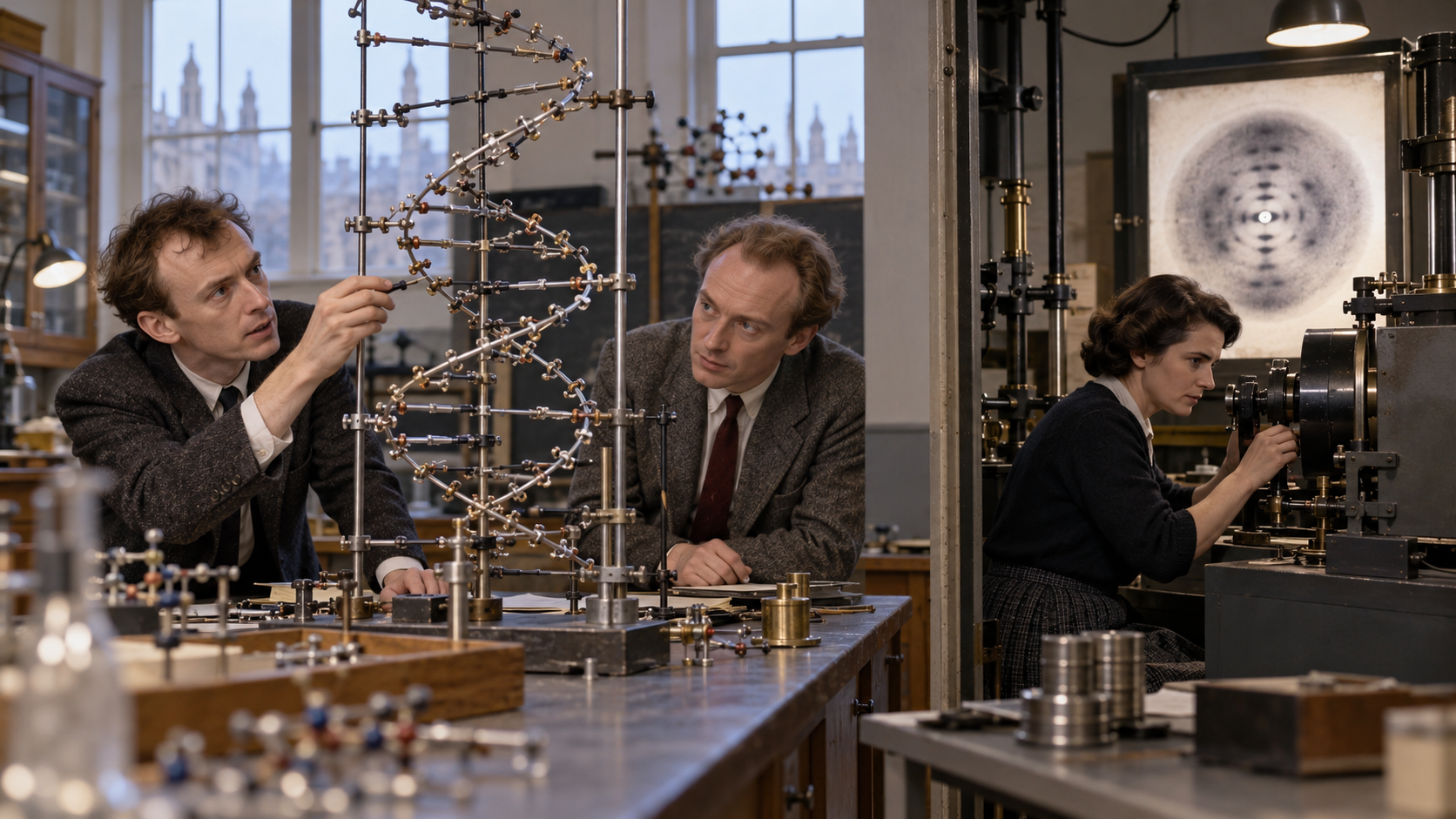
By February 28, 1953, James Watson and Francis Crick had assembled a model of DNA with two intertwined chains and complementary base pairs at Cambridge’s Cavendish Laboratory. A celebrated account places Crick at the nearby Eagle pub announcing that they had found the secret of life. The breakthrough was not an isolated flash. It drew on chemical measurements, model building, X-ray diffraction, and the work of several researchers—most importantly Rosalind Franklin and Maurice Wilkins at King’s College London, along with Erwin Chargaff’s findings about the proportions of DNA bases.
Franklin’s precise diffraction studies showed that DNA could take a helical form and supplied critical dimensions, water content, and symmetry constraints. Her famous Photograph 51, produced with graduate student Raymond Gosling, offered a striking X-shaped pattern. Wilkins shared that image with Watson without Franklin’s direct knowledge, while unpublished summaries of her measurements also reached the Cambridge team. Those circumstances are central to the history: the model’s success depended on evidence produced through rigorous work, but the flow of that evidence did not meet today’s expectations for consent, credit, or collaboration.
Watson and Crick used physical models to test how molecular components might fit. They placed sugar-phosphate backbones on the outside and paired bases inside the helix. Pairing adenine with thymine and guanine with cytosine satisfied geometric and chemical requirements while explaining Chargaff’s ratios. The two strands ran in opposite directions, and the sequence on one specified the sequence on the other. That complementarity immediately suggested a mechanism for copying genetic information, although the molecular machinery of replication would require much more research.
Three related papers appeared in Nature on April 25, 1953: one by Watson and Crick and two reporting X-ray work from the King’s groups. The structure became foundational to molecular biology, leading toward understanding genetic coding, mutation, sequencing, and biotechnology. Watson, Crick, and Wilkins received the 1962 Nobel Prize; Franklin had died in 1958 and Nobels are not awarded posthumously. Remembering February 28 responsibly means holding discovery and attribution together. The double helix was a brilliant model, but it emerged from a network of observations, labor, and unequal recognition that is now part of the scientific lesson. Its place on the calendar is therefore useful as an entry point, not an endpoint. The people involved worked with the instruments, assumptions, and social conditions of their time, and later research has both extended and corrected their conclusions. Reconstructing the event carefully means separating what was known that day from what became clear afterward. That distinction protects the history from myth while showing how cumulative evidence turns a memorable episode into lasting scientific knowledge.
X-ray diffraction, chemical measurements, and base ratios limited which structures could plausibly fit DNA.
Franklin's work supplied essential dimensions and evidence of helical organization.
Adenine paired with thymine and guanine with cytosine inside two antiparallel sugar-phosphate backbones.
Because each strand specifies its partner, the model suggested a way genetic information could be copied.
Watson and Crick's model depended on work by Franklin, Gosling, Wilkins, Chargaff, and others.
The unauthorized sharing of Franklin's data and her later under-recognition remain essential to an accurate history.
Explore more of "On This Day ..."
Discover more events from the same date across news, politics, technology, sports, and other fields. Each link highlights significant moments that shaped history on different fronts.