

On This Day in Science: March 1, 1966
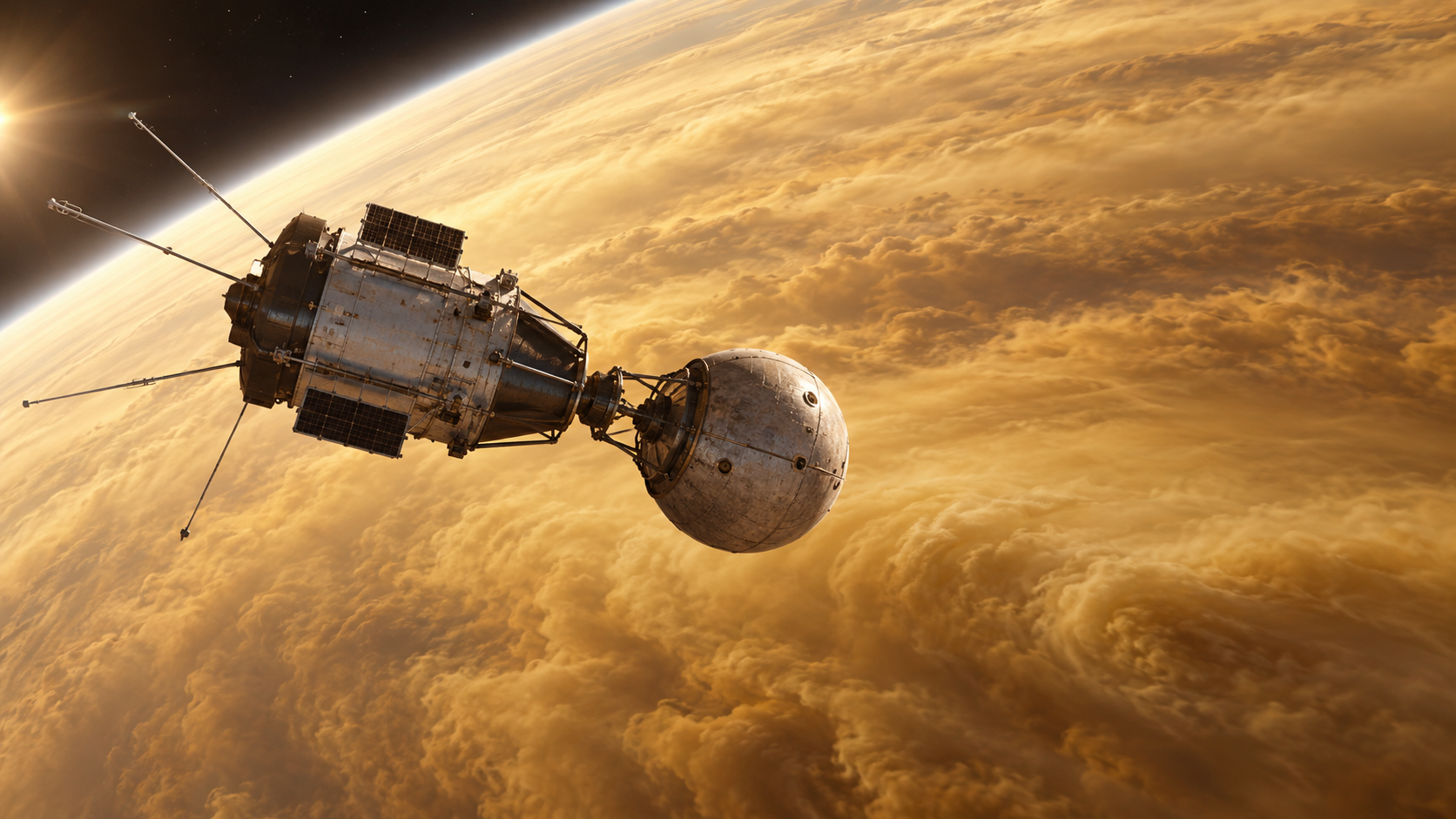
On March 1, 1966, the Soviet spacecraft Venera 3 reached Venus and became the first human-made object to touch another planet. The probe had been launched the previous November and carried a spherical descent capsule toward the cloud-covered world. Engineers lost contact before arrival, so no data came back from the encounter. Trajectory calculations nevertheless placed the spacecraft’s impact on the Venusian surface, turning an incomplete mission into a landmark in interplanetary travel.
Venus was a formidable destination. Its position had to be predicted months ahead, and the spacecraft needed enough velocity to leave Earth while remaining on a path that crossed the planet’s orbit. Mid-1960s electronics had limited autonomy, and long-distance radio links were fragile. Venera 3 combined a cruise bus with a capsule intended to study the atmosphere during descent, but a failure in the spacecraft ended communications before those instruments could operate.
The silent arrival followed several unsuccessful Soviet Venus attempts and preceded the first direct measurements from the planet. Venera 4 transmitted atmospheric data in 1967, and later landers survived long enough to measure the surface and return photographs. Each mission forced engineers to revise assumptions about heat, pressure, communications, and descent. Venus proved far hotter and more hostile than many early models had allowed.
Venera 3 is remembered with an important qualification: it achieved planetary contact but not a functioning scientific encounter. That distinction shows why exploration records contain different kinds of firsts—flyby, impact, atmospheric entry, soft landing, and successful transmission. The mission demonstrated that hardware could be aimed from Earth to another planet, while its failure helped define what the next spacecraft had to survive. For science history, the episode is also a case study in how evidence moves from an observation or engineered test into a durable body of knowledge. Instruments supplied measurements, specialists debated interpretation, and later work refined what the first result could mean. Archives preserve the early record while new methods let researchers ask different questions of it. That continuing revision is not a weakness in the original achievement; it is the process through which a dated milestone remains scientifically useful. Seen across a longer timeline, the event also shows that scientific milestones are junctions rather than isolated beginnings. Earlier experiments, tools, and institutions made the work possible, while later teams tested its limits and carried the result into new settings. What survives is more than an anniversary fact: it is a traceable chain of evidence, correction, and application that allows one moment to remain relevant as knowledge and technology continue to change. The anniversary also highlights the difference between a first result and a finished understanding. A successful observation can settle one question while opening several harder ones, and even a failed objective can return measurements that reshape later designs. Preserved data, specimens, photographs, and hardware allow new generations to revisit the work with better tools. Science advances through that continuity, where a specific date marks progress without pretending that inquiry stopped there.
Trajectory analysis placed Venera 3 on Venus on March 1, 1966, the first human-made object to reach another planet.
The spacecraft struck the surface rather than making a controlled soft landing.
Contact was lost before the encounter, so the descent capsule returned no measurements from the atmosphere or surface.
The failure left engineers without a direct account of the final approach.
Later Soviet probes measured Venus's dense atmosphere and eventually transmitted data and images from the ground.
Venera 3 supplied an early milestone in the longer process of learning how to explore an extreme world.
Explore more of "On This Day ..."
Discover more events from the same date across news, politics, technology, sports, and other fields. Each link highlights significant moments that shaped history on different fronts.