

On This Day in Science: March 3, 1969
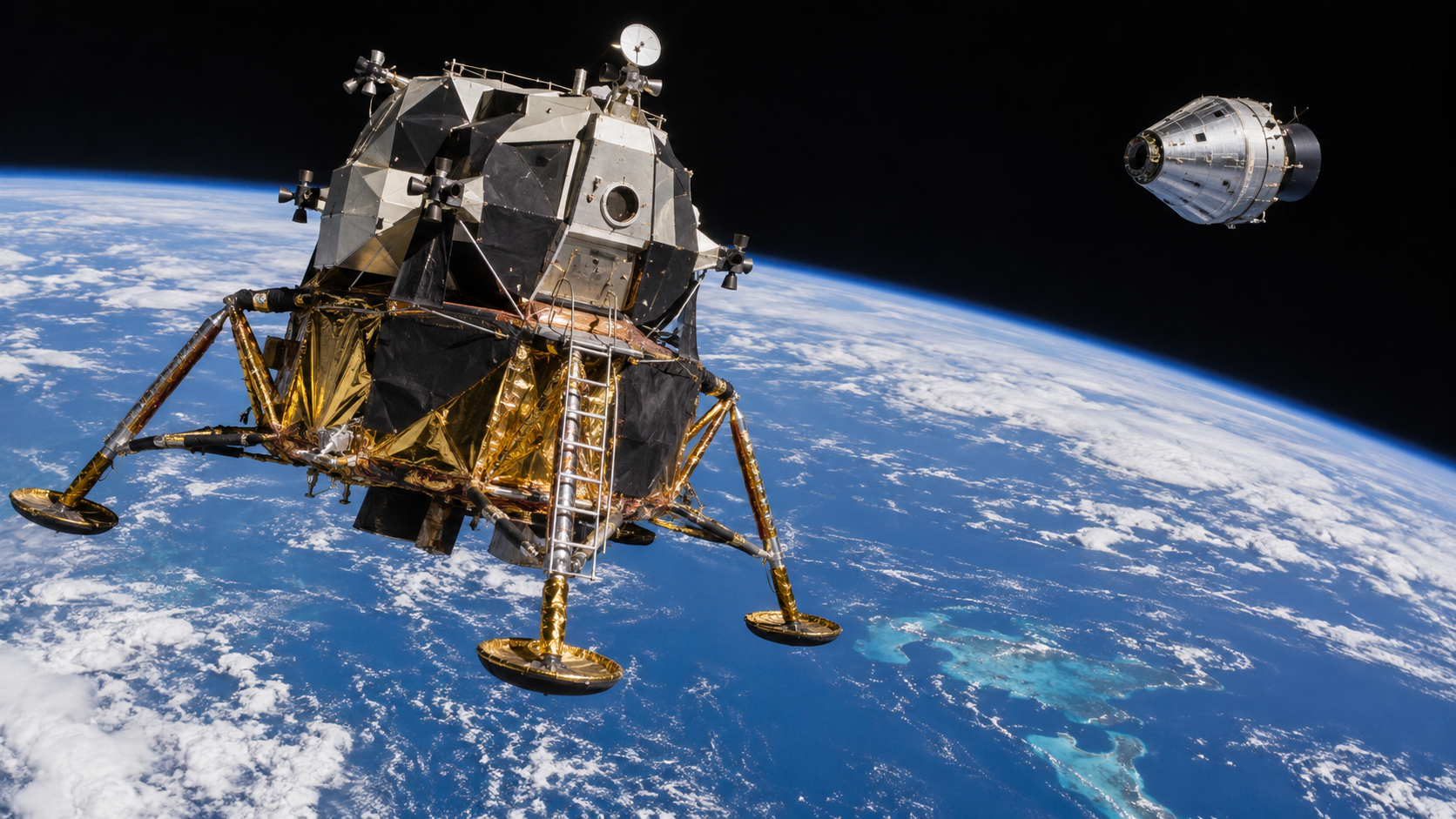
On March 3, 1969, Apollo 9 lifted off from Kennedy Space Center carrying James McDivitt, David Scott, and Russell Schweickart. Rather than head for the Moon, the ten-day mission remained in Earth orbit to test the complete Apollo spacecraft with a crew. Its central task was the first crewed flight of the lunar module, the fragile-looking vehicle that would have to descend to the Moon, support two astronauts, and launch them back to the command module.
After reaching orbit, the command module Gumdrop separated, turned around, and extracted the lunar module Spider from the Saturn V’s upper stage. The crew checked docking, life support, propulsion, navigation, and communications. Schweickart wore the portable life-support backpack during a spacewalk, testing equipment intended for the lunar surface. Illness shortened part of the planned outside work, but the essential suit and hatch procedures were demonstrated.
McDivitt and Schweickart later flew Spider independently, using its descent engine to move more than one hundred miles from Gumdrop. They then fired the ascent stage, discarded the lower stage, and rendezvoused with Scott. The sequence rehearsed the most consequential part of a lunar mission: two vehicles separating, navigating independently, and finding one another again when the crew’s return depended on it.
Apollo 9 ended with a safe splashdown on March 13 and cleared a major obstacle on the route to the first landing. Apollo 10 could now rehearse near the Moon, followed by Apollo 11’s attempt in July. The mission’s success came from treating Earth orbit as a controlled laboratory for a complicated chain of hardware and human decisions before committing that chain to lunar distance. The anniversary also highlights the difference between a first result and a finished understanding. A successful observation can settle one question while opening several harder ones, and even a failed objective can return measurements that reshape later designs. Preserved data, specimens, photographs, and hardware allow new generations to revisit the work with better tools. Science advances through that continuity, where a specific date marks progress without pretending that inquiry stopped there. Its place on the calendar is therefore useful as an entry point, not an endpoint. The people involved worked with the instruments, assumptions, and social conditions of their time, and later research has both extended and corrected their conclusions. Reconstructing the event carefully means separating what was known that day from what became clear afterward. That distinction protects the history from myth while showing how cumulative evidence turns a memorable episode into lasting scientific knowledge. For science history, the episode is also a case study in how evidence moves from an observation or engineered test into a durable body of knowledge. Instruments supplied measurements, specialists debated interpretation, and later work refined what the first result could mean. Archives preserve the early record while new methods let researchers ask different questions of it. That continuing revision is not a weakness in the original achievement; it is the process through which a dated milestone remains scientifically useful.
Apollo 9 was the first crewed mission to operate the command-service module and lunar module together.
Earth orbit provided a comparatively reachable setting for testing the landing system.
McDivitt and Schweickart separated in the lunar module, tested both propulsion stages, and rendezvoused with Scott.
The maneuver rehearsed the architecture that would bring lunar crews back from the surface.
Schweickart tested the portable backpack and pressure suit that astronauts would use outside on the Moon.
Successful systems tests allowed Apollo 10 and Apollo 11 to proceed with greater confidence.
Explore more of "On This Day ..."
Discover more events from the same date across news, politics, technology, sports, and other fields. Each link highlights significant moments that shaped history on different fronts.