

On This Day in Science: March 2, 1972
On March 2, 1972, NASA launched Pioneer 10 from Cape Kennedy on an Atlas-Centaur rocket. The spin-stabilized spacecraft was bound for Jupiter, a destination no probe had yet visited. Its path would also carry it through the asteroid belt, whose practical hazard to spacecraft was still uncertain. Pioneer 10 departed Earth faster than any previous vehicle and began a journey that would turn a distant point of light into a measured planetary system.
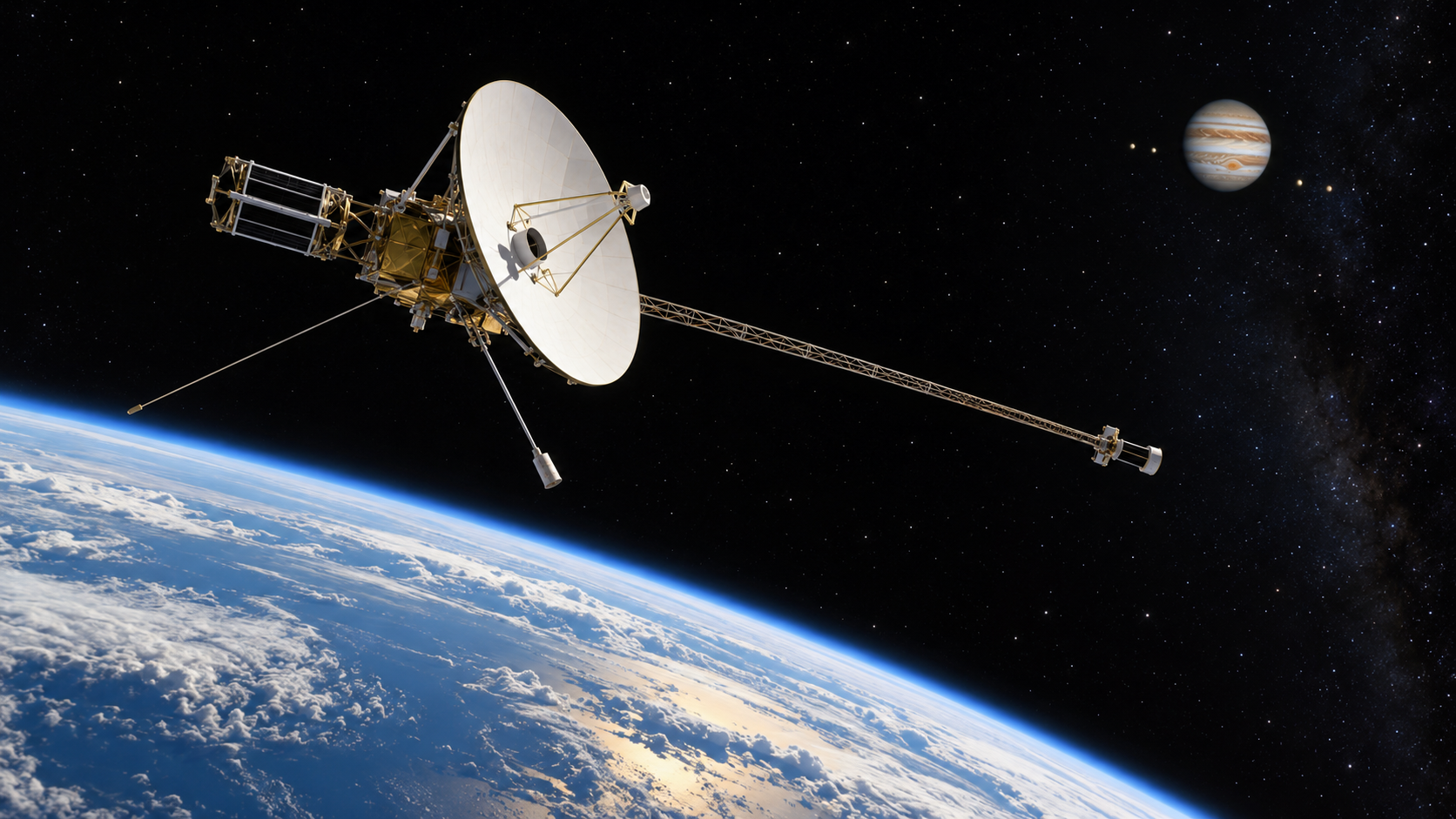
The craft carried instruments for magnetic fields, energetic particles, cosmic rays, meteoroids, ultraviolet light, and imaging. Its large dish antenna maintained contact while radioactive generators supplied electricity far from the Sun. Spinning the main body provided passive stability, while instruments and the communications beam were arranged so the spacecraft could collect data without complex continuous control. The simple architecture helped Pioneer operate across unprecedented distance.
Pioneer crossed the asteroid belt without catastrophic damage and reached Jupiter in December 1973. It measured the giant planet’s intense radiation belts, mapped aspects of its magnetic environment, observed its atmosphere, and returned close images of Jupiter and several moons. The radiation environment was harsher than expected, knowledge that directly influenced the design and operations of the Voyager missions that followed later in the decade.
After the encounter, Jupiter’s gravity sent Pioneer 10 onto an escape path from the Solar System. The probe continued reporting on the outer heliosphere for years, and its last useful telemetry arrived in 2002. Its launch represents a transition from cautious inner-planet missions to exploration across the giant-planet realm, with instruments, power systems, and radio engineering working as one long-distance scientific observatory. Seen across a longer timeline, the event also shows that scientific milestones are junctions rather than isolated beginnings. Earlier experiments, tools, and institutions made the work possible, while later teams tested its limits and carried the result into new settings. What survives is more than an anniversary fact: it is a traceable chain of evidence, correction, and application that allows one moment to remain relevant as knowledge and technology continue to change. The anniversary also highlights the difference between a first result and a finished understanding. A successful observation can settle one question while opening several harder ones, and even a failed objective can return measurements that reshape later designs. Preserved data, specimens, photographs, and hardware allow new generations to revisit the work with better tools. Science advances through that continuity, where a specific date marks progress without pretending that inquiry stopped there. Its place on the calendar is therefore useful as an entry point, not an endpoint. The people involved worked with the instruments, assumptions, and social conditions of their time, and later research has both extended and corrected their conclusions. Reconstructing the event carefully means separating what was known that day from what became clear afterward. That distinction protects the history from myth while showing how cumulative evidence turns a memorable episode into lasting scientific knowledge.
Pioneer 10 was the first spacecraft sent through the asteroid belt and toward a close encounter with Jupiter.
Its Atlas-Centaur launch supplied the speed needed for the long outward journey.
The spacecraft measured radiation, particles, magnetic fields, atmosphere, and moons during its 1973 flyby.
The severe radiation environment became vital planning information for later missions.
Jupiter's gravity redirected Pioneer 10 onto a trajectory escaping the Solar System.
Radio contact at extraordinary distance extended its role into a study of the outer heliosphere.
Explore more of "On This Day ..."
Discover more events from the same date across news, politics, technology, sports, and other fields. Each link highlights significant moments that shaped history on different fronts.