

On This Day in Science: March 4, 1675
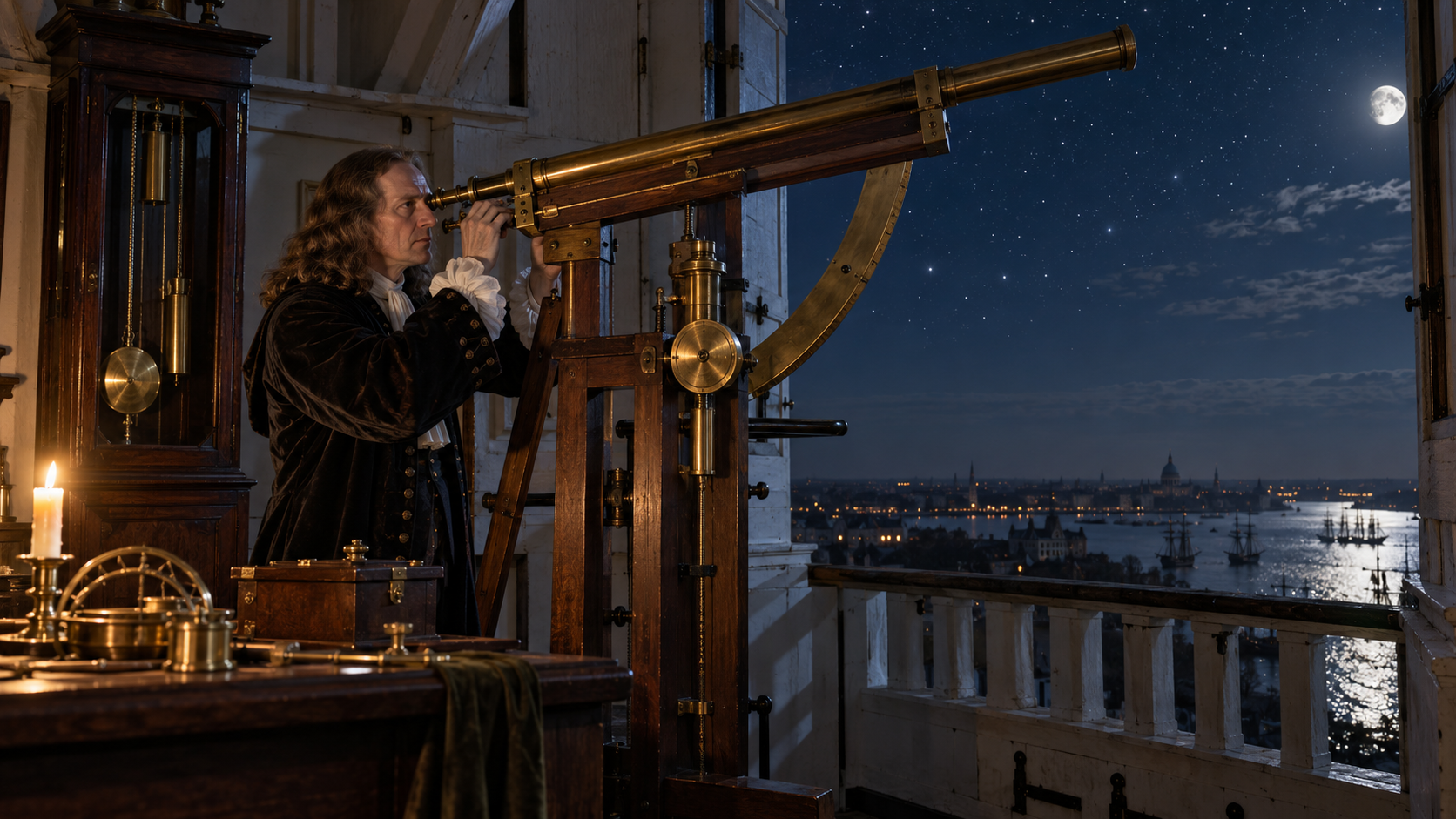
On March 4, 1675, King Charles II appointed John Flamsteed as “astronomical observator,” the office later known as Astronomer Royal. England needed more accurate star positions for astronomy and navigation, especially efforts to determine longitude at sea. Flamsteed, a careful observer and calculator, was charged with improving the tables of celestial motions. The appointment linked state support, practical navigation, and precision measurement in a new permanent role.
A royal warrant later that year established an observatory at Greenwich, designed by Christopher Wren and built on a hill above the Thames. Flamsteed began observing there with clocks, quadrants, telescopes, and sighting instruments that were repeatedly improved. He measured transits across the meridian and compared positions over time, work that demanded attention to instrument alignment, refraction, timekeeping, and the observer’s own errors.
Longitude could be found in principle by comparing local time with the time at a known reference meridian, but reliable clocks and celestial predictions were both difficult. Flamsteed’s catalog of star positions helped strengthen the astronomical foundation for such methods. His observations also supported later work by Isaac Newton and Edmond Halley, though disputes over publication showed how control, credit, and urgency could collide in early institutional science.
The Greenwich observatory became a center for astronomy, navigation, time, and geodesy long after Flamsteed’s tenure. The prime meridian adopted internationally in the nineteenth century passed through its grounds, though modern geodetic coordinates use a slightly different reference. The March appointment mattered because it gave repeated precision work an institutional home, turning nightly observation into a cumulative national and eventually global scientific record. Its place on the calendar is therefore useful as an entry point, not an endpoint. The people involved worked with the instruments, assumptions, and social conditions of their time, and later research has both extended and corrected their conclusions. Reconstructing the event carefully means separating what was known that day from what became clear afterward. That distinction protects the history from myth while showing how cumulative evidence turns a memorable episode into lasting scientific knowledge. For science history, the episode is also a case study in how evidence moves from an observation or engineered test into a durable body of knowledge. Instruments supplied measurements, specialists debated interpretation, and later work refined what the first result could mean. Archives preserve the early record while new methods let researchers ask different questions of it. That continuing revision is not a weakness in the original achievement; it is the process through which a dated milestone remains scientifically useful. Seen across a longer timeline, the event also shows that scientific milestones are junctions rather than isolated beginnings. Earlier experiments, tools, and institutions made the work possible, while later teams tested its limits and carried the result into new settings. What survives is more than an anniversary fact: it is a traceable chain of evidence, correction, and application that allows one moment to remain relevant as knowledge and technology continue to change.
Flamsteed was appointed to improve knowledge of star positions and celestial motions for astronomy and navigation.
The position later became known as Astronomer Royal.
A purpose-built observatory gave Flamsteed a permanent site for meridian measurements, clocks, and telescopes.
Repeated observations required constant correction for instruments, atmosphere, and timekeeping.
Flamsteed's catalog strengthened the reference framework used by astronomers and navigators.
Greenwich later became internationally associated with the prime meridian and standardized time.
Explore more of "On This Day ..."
Discover more events from the same date across news, politics, technology, sports, and other fields. Each link highlights significant moments that shaped history on different fronts.