

On This Day in Science: March 5, 1979
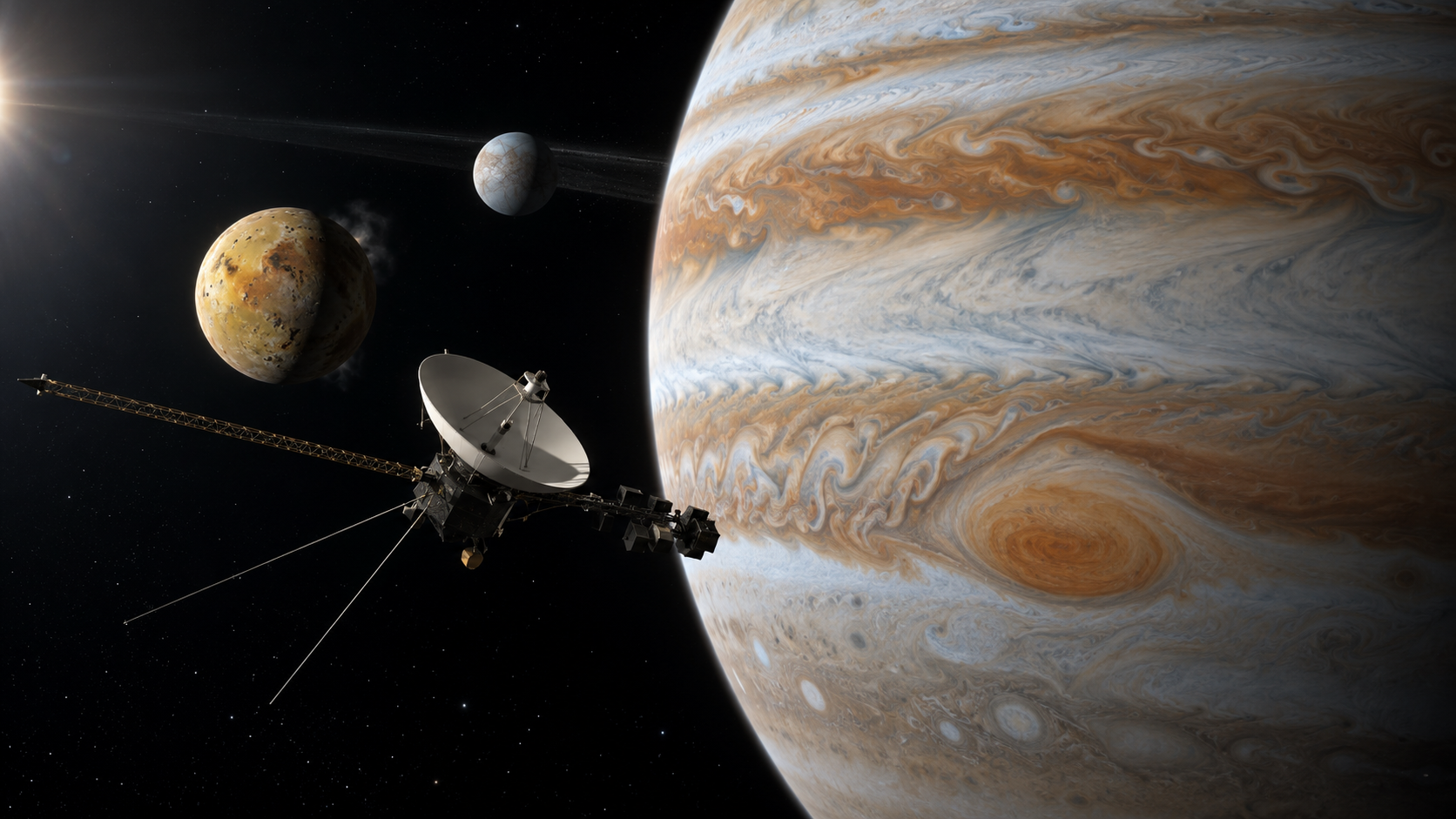
On March 5, 1979, NASA’s Voyager 1 made its closest approach to Jupiter after an eighteen-month flight from Earth. The spacecraft passed through a complex system of clouds, rings, magnetic fields, radiation, and moons, returning data at a scale no earlier mission could match. Pioneer 10 and 11 had reconnoitered the region, but Voyager carried more capable cameras and instruments designed to reveal the planet and its satellites as changing worlds.
The images showed turbulent cloud bands, rotating storms, and intricate motion around the Great Red Spot. Instruments examined atmospheric composition, charged particles, radio emissions, and Jupiter’s immense magnetosphere. Voyager also photographed a faint ring around the planet. Radiation produced faults and timing problems, forcing the spacecraft and ground team to operate carefully in an environment known to be dangerous but still surprising in its intensity.
The moons supplied the most dramatic discoveries. Io displayed a young, colorful surface, and analysis of Voyager images revealed active volcanic plumes—the first observed beyond Earth. Europa’s bright, fractured exterior suggested a shell of ice with very few impact craters. Ganymede and Callisto showed distinct records of tectonics and bombardment. Jupiter’s satellites emerged as a diverse planetary system rather than four similar points of light.
Jupiter’s gravity then redirected Voyager 1 toward Saturn and ultimately onto an interstellar trajectory. The encounter established scientific questions that Galileo, Juno, and future Europa missions would pursue with more specialized instruments. March 5 marks not merely a close pass but the moment a brief flyby delivered a whole research program, demonstrating how carefully timed observations can transform several worlds during a single planetary encounter. For science history, the episode is also a case study in how evidence moves from an observation or engineered test into a durable body of knowledge. Instruments supplied measurements, specialists debated interpretation, and later work refined what the first result could mean. Archives preserve the early record while new methods let researchers ask different questions of it. That continuing revision is not a weakness in the original achievement; it is the process through which a dated milestone remains scientifically useful. Seen across a longer timeline, the event also shows that scientific milestones are junctions rather than isolated beginnings. Earlier experiments, tools, and institutions made the work possible, while later teams tested its limits and carried the result into new settings. What survives is more than an anniversary fact: it is a traceable chain of evidence, correction, and application that allows one moment to remain relevant as knowledge and technology continue to change. The anniversary also highlights the difference between a first result and a finished understanding. A successful observation can settle one question while opening several harder ones, and even a failed objective can return measurements that reshape later designs. Preserved data, specimens, photographs, and hardware allow new generations to revisit the work with better tools. Science advances through that continuity, where a specific date marks progress without pretending that inquiry stopped there.
Voyager 1 recorded storms, cloud circulation, radiation, and magnetic activity during the close pass.
Its cameras also revealed Jupiter's faint ring system.
Images exposed active volcanism on Io and a young fractured icy surface on Europa.
Ganymede and Callisto displayed different histories of tectonics and impacts.
Jupiter accelerated and redirected Voyager 1 toward Saturn and an eventual escape from the Solar System.
The flyby framed questions pursued by later missions dedicated to Jupiter and its moons.
Explore more of "On This Day ..."
Discover more events from the same date across news, politics, technology, sports, and other fields. Each link highlights significant moments that shaped history on different fronts.