

On This Day in Science: March 6, 1869
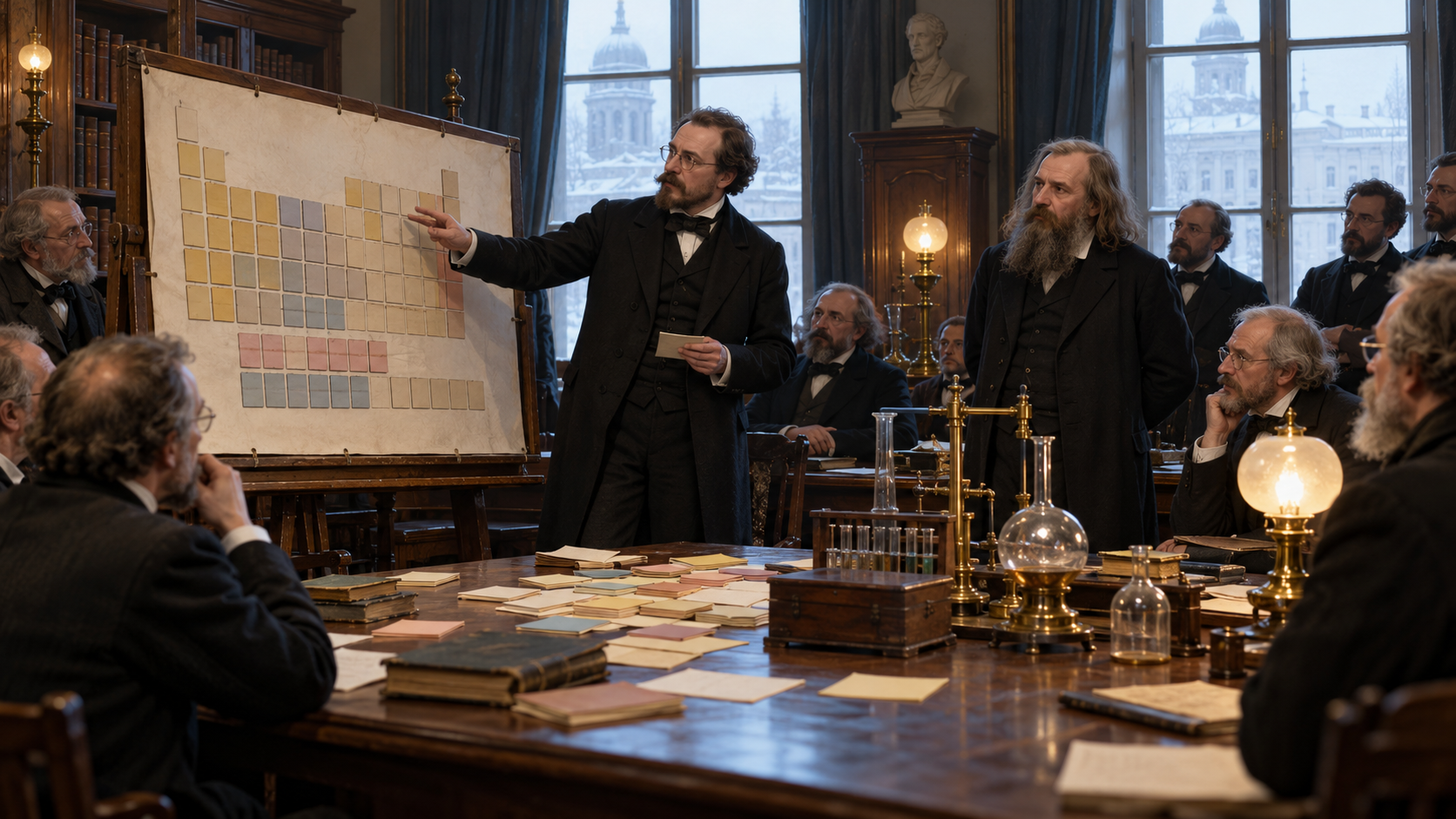
On March 6, 1869, Dmitri Mendeleev’s periodic system was presented to the Russian Chemical Society in St. Petersburg. Mendeleev was ill, so his colleague Nikolai Menschutkin read the work on his behalf. Chemists already knew dozens of elements and had proposed several patterns, but the growing list was difficult to organize consistently. Mendeleev arranged elements so that chemical properties recurred in a regular sequence related to atomic weight.
His table was powerful because it did not force every known element into a continuous grid. Mendeleev left gaps where the pattern implied an undiscovered element and predicted properties for several missing entries. He also questioned some accepted atomic weights and, in a few cases, prioritized chemical behavior over strict numerical order. Those choices made the system testable: future discoveries could either fill the gaps with the expected properties or expose flaws.
Gallium, scandium, and germanium later matched key predictions closely enough to establish the table’s credibility. The underlying explanation changed in the twentieth century when atomic number—the number of protons—replaced atomic weight as the fundamental ordering principle. Quantum mechanics then explained repeating chemical behavior through electron structure. Mendeleev’s empirical pattern survived because it captured a real regularity before scientists understood its physical cause.
The periodic table now organizes elements, isotopes, bonding trends, and laboratory expectations across chemistry. It is not a finished poster: superheavy elements extend its lower edge, and debates continue over the best visual arrangement for certain families. The 1869 presentation matters because it converted a catalog into a predictive framework, showing how classification becomes scientific when its structure points beyond the facts already known. Seen across a longer timeline, the event also shows that scientific milestones are junctions rather than isolated beginnings. Earlier experiments, tools, and institutions made the work possible, while later teams tested its limits and carried the result into new settings. What survives is more than an anniversary fact: it is a traceable chain of evidence, correction, and application that allows one moment to remain relevant as knowledge and technology continue to change. The anniversary also highlights the difference between a first result and a finished understanding. A successful observation can settle one question while opening several harder ones, and even a failed objective can return measurements that reshape later designs. Preserved data, specimens, photographs, and hardware allow new generations to revisit the work with better tools. Science advances through that continuity, where a specific date marks progress without pretending that inquiry stopped there. Its place on the calendar is therefore useful as an entry point, not an endpoint. The people involved worked with the instruments, assumptions, and social conditions of their time, and later research has both extended and corrected their conclusions. Reconstructing the event carefully means separating what was known that day from what became clear afterward. That distinction protects the history from myth while showing how cumulative evidence turns a memorable episode into lasting scientific knowledge.
Mendeleev grouped elements so that related chemical properties recurred as atomic weight increased.
Menschutkin presented the work because Mendeleev was unable to attend the meeting.
Blank spaces preserved the pattern and allowed Mendeleev to forecast properties of undiscovered elements.
Later discoveries such as gallium, scandium, and germanium strengthened the system.
Modern tables order elements by proton number rather than atomic weight.
Quantum theory explains the repeating electron structures behind the chemical periodicity Mendeleev recognized.
Explore more of "On This Day ..."
Discover more events from the same date across news, politics, technology, sports, and other fields. Each link highlights significant moments that shaped history on different fronts.