

On This Day in Science: April 14, 1981
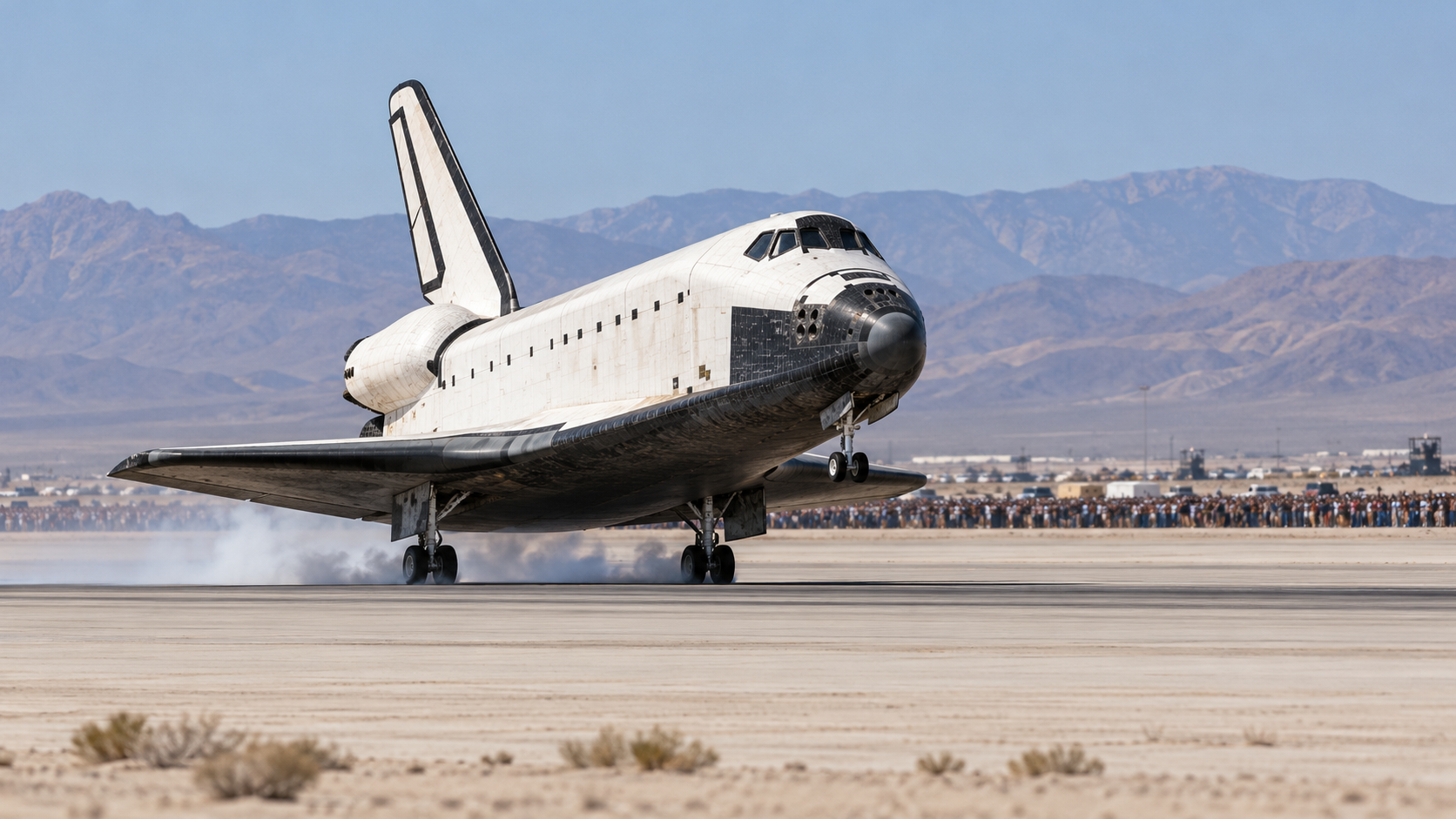
On April 14, 1981, Space Shuttle Columbia descended from orbit and touched down on the dry lakebed runway at Edwards Air Force Base, California. John Young and Robert Crippen completed STS-1 after two days, six hours, and thirty-seven orbits. The landing was the first time a crewed orbital spacecraft returned to Earth on wings and wheels instead of descending beneath parachutes into the ocean.
Columbia entered the atmosphere as a glider with no ability to restart its main engines. Thermal-protection tiles shielded the aluminum structure while aerodynamic control surfaces gradually took over from reaction-control thrusters. The crew used energy-management turns to reduce speed and align with the runway. Because there was no powered go-around, the approach had to succeed on the first attempt.
The orbiter crossed the California desert with twin sonic booms, flared above Rogers Dry Lake, and rolled to a stop after deploying its speed brake and wheel brakes. Postflight inspection found lost and damaged tiles but confirmed that the major systems had functioned well. The flight validated launch, orbital operations, reentry, and a conventional-looking landing within one reusable vehicle.
The shuttle never achieved the airline-like simplicity once imagined, and refurbishment remained expensive and complex. Still, STS-1 demonstrated a new class of spacecraft capable of returning large payloads and landing on a runway. The touchdown made reusability visible while revealing how much engineering was required to sustain it. Seen across a longer timeline, scientific milestones are junctions rather than isolated beginnings. Earlier experiments, tools, and institutions made the work possible, while later teams tested its limits and carried the result into new settings. What survives is a traceable chain of evidence, correction, and application that allows one moment to remain relevant as knowledge and technology continue to change. The anniversary highlights the difference between a first result and a finished understanding. A successful observation can settle one question while opening several harder ones, and even a failed objective can reshape later designs. Preserved data, specimens, photographs, and hardware allow new generations to revisit the work with better tools. Science advances through that continuity rather than stopping on a memorable date. Its calendar date is an entry point, not an endpoint. The people involved worked with the instruments, assumptions, and social conditions of their time, and later research has both extended and corrected their conclusions. Separating what was known that day from what became clear afterward protects the history from myth and shows how cumulative evidence turns an episode into lasting scientific knowledge.
Columbia had no powered go-around after reentry and had to manage energy precisely.
Thermal tiles and control surfaces carried the vehicle from hypersonic flight to runway speed.
Young and Crippen landed on Runway 23 at Edwards after thirty-seven orbits.
The orbiter rolled to a stop sixty seconds after touchdown.
STS-1 proved that an orbital spacecraft could return on wings and wheels.
Later operations showed that inspection and refurbishment remained demanding and costly.
Explore more of "On This Day ..."
Discover more events from the same date across news, politics, technology, sports, and other fields. Each link highlights significant moments that shaped history on different fronts.