

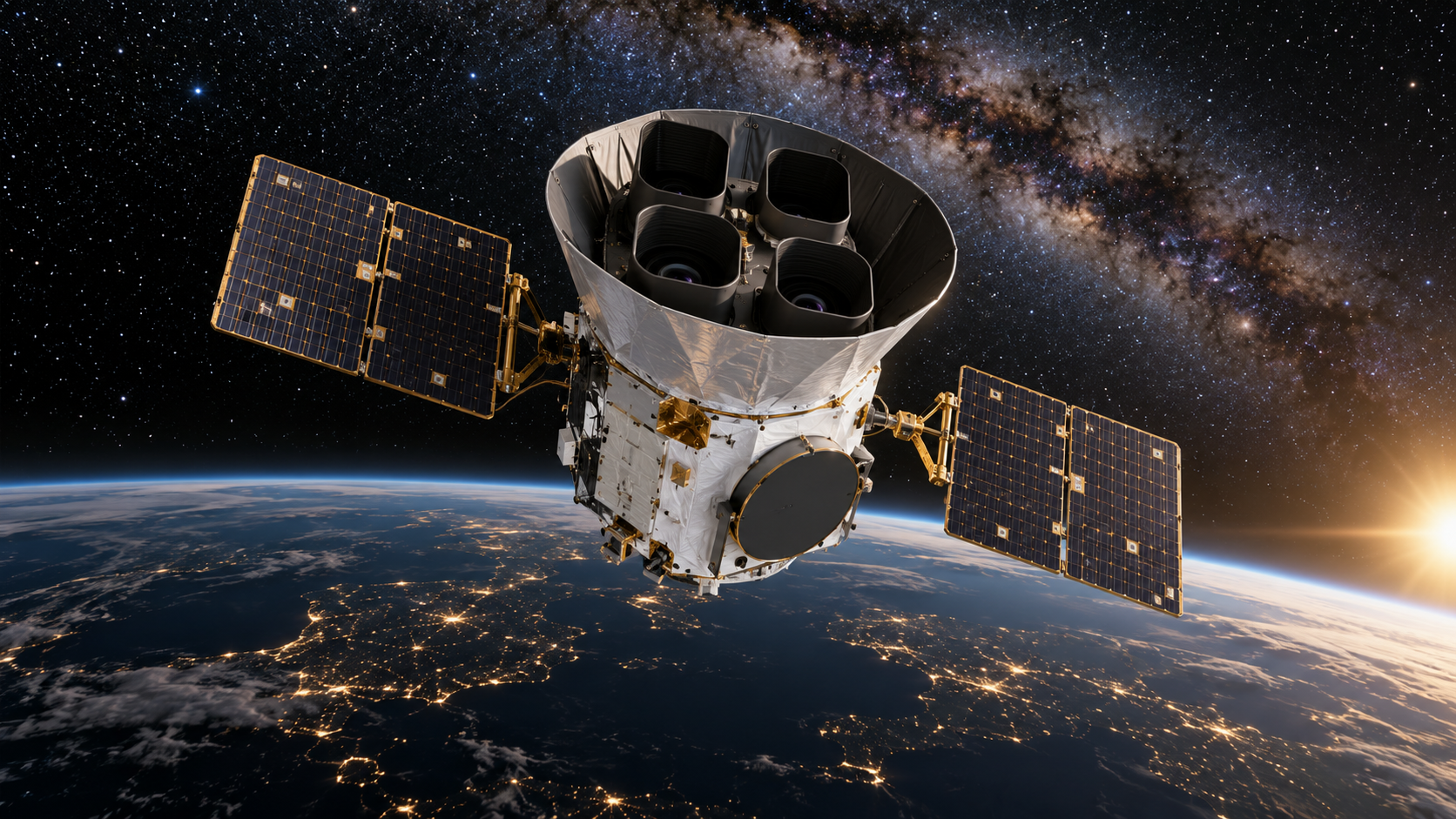
On This Day in Science: April 18, 2018
On April 18, 2018, NASA’s Transiting Exoplanet Survey Satellite launched from Cape Canaveral aboard a Falcon 9 rocket. TESS was designed to search most of the sky for planets crossing bright, nearby stars. Its four wide-field cameras observe large sectors for weeks at a time, measuring repeated changes in brightness that may reveal worlds suitable for follow-up with larger telescopes.
TESS entered a highly elongated orbit around Earth synchronized with the Moon. A lunar gravity assist helped establish the path, which offers stable temperatures, long uninterrupted observations, and regular opportunities to transmit data. The spacecraft stares at broad sky strips, records the brightness of many stars, and shifts sectors until the combined survey covers nearly the entire celestial sphere.
Transit signals reveal planet size and orbital period, but other observations are needed to confirm candidates and measure mass. Ground-based telescopes examine stellar motion and rule out eclipsing stars, while observatories such as the James Webb Space Telescope can study selected atmospheres. TESS therefore operates as the discovery stage of a distributed research system.
The mission has identified thousands of candidates and many confirmed planets, including small worlds and systems around nearby red dwarfs. Its launch shifted emphasis from Kepler’s deep, distant field toward bright stars spread across the sky. That design makes discoveries more accessible to follow-up and turns a space survey into a long list of shared targets. Seen across a longer timeline, scientific milestones are junctions rather than isolated beginnings. Earlier experiments, tools, and institutions made the work possible, while later teams tested its limits and carried the result into new settings. What survives is a traceable chain of evidence, correction, and application that allows one moment to remain relevant as knowledge and technology continue to change. The anniversary highlights the difference between a first result and a finished understanding. A successful observation can settle one question while opening several harder ones, and even a failed objective can reshape later designs. Preserved data, specimens, photographs, and hardware allow new generations to revisit the work with better tools. Science advances through that continuity rather than stopping on a memorable date. Its calendar date is an entry point, not an endpoint. The people involved worked with the instruments, assumptions, and social conditions of their time, and later research has both extended and corrected their conclusions. Separating what was known that day from what became clear afterward protects the history from myth and shows how cumulative evidence turns an episode into lasting scientific knowledge.
TESS monitors broad sectors of sky for repeated dips in stellar brightness.
Its survey favors bright nearby stars that other telescopes can examine in detail.
A highly elongated resonant orbit provides stable observing conditions and regular data downlinks.
The path also keeps the spacecraft away from much of Earth's reflected light and radiation.
Transit data estimate planet size and period but do not answer every physical question.
Ground observatories and space telescopes confirm candidates and measure masses or atmospheres.
Explore more of "On This Day ..."
Discover more events from the same date across news, politics, technology, sports, and other fields. Each link highlights significant moments that shaped history on different fronts.