

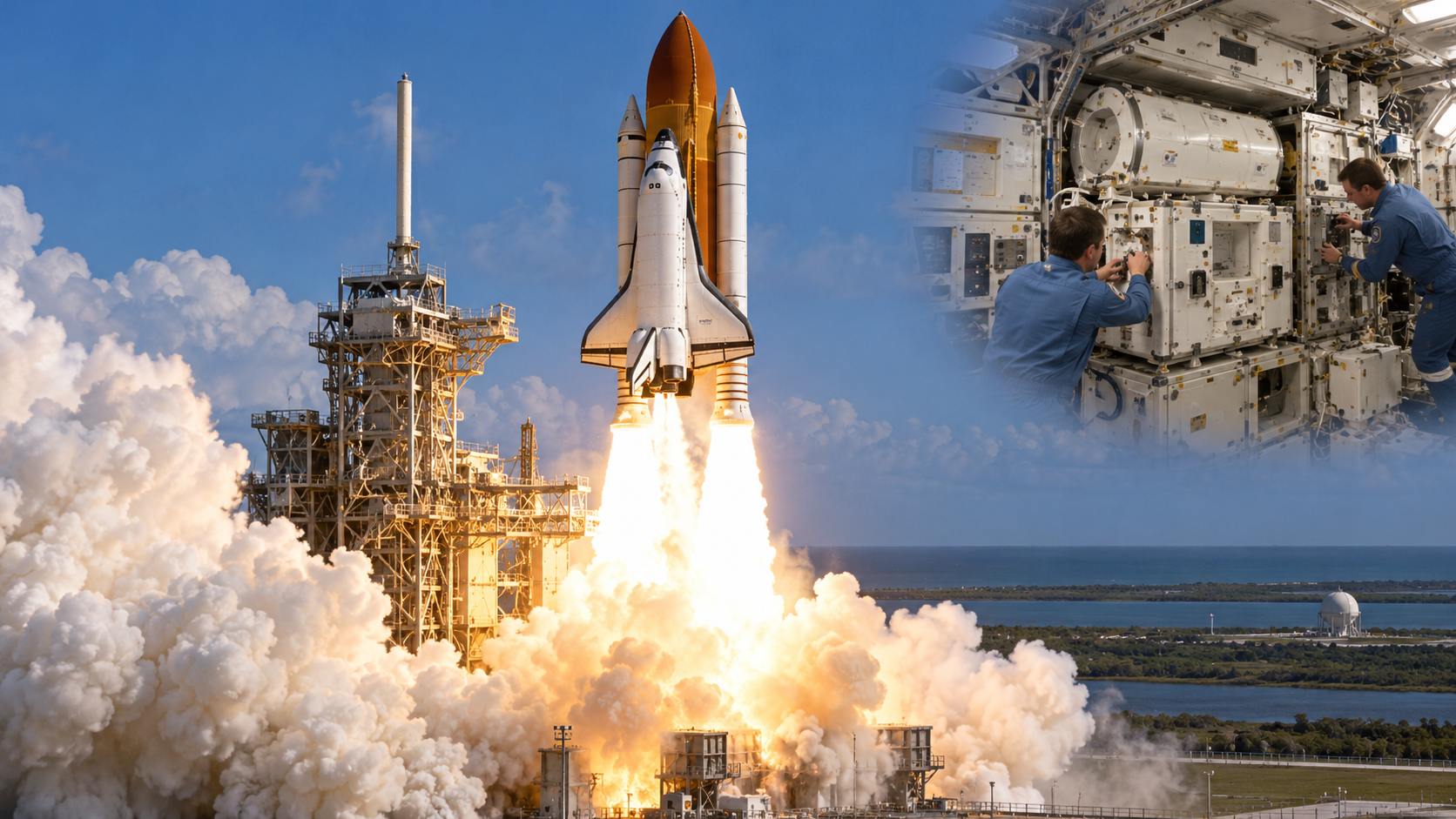
On This Day in Science: April 29, 1985
On April 29, 1985, Space Shuttle Challenger launched from Kennedy Space Center carrying Spacelab 3 and a seven-person crew. The reusable laboratory module filled much of the payload bay and provided a pressurized workspace for experiments in materials science, fluid physics, atmospheric studies, astronomy, and biology. STS-51B was the first operational flight of the full Spacelab laboratory configuration.
Spacelab was developed by the European Space Agency and connected to the shuttle cabin through a tunnel. Scientists could operate racks of instruments in shirtsleeves while the orbiter supplied power, cooling, communications, and return transportation. The mission sought a stable microgravity environment for experiments that gravity, convection, and sedimentation complicate on Earth.
Fourteen of fifteen primary experiments were considered successful. Work included crystal growth, fluid behavior, atmospheric observations, and studies using rodents and two squirrel monkeys to examine physiological adaptation. The mission also tested animal-holding systems and laboratory operations, producing practical lessons about containment, cleaning, vibration, crew time, and data collection.
Spacelab helped turn the shuttle into a temporary orbital research facility and built experience later used on the International Space Station. The mission also revealed that microgravity is not an absence of forces: vehicle motion, crew activity, pumps, and thrusters all disturb delicate experiments. Measuring that environment became part of doing the science. For science history, the event also shows how evidence moves from an observation or engineered test into a durable body of knowledge. Instruments supplied measurements, specialists debated interpretation, and later work refined what the first result could mean. Archives preserve the early record while new methods let researchers ask different questions of it. That continuing revision is the process through which a dated milestone remains scientifically useful. Seen across a longer timeline, scientific milestones are junctions rather than isolated beginnings. Earlier experiments, tools, and institutions made the work possible, while later teams tested its limits and carried the result into new settings. What survives is a traceable chain of evidence, correction, and application that allows one moment to remain relevant as knowledge and technology continue to change. The anniversary highlights the difference between a first result and a finished understanding. A successful observation can settle one question while opening several harder ones, and even a failed objective can reshape later designs. Preserved data, specimens, photographs, and hardware allow new generations to revisit the work with better tools. Science advances through that continuity rather than stopping on a memorable date.
The pressurized Spacelab module gave astronauts racks, power, cooling, and room to work.
A tunnel connected the laboratory directly to Challenger's cabin.
Experiments covered materials, fluids, atmosphere, astronomy, and animal physiology.
Fourteen of the fifteen primary investigations were judged successful.
Crew movement, machinery, and spacecraft maneuvers can disturb sensitive experiments.
Spacelab experience helped prepare long-duration research operations on the space station.
Explore more of "On This Day ..."
Discover more events from the same date across news, politics, technology, sports, and other fields. Each link highlights significant moments that shaped history on different fronts.