

On This Day in Science: October 19, 2017
On October 19, 2017, astronomer Robert Weryk identified a fast-moving object in images from the Pan-STARRS1 telescope on Haleakalā, Hawaiʻi. Follow-up observations showed that its path was strongly hyperbolic, meaning it was not gravitationally bound to the Sun.
The object received the Hawaiian name ʻOumuamua, often translated as a scout or messenger arriving first. It was already heading away when found, so telescopes had only weeks to measure its brightness, color, rotation, and trajectory before it became too faint.
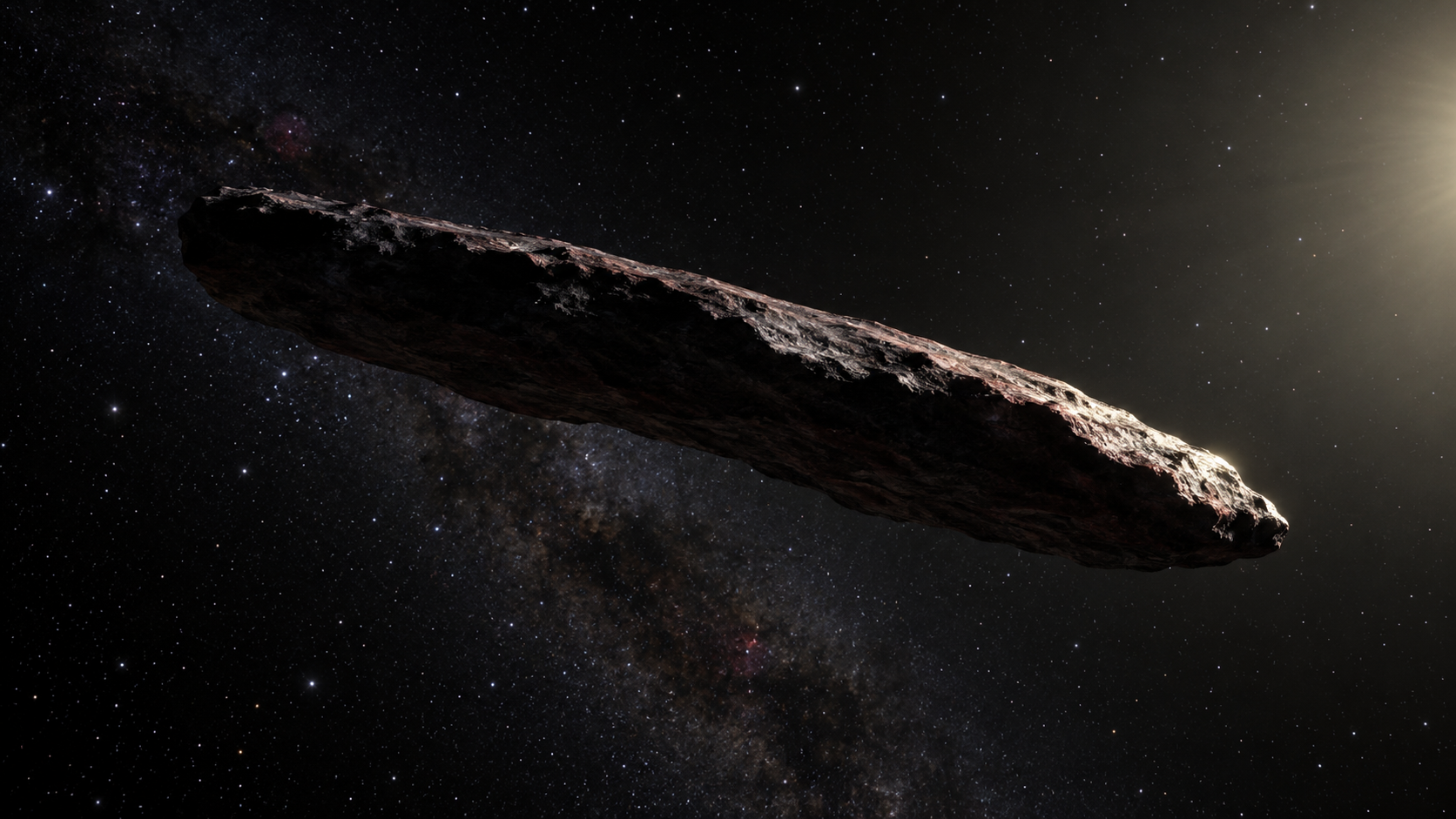
Large brightness variations indicated a highly elongated or flattened shape, but no resolved image showed its form. Astronomers detected a small non-gravitational acceleration without a visible dust coma, prompting several natural models involving unusual ices, outgassing, or radiation pressure.
ʻOumuamua became the first recognized interstellar visitor observed passing through the Solar System. A second object, Comet Borisov, followed in 2019. The discovery encouraged new surveys and mission concepts aimed at detecting such visitors earlier and studying material formed around other stars. The anniversary also illustrates how a scientific milestone becomes useful through records that later researchers can inspect. Instruments, notebooks, images, specimens, and engineering reports preserve more than a celebratory date: they show what was actually measured, what remained uncertain, and how conclusions changed as better methods became available. Placed in a longer timeline, the event was a junction rather than a finished answer. Earlier discoveries and technical work made it possible, while later teams tested its limits and applied the result in new settings. That traceable sequence of evidence and revision is what turns one day into a durable part of scientific history. The episode also separates a first demonstration from mature understanding. A successful observation or flight can settle one question while exposing harder problems in reliability, interpretation, safety, and scale. Preserved data allow later generations to revisit the achievement without confusing what was known on the date with what became clear afterward. Its calendar date is an entry point rather than an endpoint. The people involved worked with the tools, assumptions, institutions, and social conditions of their time. Later research has extended some conclusions and corrected others, showing how science advances by keeping evidence open to comparison instead of treating a memorable event as final. What makes the event scientifically important is not only priority, but the ability of others to check, repeat, compare, or build on the result. That process can reveal limitations hidden by the excitement of a first success. It also explains why careful archives and transparent measurements matter as much as the date remembered by the public.
The object's speed and trajectory showed it was not orbiting the Sun.
Its passage connected the Solar System to material formed around another star.
No telescope resolved the object's surface.
Changing brightness instead revealed rapid rotation and an extreme overall form.
A small unexplained acceleration complicated simple asteroid models.
Sparse data support several natural hypotheses but not one settled physical description.
Explore more of "On This Day ..."
Discover more events from the same date across news, politics, technology, sports, and other fields. Each link highlights significant moments that shaped history on different fronts.