

On This Day in Tech: October 14, 1947
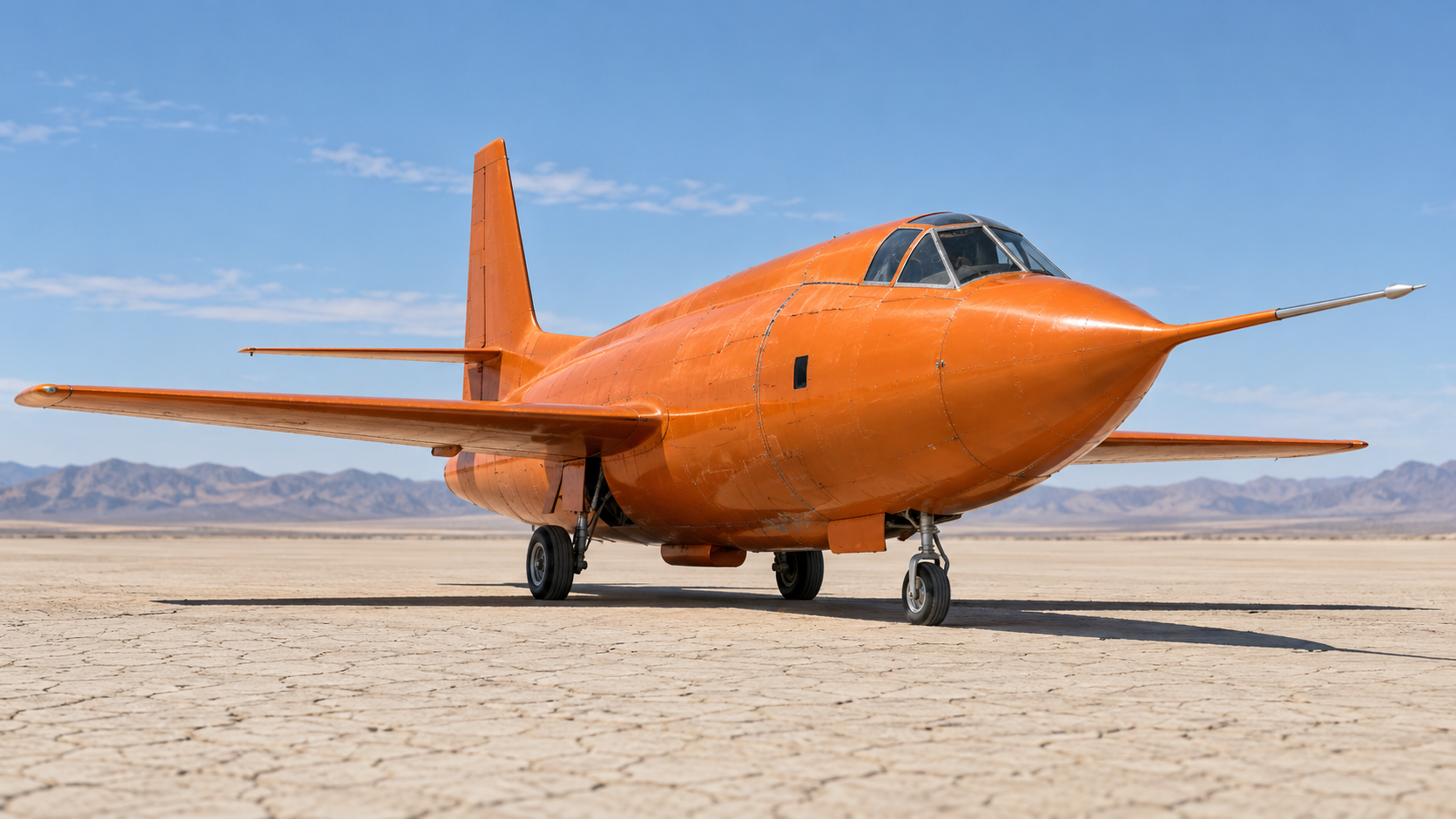
On October 14, 1947, U.S. Air Force pilot Chuck Yeager flew the Bell X-1 faster than sound above the Mojave Desert near Muroc Dry Lake, California. Released from a B-29 carrier aircraft, the orange rocket plane climbed under its own power and reached approximately Mach 1.06 at about forty-three thousand feet. The flight supplied a controlled demonstration of supersonic airplane flight and valuable measurements of an unfamiliar aerodynamic regime. It was part of a joint research effort involving Bell Aircraft, the military, and the National Advisory Committee for Aeronautics, rather than a new passenger or combat aircraft entering service.
Aircraft approaching the speed of sound had encountered strong changes in drag, pressure, stability, and control. Shock waves could form around parts of an airframe even before the entire airplane exceeded the local speed of sound. These effects encouraged talk of a sound barrier, but the engineering problem was to understand and manage the airflow rather than break through a physical wall. The X-1 was built specifically for that work. Its compact fuselage, thin straight wings, rocket propulsion, and extensive instrumentation allowed researchers to examine conditions that conventional aircraft of the period could not safely or consistently reach.
Air launching saved fuel and let the small research airplane begin its powered climb above the ground. A series of glide and powered flights progressively tested handling and expanded the flight envelope before the October breakthrough. Yeager’s mission crossed the sonic threshold briefly, while instruments recorded pressures, loads, and other characteristics. Mach number expresses speed relative to the local speed of sound, which changes with atmospheric temperature; it is not a single universal miles-per-hour figure. The achievement therefore depended on a measured combination of speed and flight conditions. After the powered portion, the X-1 returned to a landing without jet-style continuous propulsion.
Later X-1 flights explored higher speeds, and other research aircraft extended knowledge into increasingly demanding regimes. The data helped engineers develop structures, controls, propulsion arrangements, and operating methods for high-speed flight. Supersonic capability did not remove challenges involving fuel use, heating, noise, or sonic booms, and it did not automatically make such aircraft practical for every task. The original airplane was preserved at the Smithsonian, where its small scale contrasts with the breadth of its influence. October 14 remains a milestone because a dedicated experimental machine converted a disputed boundary into repeatable engineering evidence, giving subsequent designers a firmer basis for building aircraft that could operate beyond the speed of sound.
Near-sonic aircraft experienced shock waves and abrupt changes in drag and control. The X-1 program investigated those effects through instrumented flight tests.
On October 14, 1947, Yeager reached about Mach 1.06 after release from a B-29 above California's Mojave Desert.
The rocket plane used thin wings, a compact fuselage, and onboard measurements to explore the transition through the speed of sound.
Mach number depends on local atmospheric conditions. The flight demonstrated supersonic operation but did not solve every problem of high-speed aircraft design.
Further research flights extended the speed envelope and supplied data for later aircraft. Dedicated testing reduced uncertainty for designers.
Fuel demand, heating, and sonic noise continued to matter after the milestone. Breaking the sonic threshold was a beginning for further engineering work.
Explore more of "On This Day ..."
Discover more events from the same date across news, politics, technology, sports, and other fields. Each link highlights significant moments that shaped history on different fronts.