

On This Day in Tech: October 17, 1907
On October 17, 1907, Marconi’s transatlantic wireless service opened between stations at Glace Bay in Nova Scotia and Clifden in Ireland. The initial commercial operation carried press messages across the Atlantic without a submarine cable connecting the two radio stations. It followed years of experiments with long-distance wireless signaling, including demonstrations that had established the possibility of crossing an ocean. Opening a service was a different challenge from receiving a brief experimental signal. News organizations needed messages that could be identified, copied, charged for, and delivered through other communications systems after their radio journey was complete.
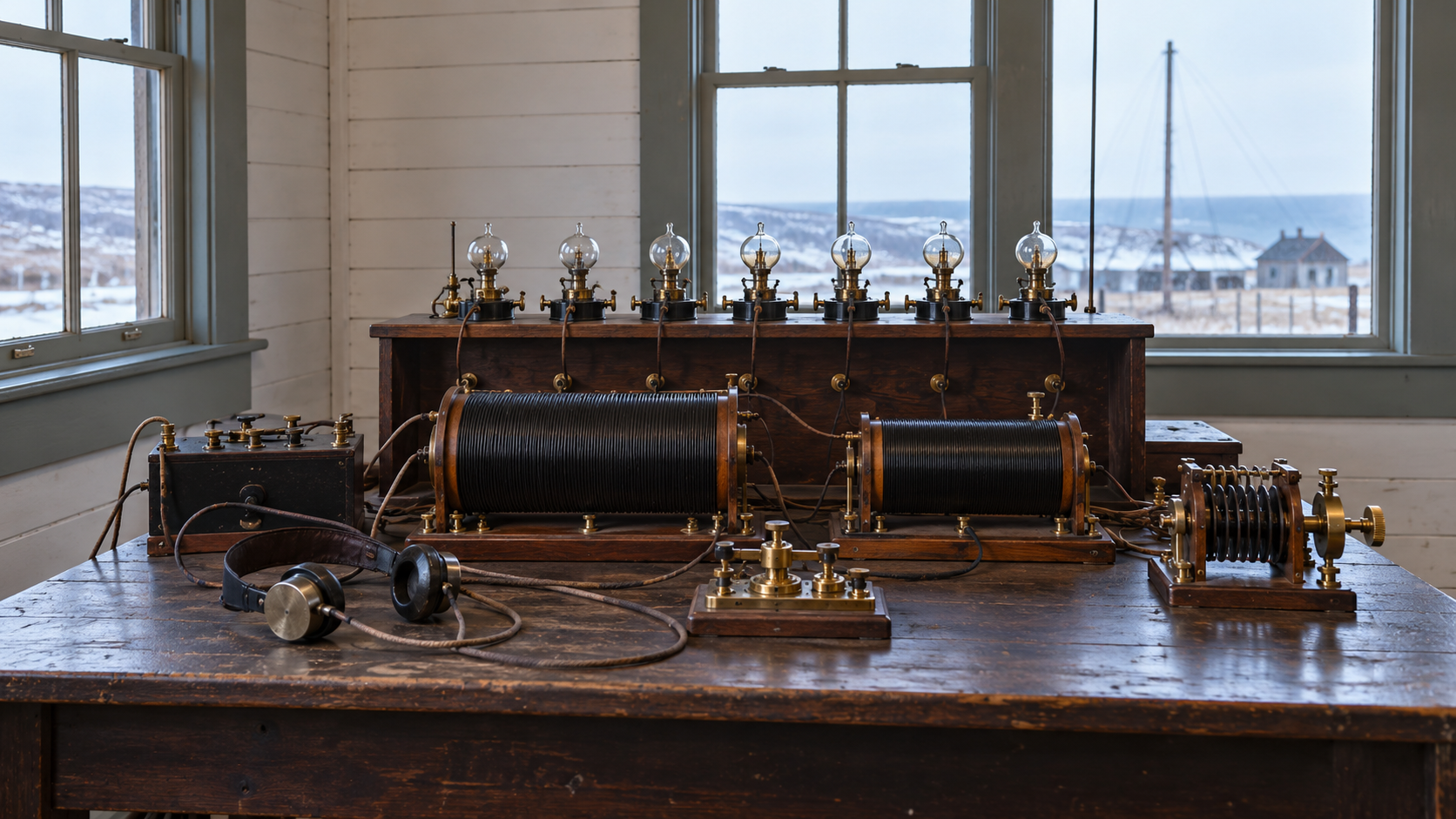
The stations were substantial engineering installations rather than small radios resembling modern consumer receivers. Large aerial structures, powerful transmitters, electrical machinery, receiving apparatus, and trained operators worked together. Information traveled as coded telegraph signals, not spoken conversation or recorded audio. Staff had to distinguish the wanted transmission from interference and atmospheric noise, then produce an accurate written message. The Nova Scotia Archives preserves a photograph of the receiving room on opening day, showing an equipment-covered wooden desk and operators at work. That room makes the human side of the network visible: long-distance radio still depended on concentration, practiced listening, and disciplined procedures.
Commercial wireless did not instantly displace the established cable companies. Signals varied with conditions, electrical interference could obscure messages, and reliable continuous operation remained difficult. Early service was limited, with ordinary public message traffic developing beyond the initial press operation. The October opening should therefore not be described as the first dependable worldwide radio network or as the arrival of transatlantic telephone calls. Its significance was more specific: an organization was attempting to turn experimental ocean-spanning radio into a repeatable paid communications service. The project tested business arrangements and operating methods alongside transmitters, antennas, tuning systems, and receiving equipment.
Wireless later became essential to ships, broadcasting, navigation, aviation, and international communications. Those applications required many further advances, including better detection, amplification, frequency control, and regulation. The 1907 stations belonged to an earlier technical era, but they exposed questions that continue to shape networks: how to share a limited channel, identify a signal, manage variable conditions, and move information accurately between different systems. October 17 marks the commercial opening of one important transatlantic link, not the completion of wireless development. It is remembered because the ocean was becoming a route for organized radio traffic as well as for ships and cables, expanding the range of ways that distant communities could exchange timely information.
Marconi's earlier experiments established that radio signals could cross the Atlantic. Turning those signals into a service required a wider operational organization.
The Glace Bay–Clifden link opened commercially on October 17, 1907. Its initial traffic included press messages rather than ordinary spoken telephone calls.
Powerful transmitters, large antennas, receiving equipment, and skilled telegraph operators formed the system. A small consumer radio is not an accurate representation of these stations.
Noise and changing propagation conditions limited reliability. The opening did not immediately replace submarine cables or establish uninterrupted worldwide coverage.
Commercial operation helped develop procedures for long-distance wireless traffic. Later technical advances made radio useful across many additional fields.
The milestone connects experimental signaling with network operations. Accurate reception, routing, and delivery were as important as transmitting enough power.
Explore more of "On This Day ..."
Discover more events from the same date across news, politics, technology, sports, and other fields. Each link highlights significant moments that shaped history on different fronts.