

On This Day in Tech: October 18, 1958
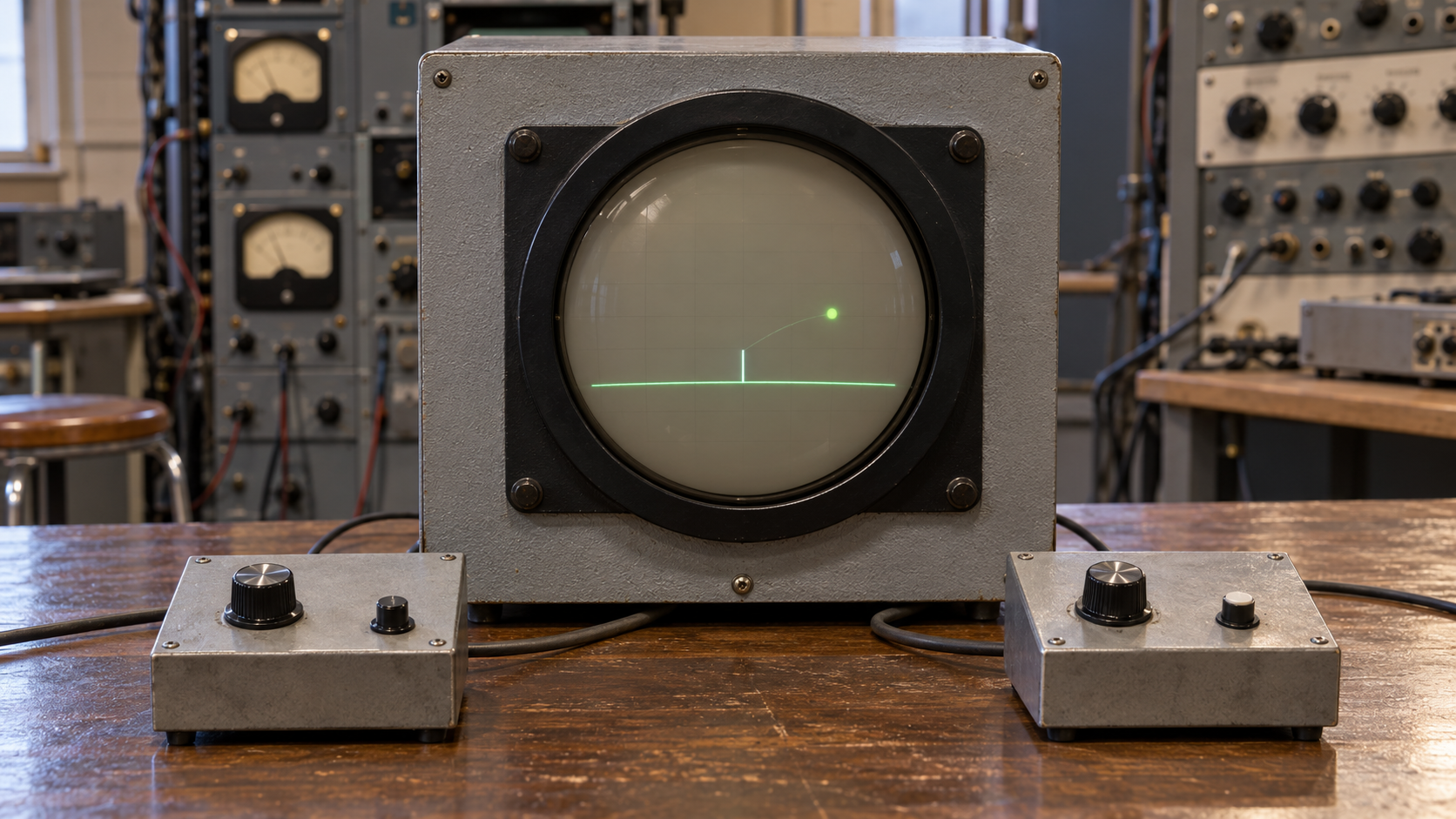
On October 18, 1958, visitors to Brookhaven National Laboratory played Tennis for Two, an electronic game devised by physicist William Higinbotham and built with technician Robert Dvorak. The demonstration used an analog computer to simulate a ball moving across a side-view tennis court on an oscilloscope. Two players used separate controllers rather than a keyboard or modern gamepad. Higinbotham wanted an exhibit that people could actively enjoy, showing that scientific equipment could support an engaging shared experience. The result became an important early example of interactive electronic entertainment, although calling it the single first video game overlooks other earlier experiments and different definitions.
The equipment came from a laboratory environment. An analog computer represented changing quantities through electrical voltages, allowing circuits to model a moving ball influenced by gravity. The oscilloscope converted electrical signals into visible traces on a small cathode-ray tube. Players adjusted the angle of a shot with a rotating control and used a button to return the ball. A horizontal court line, a short net, and a bright moving point provided enough visual information to make the contest understandable. The original display was only five inches across, very different from either a living-room television game or a modern high-resolution screen.
Producing that simple scene required deliberate electronic design. Circuits generated the ball’s trajectory, detected events such as contact with the ground or net, and switched among the signals used to draw the different elements. Fast switching made the separate traces appear together to the viewer. Dvorak assembled the apparatus, and the team tested and adjusted it before the visitors arrived. People lined up to play, demonstrating the appeal of immediate control and visible response. A revised version appeared the following year with a larger display and variations in simulated gravity. Those later changes should not be confused with the original 1958 arrangement.
Tennis for Two was not developed into a commercial product, and the original apparatus was eventually dismantled. Its place in history was recognized more widely years later, prompting research, reconstructions, and discussion about the origins of electronic games. Earlier devices had already explored electronic amusement and computer play, so precise language matters when assigning priority. The Brookhaven demonstration stands out for its playful purpose and two-person interaction, not for containing every feature of later video games. October 18 marks the moment a laboratory instrument became a public game. It shows how a modest display, a clear rule set, and responsive controls can create a compelling experience without elaborate graphics or a general-purpose digital computer.
Higinbotham wanted a more interactive visitors' exhibit. Technician Robert Dvorak helped turn the design into working laboratory equipment.
Visitors first played Tennis for Two on October 18, 1958. Two controllers operated a simulated tennis rally on an oscilloscope.
Analog circuitry generated trajectories and detected events. Fast switching combined the court, net, and ball into an apparently continuous display.
The original screen measured five inches across. Larger screens and different gravity settings belonged to a later version.
The game was not commercialized, and its historical importance became widely discussed years later. Reconstructions helped explain how it worked.
Earlier electronic games complicate any single first-game claim. Tennis for Two remains notable for entertainment-focused design and shared real-time play.
Explore more of "On This Day ..."
Discover more events from the same date across news, politics, technology, sports, and other fields. Each link highlights significant moments that shaped history on different fronts.