

On This Day in Tech: October 21, 1949
On October 21, 1949, An Wang filed a U.S. patent application for pulse transfer controlling devices, an invention associated with the development of magnetic-core computer memory. Wang was working at Harvard’s Computation Laboratory under Howard Aiken, where researchers needed ways to store information electronically without relying on moving mechanical parts. His work addressed how magnetic material could retain information and how that information could be read and transferred. The application was a legal and technical milestone, not the launch of a complete commercial memory product. The resulting patent was issued in 1955, several years after the filing remembered on this date.
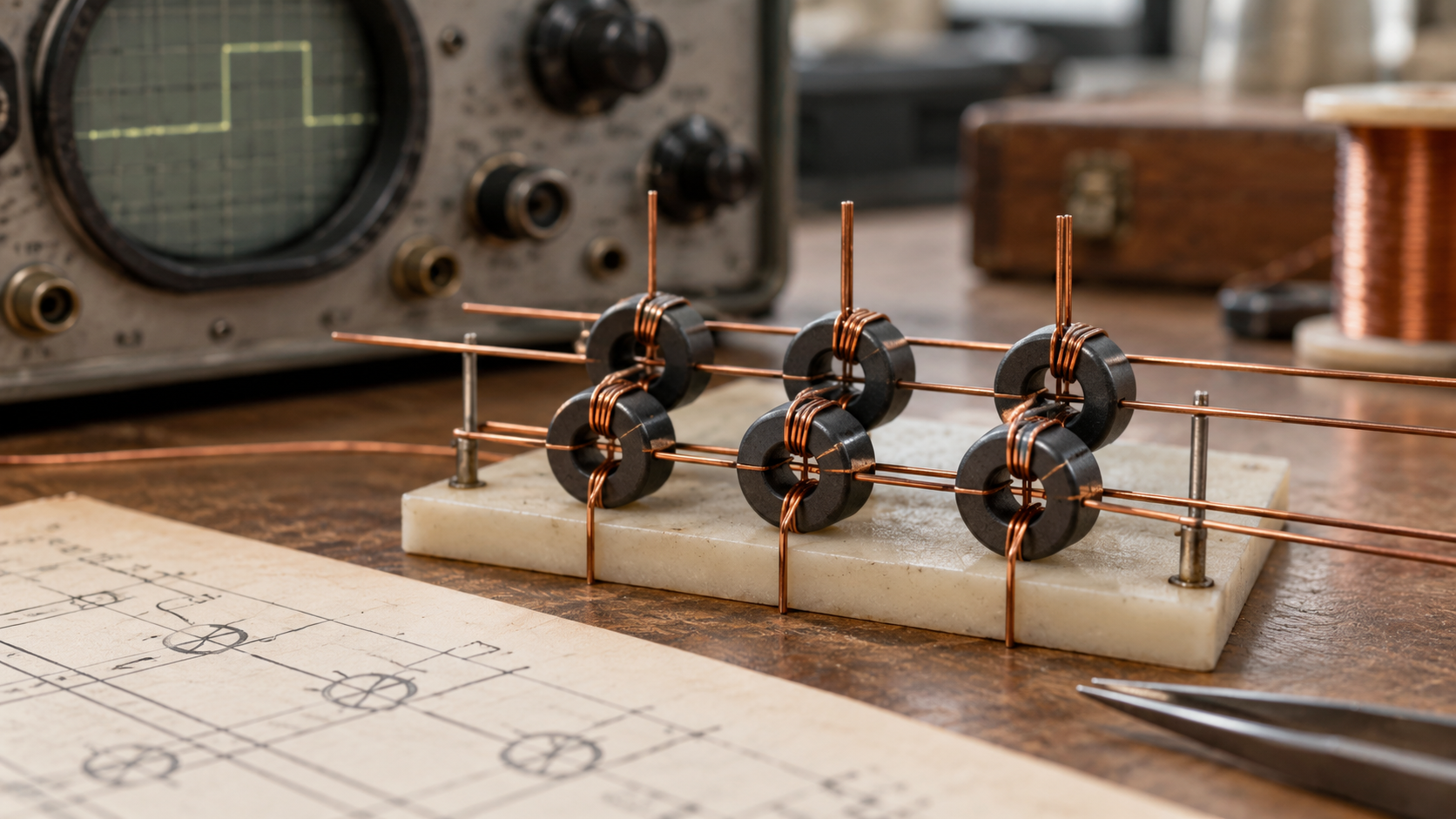
A magnetic core can retain one of two magnetization directions, allowing it to represent a binary state. Wires passing through or around the core can change that state or detect a change. The difficult part is organizing those electrical pulses so that information can be written, recovered, and preserved as the system operates. Reading a core can disturb the state that held the information. Wang recognized that a read operation could be followed by restoration, so destruction during reading did not necessarily mean permanent loss. This linked storage with a controlled sequence of operations rather than treating a magnetic element as an isolated passive component.
The history includes several researchers and different arrangements of magnetic elements. Wang’s early work involved transferring information through a sequence of cores, while Jay Forrester and others developed methods for selecting cores in arrays. Later practical memories combined ideas about materials, pulse control, addressing, sensing, and manufacturing. It would therefore be misleading to describe the October application as a finished version of every core-memory system that followed. Building reliable equipment required consistent magnetic properties, carefully arranged wires, suitable driving circuits, and accurate timing. Legal claims and engineering development progressed alongside one another, sometimes producing disputes about the scope and ownership of particular inventions.
Core memory became a central technology in computers before semiconductor memory displaced it. Wang’s patent rights later passed to IBM, and Wang developed a business career through Wang Laboratories. Those later outcomes should be distinguished from the original filing and from the collaborative technical development of memory systems. October 21 marks a step in making stored information dependable and accessible to electronic computation. Its broader significance is that a computer needs more than arithmetic circuits: it must keep track of data through repeated operations. A seemingly small decision about reading and restoring a magnetic state helped solve that larger problem, linking the behavior of a physical material to the reliable organization of digital information.
Harvard researchers wanted storage without mechanical motion. Wang investigated how magnetic states could carry information through controlled electrical pulses.
His application was filed October 21, 1949. The patent was granted in 1955, so filing and issuance are distinct milestones.
Reading a magnetic state can disturb it. Restoring information after a read operation made that behavior manageable within a memory system.
Wang's transfer arrangement differed from later addressed arrays. Several researchers contributed to practical core memory and its manufacturing methods.
Core memory became widely used before semiconductor storage took over. Its success required materials, wiring, driving circuits, and timing to work together.
The milestone concerns dependable information storage, not only faster arithmetic. Memory operations connect physical states with the repeated needs of digital programs.
Explore more of "On This Day ..."
Discover more events from the same date across news, politics, technology, sports, and other fields. Each link highlights significant moments that shaped history on different fronts.