

On This Day in Tech: October 22, 1938
On October 22, 1938, Chester Carlson and his assistant Otto Kornei made the first xerographic copy in a small laboratory in Astoria, Queens, New York. The image reproduced a short notation recording the date and location. Their experiment combined a charged surface, light, and fine powder to produce an image without the wet photographic processing associated with other copying methods. It was a proof of principle, not a functioning office machine ready for sale. The process would require many years of additional research and mechanical development before copying a document could become an ordinary push-button task in a workplace.
Carlson’s work in a patent department had made the difficulty of obtaining document copies particularly apparent. Retyping took time and introduced opportunities for mistakes, while photographic reproduction could be inconvenient and expensive. He investigated photoconductivity, the property by which certain materials conduct electricity differently when illuminated. If a charged surface lost charge where light reached it, darker areas could retain a pattern corresponding to an original image. Fine particles attracted to that pattern could make the invisible electrical arrangement visible. The concept joined optical information with electrical behavior, offering a different route from directly exposing photographic paper or manually recreating a document.
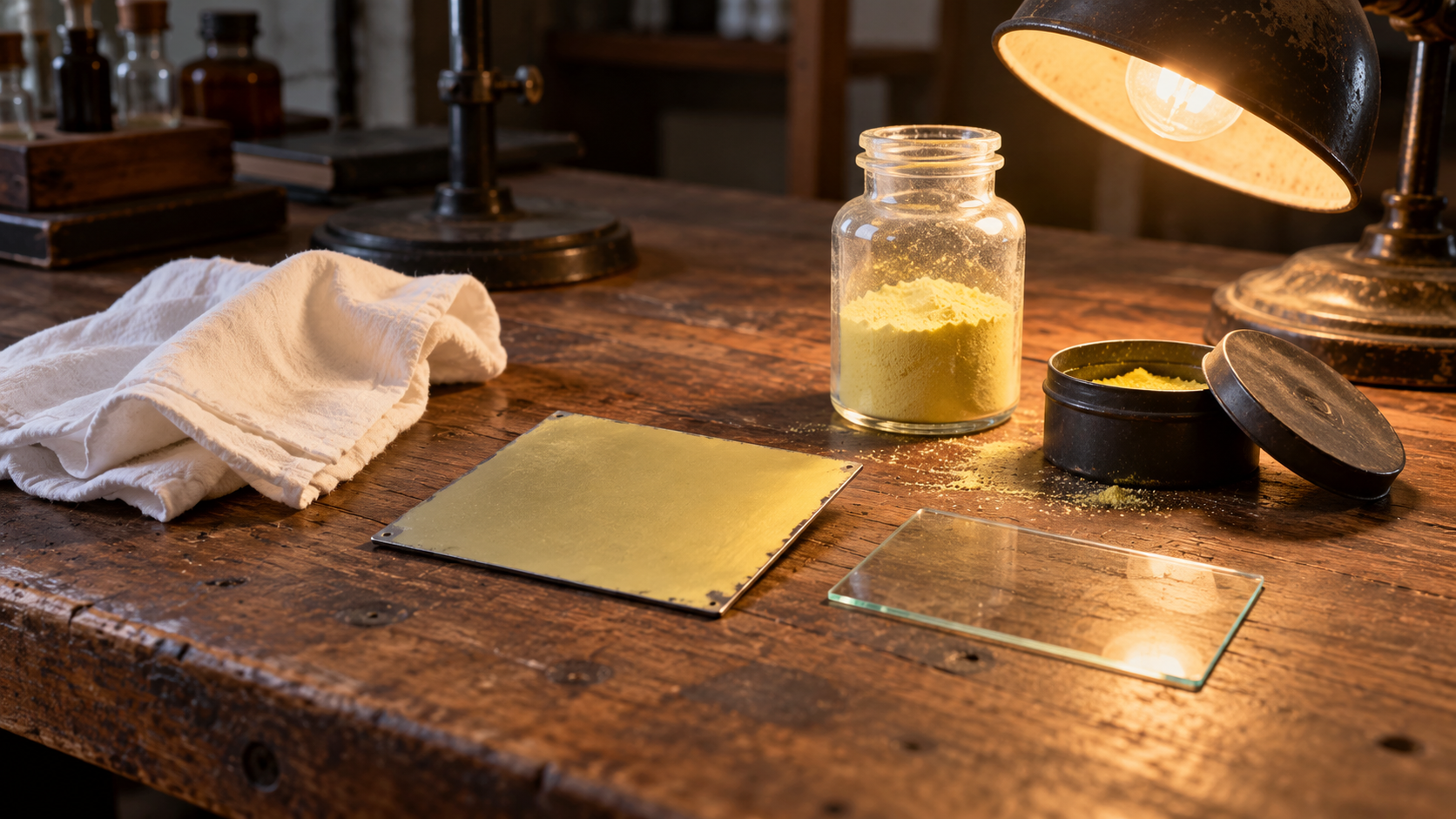
For the Astoria experiment, the men prepared a sulfur-coated zinc plate and a glass slide bearing the notation. They charged the surface by rubbing it, exposed the arrangement to light, and applied powder that revealed the image. Transferring and fixing the powder made the result more permanent. Such a sequence sounds straightforward in retrospect, but it was still a collection of laboratory operations performed by hand. A useful copier would have to repeat the steps consistently, feed and handle paper, control illumination and charge, manage powder, and deliver a clean fixed image. The first successful copy did not solve those practical problems all at once.
Carlson struggled to attract commercial interest before Battelle Memorial Institute began supporting development in the 1940s. The Haloid Company, later Xerox, subsequently joined the effort. The successful Xerox 914 plain-paper copier arrived in 1959, more than two decades after the original experiment. That gap is essential to understanding the milestone: invention established a possibility, while sustained engineering made the possibility convenient enough for everyday use. October 22 marks the laboratory demonstration that began this particular chain of development. Xerography eventually changed how offices, schools, and individuals reproduced information, showing how control of light and electrostatic charge could transform a slow document-handling problem into a routine service performed by a machine.
Carlson wanted an easier way to reproduce documents. His approach joined photoconductivity with electrostatic attraction rather than ordinary wet photographic processing.
Carlson and Kornei produced their first xerographic copy in Astoria on October 22, 1938. It was a laboratory result, not a commercial copier launch.
A charged sulfur-coated plate, a glass slide, light, and powder produced the image. Transfer and fixation made it more permanent.
Automating those steps introduced difficult problems of consistency, paper handling, and powder control. A successful experiment was only the beginning.
Battelle and Haloid helped develop the process further. The Xerox 914 became a successful plain-paper office copier in 1959.
The long path from experiment to product separates invention from practical adoption. Xerography changed document work when machines could repeat the process conveniently.
Explore more of "On This Day ..."
Discover more events from the same date across news, politics, technology, sports, and other fields. Each link highlights significant moments that shaped history on different fronts.