

On This Day in Tech: October 30, 1888
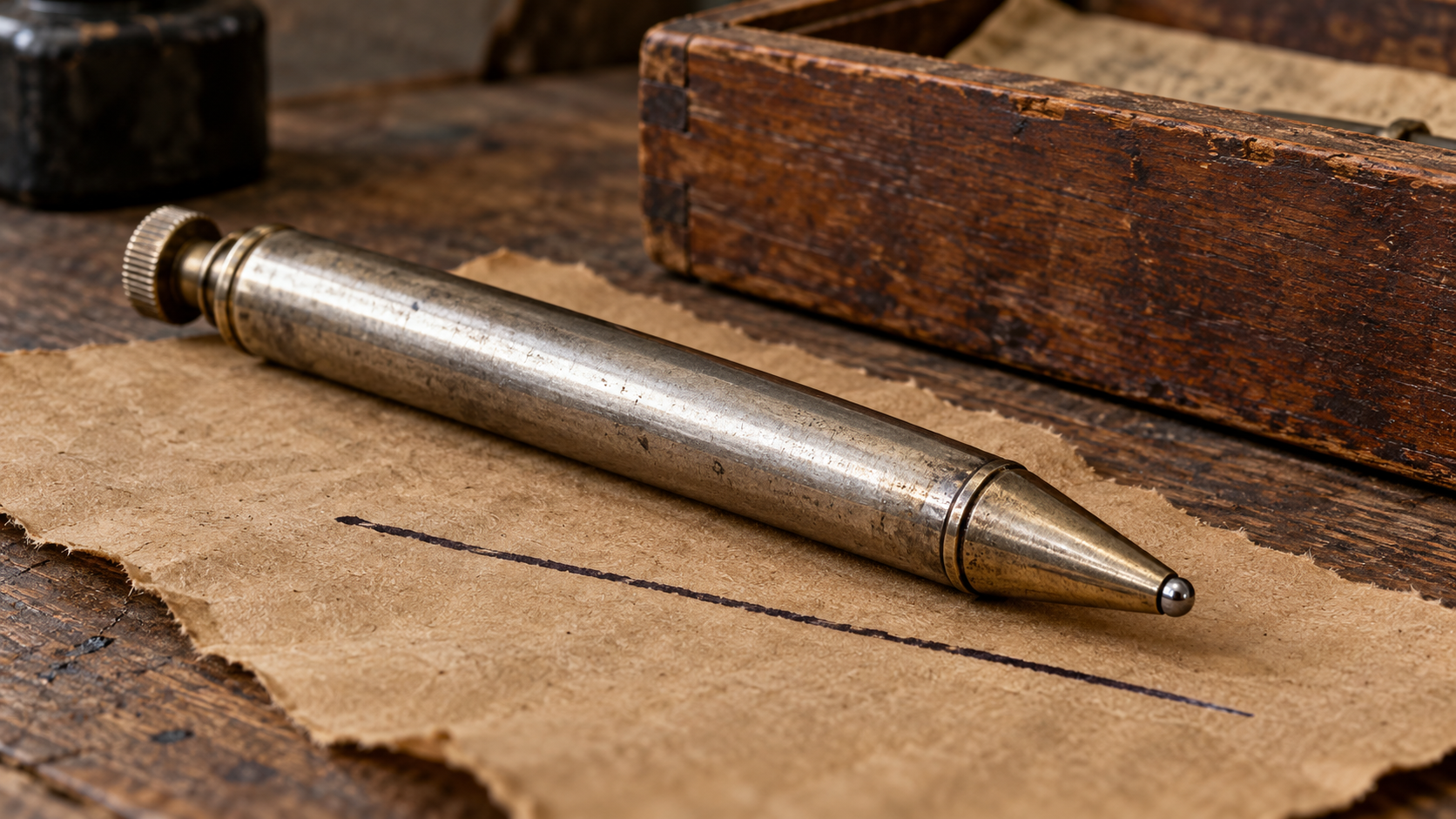
On October 30, 1888, John J. Loud of Weymouth, Massachusetts, received U.S. Patent 392,046 for an improved pen with a rolling marking point. The design used a small sphere held at the end of a reservoir tube, allowing ink to reach a surface as the point moved. Loud described its usefulness on rough materials such as wood and coarse wrapping paper, where an ordinary pen could catch or perform poorly. The patent is an important early ballpoint milestone, but it should not be confused with the later mass-market writing pens associated with László Bíró and other twentieth-century developers.
The drawing and specification explain a mechanical arrangement more involved than simply putting a loose ball in a tube of ink. A narrowed opening retained the marking sphere, while smaller balls and a spring-loaded internal assembly supported its movement. Adjustments controlled the relationship between the point, its seat, and the ink supply. Pressing the pen against the work surface allowed movement within the mechanism so that ink could flow around the ball. The sphere could roll across irregularities rather than depending on the split nib of a conventional writing instrument. The intended problem was therefore practical marking on difficult materials, not merely making everyday handwriting look different.
A reservoir pen must balance competing requirements. Ink needs to reach the surface during use but must not leak freely when the instrument is put aside. The moving point must turn without jamming, while its supporting parts must keep the opening controlled. Loud’s specification described a screw arrangement that could close the system when it was not in use, as well as access for refilling. Those details show why a familiar-looking concept can require careful engineering. Materials, clearances, pressure, fluid behavior, and maintenance all affect whether an instrument works consistently. A patent drawing establishes a proposed construction; it does not by itself demonstrate inexpensive manufacturing or convenient use by a large public.
Later ballpoint development addressed writing quality, suitable inks, reliable feed, and production at commercial scale. The eventual everyday pen was the result of further work rather than a finished consumer product appearing with Loud’s patent in 1888. October 30 marks the grant of a specific early design that put a rolling sphere at the point of an ink instrument. Its significance lies both in that principle and in the task it was meant to solve. The history is a reminder to separate an early patent from later successful products: an idea can resemble a familiar object while still differing substantially in purpose, mechanism, manufacturing demands, and the quality of the experience it provides.
Loud received U.S. Patent 392,046 on October 30, 1888. The design addressed marking on rough surfaces rather than the later mass-market handwriting task.
Its rolling sphere was retained in a narrowed tube opening. Internal support and spring arrangements helped control movement and ink delivery.
A useful pen must deliver ink while resisting leakage. Clearances, pressure, fluid behavior, and the condition of the point all matter.
A patented construction is not proof of cheap manufacturing or broad adoption. Loud's design should not be described as the finished modern disposable ballpoint.
Later inventors improved inks, feed systems, writing quality, and production. Familiar consumer pens emerged through additional development.
The milestone distinguishes a technical principle from a successful everyday product. Similar-looking mechanisms can serve different purposes and impose different practical demands.
Explore more of "On This Day ..."
Discover more events from the same date across news, politics, technology, sports, and other fields. Each link highlights significant moments that shaped history on different fronts.