

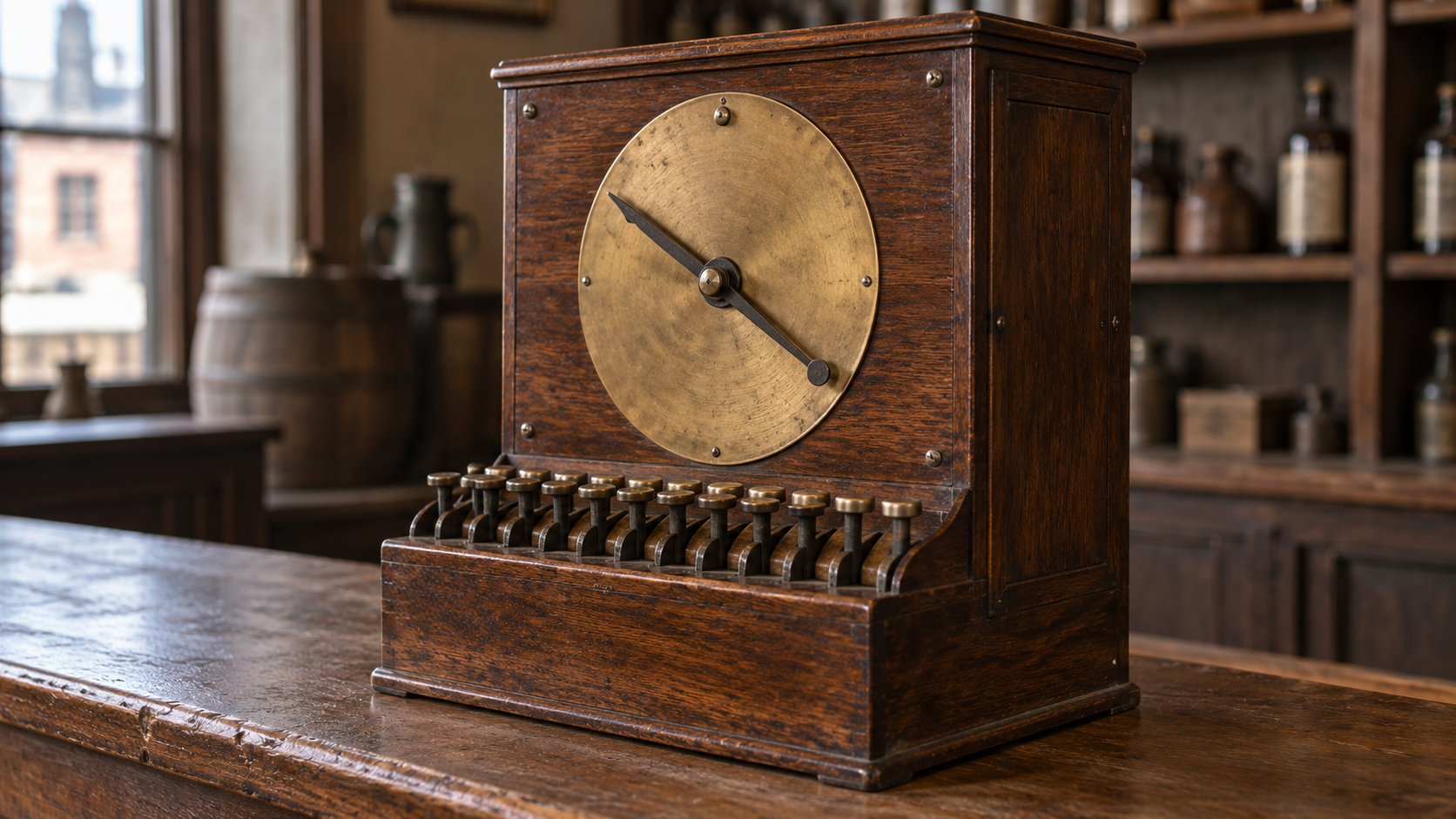
On This Day in Tech: November 4, 1879
On November 4, 1879, James and John Ritty of Dayton, Ohio, received U.S. Patent 221,360 for improvements in a cash register and indicator. James operated a saloon and wanted a more dependable way to record money received by employees. John brought mechanical skill to the brothers’ experiments. Their design joined the physical act of entering a transaction with an indication of its amount and a running record of receipts. The patent was an important step in retail machinery, not the arrival of a modern electronic checkout. Its significance lay in making a sale leave a mechanical trace that could be checked afterward.
The brothers’ approach used keys or levers representing money values, an indicating dial, and cooperating numbered components that recorded totals. Pressing a key moved a mechanism rather than sending an electrical signal to a processor. Ratchets, disks, springs, and linkages had to turn repeated human actions into a dependable accumulated result. The patent also described a sounding device to make registration audible. That was useful because a transaction not entered into the machine would otherwise be less visible to someone supervising the business. The device was intended to support oversight; it could not independently establish that every purchase had been entered honestly or correctly.
Early versions differed from the registers familiar from later shop photographs. The original Ritty design did not include the cash drawer that became strongly associated with the product category. Paper records, electric drive, and many refinements came through later development. A preserved Model 1 register at the Smithsonian, possibly a replica, illustrates the early dial-and-key form but should not be treated as unquestioned evidence of the exact first machine. The primary patent supplies a clearer record of what the brothers claimed in 1879. Separating that design from later additions prevents a convenient but misleading picture of a fully mature checkout system appearing on a single date.
The cash-register business changed ownership, and the Patterson brothers later developed the National Cash Register Company. Commercial success required manufacturing, selling, maintaining, and improving machines as well as obtaining a patent. Registers eventually became electromechanical and electronic systems, with functions extending into inventory and other business records. Those later capabilities were far beyond the Rittys’ initial mechanism. November 4 marks a specific patent milestone in the mechanization of everyday commercial recordkeeping. It shows how a machine can change a workplace by linking an action to a visible and auditable record, while also showing the limits of automation: useful records still depend on people entering the right information and organizations deciding how to review it.
James Ritty wanted better oversight of receipts at his Dayton saloon. He and John Ritty developed mechanical methods for recording transactions.
Their patent was granted on November 4, 1879. It concerned a register and indicator, not an electronic payment terminal.
Keys, disks, ratchets, and linkages connected entries with displayed amounts and totals. A sounding device made registration noticeable.
The early design lacked a cash drawer. Paper records and electrical mechanisms belonged to later improvements.
Subsequent owners developed the manufacturing and commercial business that became NCR. A patented mechanism still needed a workable product and support system.
Mechanical records could support auditing but could not ensure honest input by themselves. The technology changed the evidence available to a business rather than removing every opportunity for error.
Explore more of "On This Day ..."
Discover more events from the same date across news, politics, technology, sports, and other fields. Each link highlights significant moments that shaped history on different fronts.