

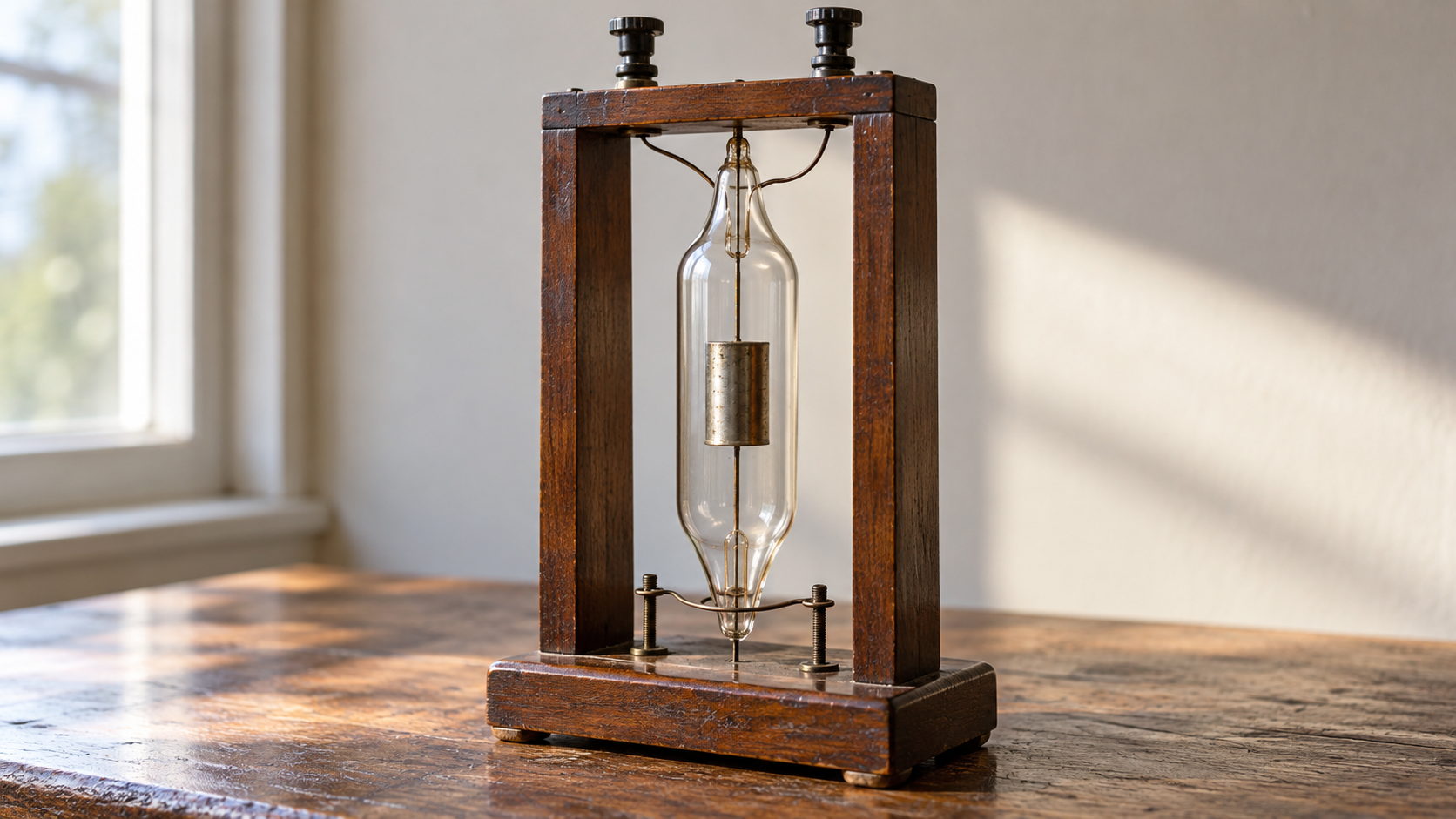
On This Day in Tech: November 16, 1904
On November 16, 1904, British electrical engineer John Ambrose Fleming filed a patent application for an electrical valve intended to detect and measure alternating currents, particularly high-frequency oscillations used in wireless communication. Fleming worked at University College London and advised the Marconi wireless enterprise. The British provisional specification dated that day described a vacuum-based device that would allow a measuring instrument to respond to currents it could not ordinarily register directly. This was a patent-filing milestone rather than the date of a modern radio receiver’s invention. The complete specification and the subsequent patent process extended into the following year.
The idea grew from research on heated filaments and electrical conduction in evacuated bulbs. Incandescent lamps already placed a hot filament inside glass, and investigators had observed that additional electrodes could collect an electrical current under suitable conditions. Fleming saw a possible use in receiving wireless signals. Rapidly alternating electrical currents could reverse direction too quickly for a conventional direct-current measuring instrument to provide the desired indication. A device that permitted conduction preferentially in one direction could convert those oscillations into a form the instrument could detect. The name valve expressed that directional behavior rather than a moving mechanical gate inside the bulb.
Fleming’s proposals used heated and unheated conductors sealed inside an evacuated glass vessel, with electrical connections passing through the glass. Later descriptions included a metal cylinder surrounding the hot filament without touching it. Maintaining the vacuum, supporting the electrodes, providing heat, and making reliable connections were all part of a practical device. The two-electrode arrangement acted as a rectifier or detector; it did not offer the signal amplification associated with later multi-electrode tubes. The distinction is important because the history of electronics involves related but separate developments. Adding control elements and improving manufacturing expanded what valves could do after Fleming’s initial work.
Vacuum-tube technology became central to radio, telephony, measurement, and eventually computing before semiconductor devices displaced it in many applications. That longer history should not be collapsed into the 1904 application. Other experimenters contributed earlier observations and later improvements, and patent claims also became subjects of dispute. November 16 marks Fleming’s documented effort to turn a physical effect into a useful receiving and measuring component. Its technological importance lies in controlling electrical behavior without relying on a mechanical switching action for every cycle. A relatively simple glass device opened a route toward electronic systems, but useful equipment still required power supplies, carefully arranged circuits, stable components, and engineering knowledge about the conditions under which the device would operate dependably.
Fleming connected research on heated filaments with the problem of detecting rapid wireless oscillations. Existing lamps and laboratory observations supplied important background.
The British provisional specification is dated November 16, 1904. Filing, completion of the specification, and patent grant are distinct events.
A hot and a cooler electrode in a vacuum could produce directional conduction. That allowed rectification for measurement or detection.
The two-electrode valve was not an amplifying triode. Vacuum quality, heating, supports, and connections affected practical performance.
Later tubes added capabilities and became important throughout electronics. Semiconductor devices eventually replaced them in many applications.
The milestone links a physical effect with a usable circuit component. Its legacy depends on the surrounding engineering as well as the bulb itself.
Explore more of "On This Day ..."
Discover more events from the same date across news, politics, technology, sports, and other fields. Each link highlights significant moments that shaped history on different fronts.