

On This Day in Tech: November 17, 1970
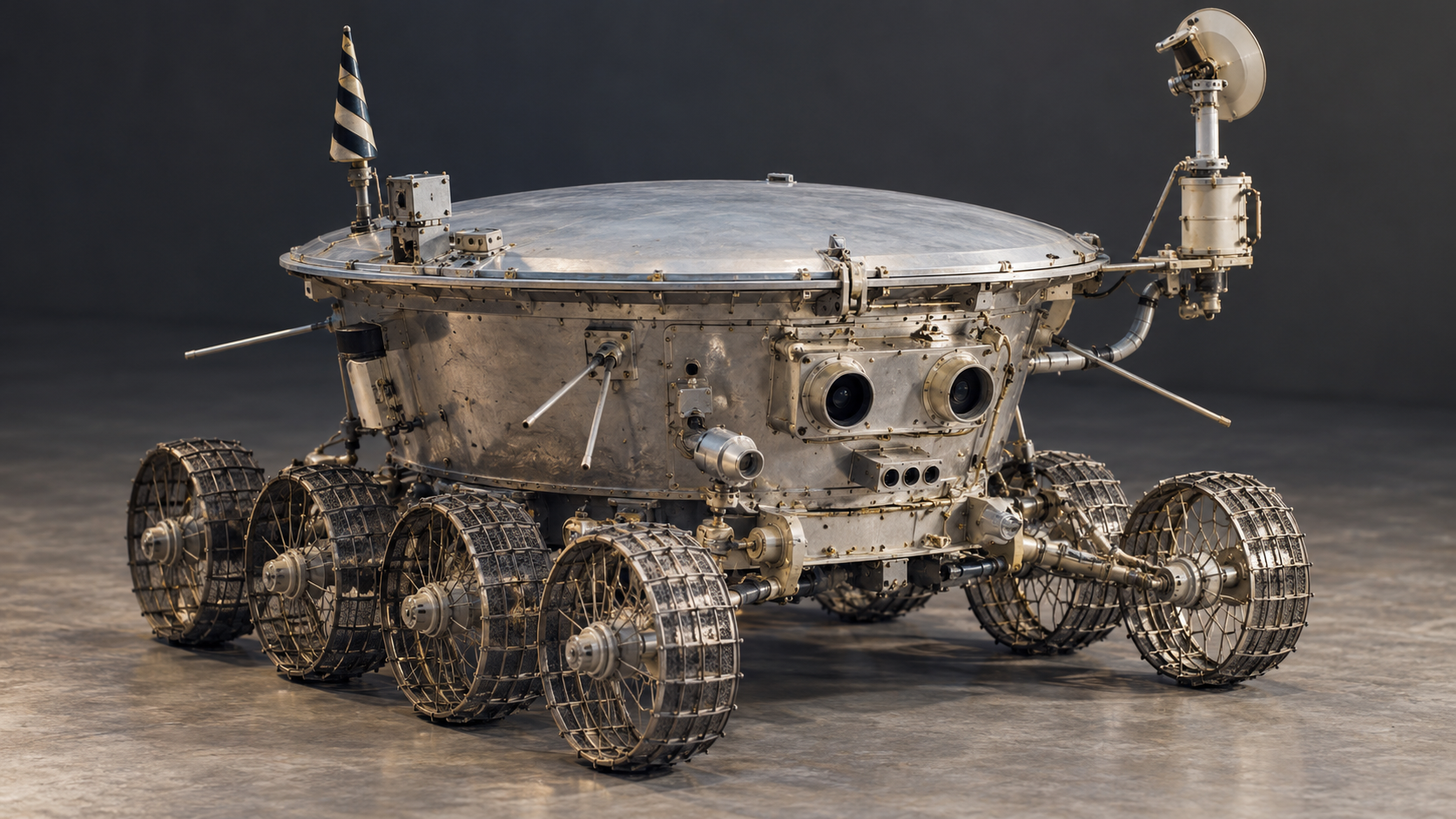
On November 17, 1970, the Soviet Luna 17 spacecraft landed in Mare Imbrium, the Moon’s Sea of Rains, carrying the remotely controlled rover Lunokhod 1. The wheeled vehicle subsequently descended a ramp to begin exploring the surface. Built through the Soviet lunar program with major work by the Lavochkin organization and specialist vehicle engineers, it became the first successfully operated remote-controlled rover on another celestial body. Its drivers remained on Earth. The landing therefore brought a different kind of exploration to the Moon: a mobile instrument platform could travel beyond a stationary lander’s immediate surroundings without carrying astronauts.
Lunokhod 1 had a distinctive tub-shaped body on eight independently driven wheels. Its equipment included television cameras, communications antennas, instruments for examining the surface, and a reflector used for laser ranging. A hinged lid exposed solar cells during operations, while the vehicle also needed protection from the extreme cold of the lunar night. The design had to reconcile mobility with power, thermal management, and radio contact. Wheels that worked on a terrestrial test course were not enough by themselves. The complete system needed to survive launch and landing, leave its carrier safely, and continue functioning in vacuum, dust, and changing illumination.
A ground team used transmitted images and other information to choose routes and command the vehicle. Radio signals required time to travel between Earth and the Moon, and the available view was more limited than a driver’s direct vision. Terrain assessment and cautious operation were therefore central to the mission. The rover could not simply be driven like an ordinary car or assumed to make every navigation decision autonomously. Luna 17 provided ramp access on more than one side, offering an alternative if an obstacle complicated departure. The first day’s successful deployment began a sequence of traverses and experiments, not an instantaneous survey of the entire region.
The rover continued operating for roughly eleven months, well beyond its initial design period, and traveled more than ten kilometers. Its measurements and imagery expanded knowledge of the local surface while demonstrating how a remotely operated vehicle could support planetary science. Decades later, modern observations located the rover, and its reflector again became useful for laser-ranging measurements. Those later achievements were separate from the 1970 landing. November 17 marks the successful delivery of a mobile robotic laboratory, whose results depended on collaboration among spacecraft designers, vehicle engineers, scientists, and ground operators. The mission showed that exploration could combine a machine’s physical presence on another world with human judgment at a distant control center, provided communications, power, mobility, and survival arrangements were designed together.
Luna 17 carried the rover to Mare Imbrium on November 17, 1970. Lunokhod 1 then left the landing platform by ramp.
The mission demonstrated mobile robotic exploration with operators on Earth. It was not a crewed lunar vehicle.
Eight powered wheels, cameras, antennas, scientific equipment, and thermal arrangements formed one coordinated system. The hinged lid supported the solar-power scheme.
Limited images and communication delay constrained driving. Human operators had to evaluate terrain and command cautious progress.
Lunokhod 1 operated for about eleven months and traveled more than ten kilometers. Later ranging work used its reflector after the rover's active mission had ended.
The mission's legacy includes remote operations and long-duration surface engineering. A mobile instrument platform can extend exploration beyond a stationary landing site.
Explore more of "On This Day ..."
Discover more events from the same date across news, politics, technology, sports, and other fields. Each link highlights significant moments that shaped history on different fronts.