

On This Day in Tech: December 19, 2013
On December 19, 2013, the European Space Agency launched Gaia from Europe’s Spaceport in French Guiana aboard a Soyuz rocket with a Fregat upper stage. The observatory began its journey toward the Sun-Earth L2 region, where it would measure stellar positions and motions with exceptional precision. Built with Astrium as prime contractor, Gaia combined telescopes, a large detector assembly, thermal protection, propulsion, communications, and extensive ground processing. Its departure was the beginning of a survey mission, not the publication of an already completed map of the Milky Way. Commissioning, calibration, observations, and data analysis still lay ahead. Those preparatory steps were essential.
The mission’s principal method was astrometry: measuring where objects appear in the sky and how those apparent positions change over time. Repeated observations allow astronomers to separate motions associated with a star’s distance from its own movement through space. Gaia also gathered information about brightness and spectra, connecting precise positions with other physical properties. Doing this for an enormous number of objects required much more than a single large photograph. The spacecraft had to scan the sky in a controlled way, preserve a stable instrument geometry, and attach accurate timing and position information to the measurements sent to Earth.
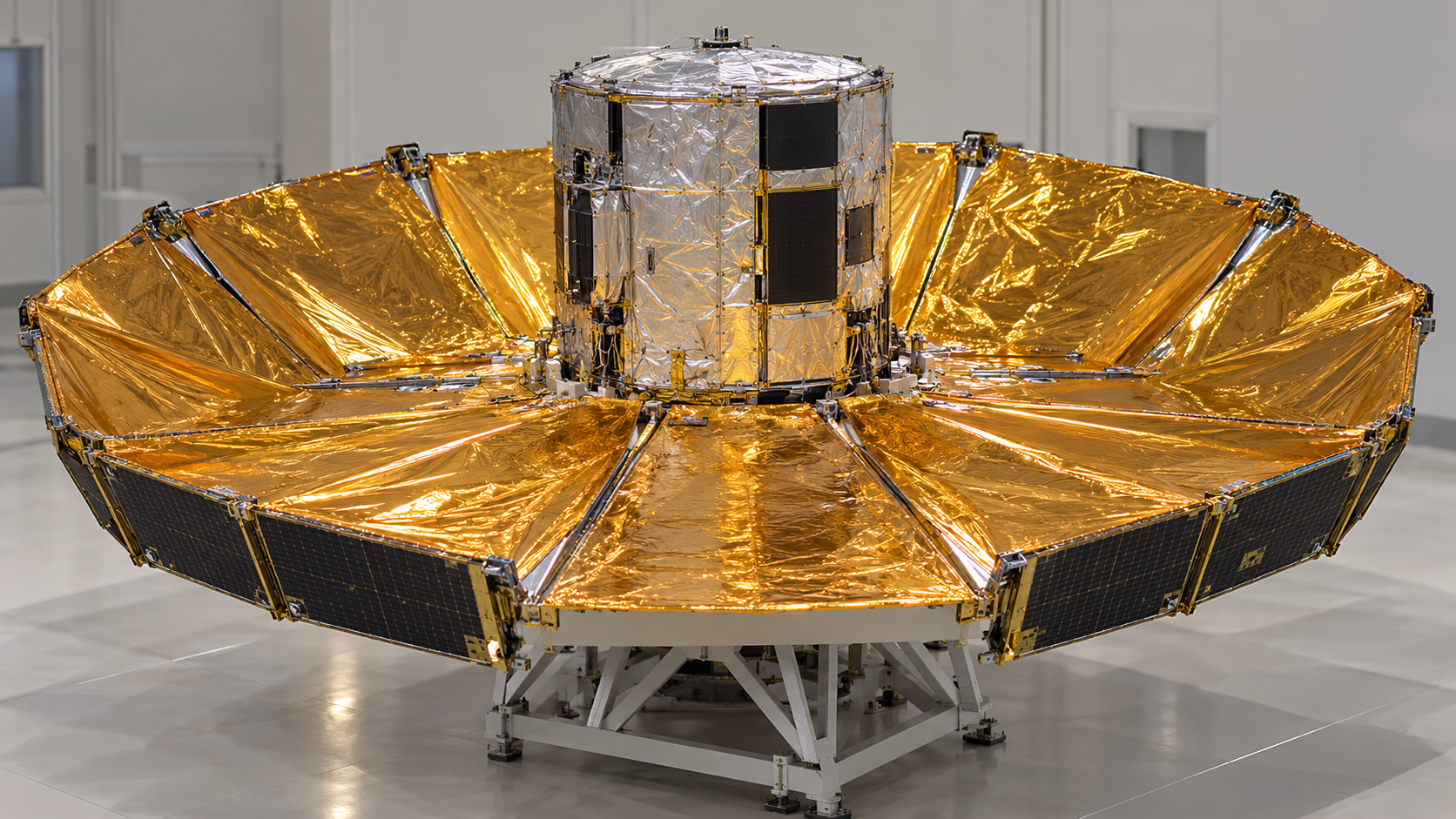
Thermal engineering was central to that precision. A broad deployable sunshield helped protect the observatory from direct sunlight and reduce changes that could disturb its measurements. The shield had to fit within the launch configuration, then unfold after separation from the rocket. Ground teams also established the spacecraft’s orientation, checked communications, and determined its trajectory. L2 offered a useful observing environment, but it was not a point at which the observatory could simply be abandoned to remain fixed forever. Orbit maintenance and careful control of the spacecraft’s attitude were continuing parts of the mission.
Gaia began routine science observations in 2014 after an extended commissioning period that included unexpected technical challenges. Its first public data release followed in 2016, with later releases expanding the information available to researchers. Those dates distinguish launch, operational readiness, and a usable scientific catalog. The technological achievement extended from the spacecraft into ground systems and the international teams that calibrated and processed its observations. December 19 marks the start of that chain. Gaia shows how a major survey depends on stable structures, accurate pointing, sensitive detectors, reliable communications, and sustained computation, all working together to transform many separate observations into a consistent record of the sky.
Astrometry concerns precise positions and their changes. A star survey becomes three-dimensional when distance information is combined with measurements across the sky.
The mission used two telescopes and a shared detector assembly. Its results depended on repeated, calibrated observations rather than a single exposure of the entire Galaxy.
The sunshield had an engineering role as well as a distinctive appearance. Reducing thermal disturbance helped maintain the stability needed for precise measurements.
Launch did not begin routine scientific surveying immediately. Commissioning tested the observatory, exposed problems, and established how its measurements should be interpreted.
Catalog releases followed years of observations and processing. Their publication dates should not be confused with the 2013 launch anniversary.
The spacecraft and the ground-processing effort formed one measurement system. Hardware precision needed corresponding calibration, data handling, and long-term coordination.
Explore more of "On This Day ..."
Discover more events from the same date across news, politics, technology, sports, and other fields. Each link highlights significant moments that shaped history on different fronts.