

On This Day in Tech: December 23, 1947
On December 23, 1947, John Bardeen and Walter Brattain demonstrated the point-contact transistor to supervisors at Bell Laboratories. The small experimental device amplified an electrical signal using closely spaced contacts on a piece of germanium. It was an internal demonstration, not the public announcement of a finished consumer product. The researchers had already observed amplification earlier that month, on December 16, and their work continued after the management presentation. December 23 therefore marks a particular step in a developing invention: showing colleagues and decision-makers that a semiconductor amplifier could actually work, even though the device looked very different from the components used in later electronics.
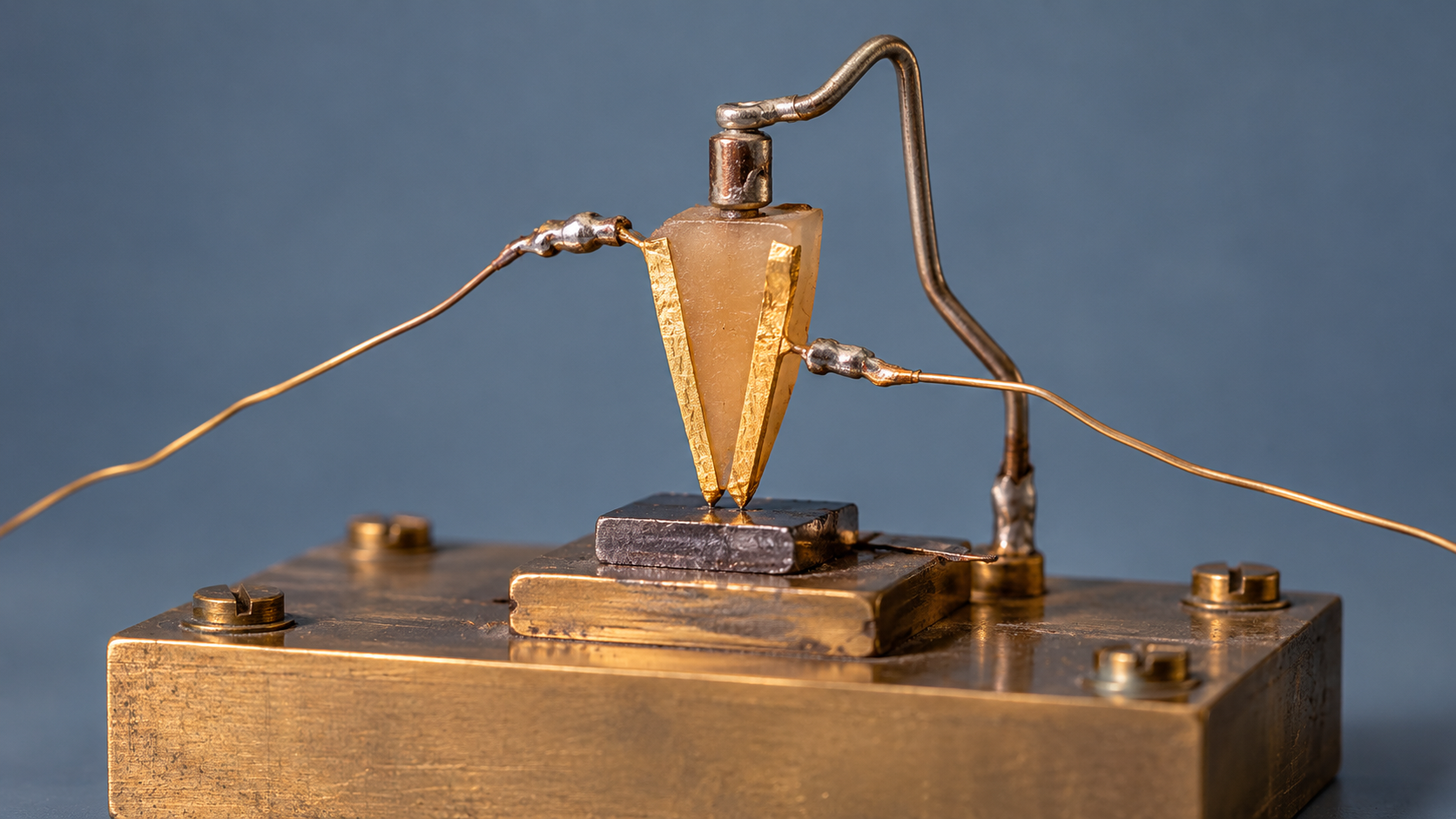
The apparatus was remarkably modest beside the equipment it would eventually help replace. Thin gold foil on a plastic wedge formed two nearby contacts pressed against a germanium surface. A spring maintained the pressure, and electrical connections allowed the researchers to investigate how a small input affected a larger output. Unlike a vacuum tube, the active device did not depend on heating a cathode inside an evacuated glass envelope. That difference suggested possibilities for smaller equipment with different power and heat requirements. The first experimental assembly was delicate, however, and a successful bench demonstration was not the same thing as a reliable, mass-produced part.
The achievement grew from a sustained research program rather than a single lucky afternoon. William Shockley led the Bell Labs semiconductor group, while Bardeen and Brattain combined theoretical reasoning with careful experiments to understand and overcome obstacles at semiconductor surfaces. Their point-contact device established a practical route to amplification, but it did not settle the best design for every application. Shockley pursued a different junction approach after the breakthrough. These related developments are often compressed into one invention story, obscuring the difference between the first working point-contact arrangement, subsequent transistor structures, and the manufacturing methods that would eventually make semiconductor electronics widespread.
The later consequences were immense, but they unfolded over years. Transistors became useful in communications equipment and portable devices, and further advances in materials and fabrication made integrated circuits possible. A modern chip containing many tiny transistors is not simply the original laboratory mechanism reduced in size; it reflects additional inventions, improved control of materials, and new ways to manufacture complex circuits. The December demonstration nevertheless established a vital foundation. It showed that a small solid-state device could perform amplification, creating a convincing reason to keep developing the technology. The anniversary recognizes a measured laboratory result and the collaborative work that turned an uncertain experiment into a new direction for electronics.
The December 23 event was a demonstration to management. It should not be confused with the earlier December 16 observation of amplification.
The active material was germanium, not the silicon associated with many later chips. Closely spaced contacts were central to the first device.
Gold foil on a plastic wedge formed the point contacts. The open experimental assembly did not resemble a modern packaged three-lead transistor.
Bardeen and Brattain combined theoretical and experimental work within Shockley's research group. The result depended on a continuing program of investigation.
Shockley's junction approach followed the point-contact breakthrough. Different transistor structures belong to distinct stages of the development story.
Mass production and integrated circuits required further advances. The 1947 demonstration proved a principle rather than delivering a complete modern computer.
Explore more of "On This Day ..."
Discover more events from the same date across news, politics, technology, sports, and other fields. Each link highlights significant moments that shaped history on different fronts.