

On This Day in Tech: December 25, 2021
On December 25, 2021, the James Webb Space Telescope launched aboard an Ariane 5 rocket from Europe’s Spaceport in French Guiana. The observatory was a partnership among NASA, the European Space Agency, and the Canadian Space Agency. Its departure began the journey toward an operating location near the Sun-Earth system’s second Lagrange point, roughly 1.5 million kilometers from Earth. Launch was a major achievement, but it was not the start of routine science observations. Webb still had to unfold large structures, cool its instruments, align its optics, and complete extensive commissioning before it could deliver the observations for which it had been built.
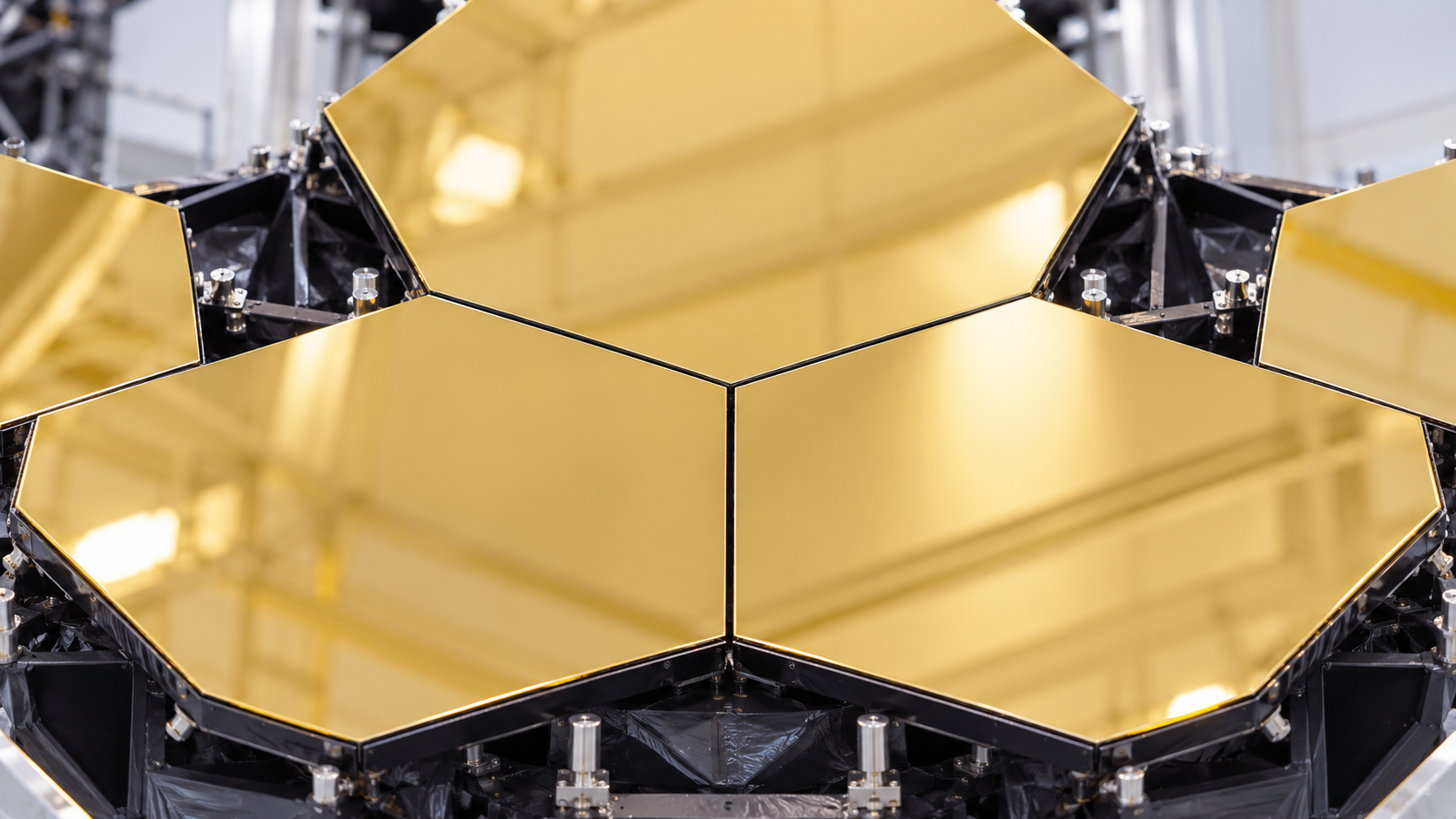
The observatory’s design followed the needs of infrared astronomy. Its large primary mirror collected faint light, while sensitive instruments were intended to study topics ranging from distant early galaxies to stars, planets, and objects in the Solar System. A mirror measuring approximately 6.5 meters across could not fit inside the rocket’s fairing in its observing configuration. Engineers therefore divided it into eighteen hexagonal segments and designed sections that could fold for launch. Gold coatings helped the mirror reflect infrared light. The polished surfaces, lightweight structure, actuators, and supporting electronics had to work together rather than behave as eighteen unrelated small telescopes.
Temperature control created another demanding problem. Warm equipment radiates infrared energy, which can interfere with observations of faint astronomical sources. Webb used a large five-layer sunshield to separate its cold telescope and instruments from the Sun’s heat and the warmer spacecraft systems. Like the mirror wings, the sunshield had to be packaged for launch and deployed afterward. Each operation depended on mechanisms, timing, and verification at a great distance from the engineers who had assembled the observatory. The journey was therefore not simply a rocket delivery followed by switching on a camera. Deployment and preparation were essential parts of making the telescope usable.
The launch linked decades of scientific planning with a sequence of carefully managed engineering tasks in space. Its international partners contributed instruments, launch services, and operational expertise, while teams on the ground monitored the observatory through the stages that followed departure. The first public science images arrived in 2022, after deployment and commissioning rather than on launch day itself. December 25 marks the beginning of that final transition from an observatory tested on Earth to one operating beyond it. Webb’s story illustrates how ambitious scientific questions can require precision manufacturing, deployable structures, thermal engineering, and patient verification long after the visible excitement of liftoff has ended.
Webb launched on an Ariane 5 from French Guiana on December 25, 2021. NASA, ESA, and CSA were partners in the observatory.
The telescope traveled toward an orbit near the Sun-Earth L2 region. It was not placed in the same kind of low Earth orbit used by Hubble.
Eighteen gold-coated hexagonal segments formed the primary mirror. Folded wings allowed the large optical system to fit inside the launch fairing.
A five-layer sunshield helped keep the telescope cold. Infrared observations required careful control of the observatory's own heat.
Deployment, cooling, alignment, and commissioning followed launch. A successful departure did not immediately produce a fully prepared science instrument.
The first public science images came in 2022. The anniversary of launch is distinct from the later beginning of scientific operations.
Explore more of "On This Day ..."
Discover more events from the same date across news, politics, technology, sports, and other fields. Each link highlights significant moments that shaped history on different fronts.