

On This Day in Tech: December 26, 1933
On December 26, 1933, Edwin Howard Armstrong received United States patents covering important parts of his frequency-modulation radio work. One was Patent 1,941,068, titled “Radiosignaling,” which described arrangements for producing and receiving signals carried by changes in frequency. Another, Patent 1,941,447, addressed radio telephone signaling and methods of reducing unwanted amplitude variations. These documents mark a step in the development of FM, not the opening of a nationwide broadcasting service. Armstrong’s experimental transmitters, field demonstrations, and the eventual adoption of FM broadcasting belonged to a longer process that continued after the patents were issued.
The underlying distinction from amplitude modulation is straightforward. An AM system carries information through changes in the strength of a radio wave. In FM, the information is represented by changes in frequency instead. That difference gives designers another way to separate the wanted signal from certain disturbances. Armstrong’s patent descriptions included limiting circuits that removed amplitude variations before the receiver recovered the original information from frequency changes. Such circuits did not make every kind of interference disappear. They formed part of a complete transmitting and receiving system whose performance depended on its design, the signal conditions, and the behavior of several connected stages.
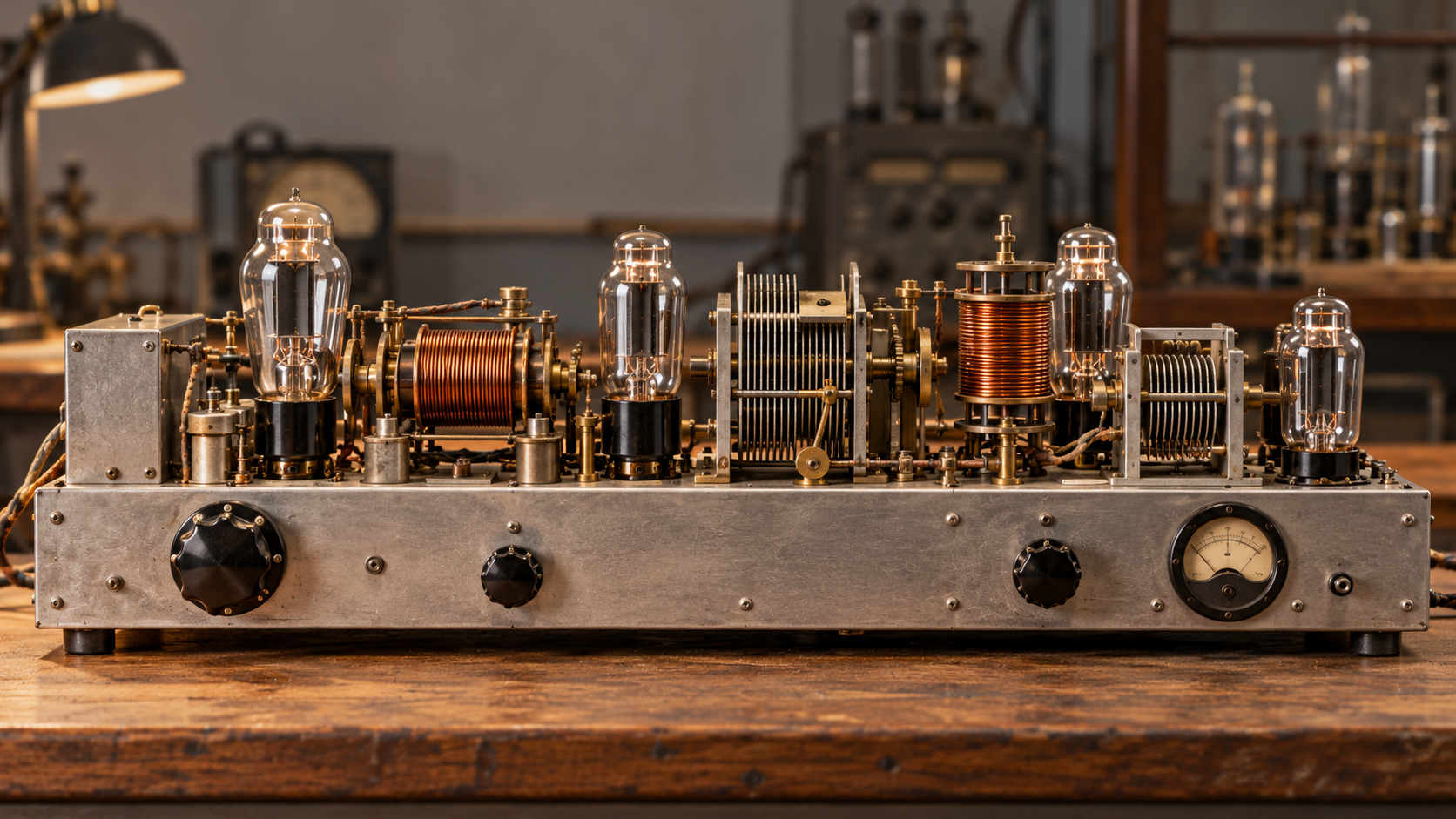
The documents also show how much engineering stood behind a simple phrase such as frequency modulation. Oscillators, modulators, amplifiers, filters, frequency multipliers, and detecting circuits each performed a different job. A transmitter had to create a controlled signal, while a receiver had to select it and turn its changing frequency back into useful sound or another output. Vacuum tubes supplied the active elements in this period. Coils, capacitors, and transformers shaped the signals passing among them. The challenge was not merely to change the frequency of an electrical oscillation, but to do so predictably and recover the information without introducing unacceptable distortion or noise.
A patent grant alone could not establish a practical broadcasting industry. Equipment still had to be built and tested, convincing demonstrations had to reach other engineers, and stations and listeners eventually needed compatible hardware. The surviving experimental apparatus from Armstrong’s later development work makes that gap between a circuit description and a functioning system visible. December 26 is important because it records specific technical approaches in a dated public document. The anniversary recognizes FM’s engineering foundations while keeping the later story separate: improved radio reception emerged from sustained experimentation and system design, not from a single patent instantly removing static from every receiver.
Patent 1,941,068 was granted on December 26, 1933. It described transmitting and receiving arrangements for frequency-modulated signals.
Patent 1,941,447, issued the same day, addressed radio telephone signaling. Its circuits included ways to suppress unwanted amplitude variations.
FM represents information through frequency changes. AM uses changes in a carrier's amplitude, so the receiver problems are not identical.
Limiting can remove amplitude fluctuations before detection. It is not a promise that every weak signal or kind of interference will vanish.
The early circuits used vacuum tubes, coils, capacitors, and transformers. Modern integrated receivers belong to a later manufacturing era.
A patent date is not a broadcasting launch date. Experimental equipment, demonstrations, and commercial adoption required additional work.
Explore more of "On This Day ..."
Discover more events from the same date across news, politics, technology, sports, and other fields. Each link highlights significant moments that shaped history on different fronts.