

On This Day in Tech: December 27, 1968
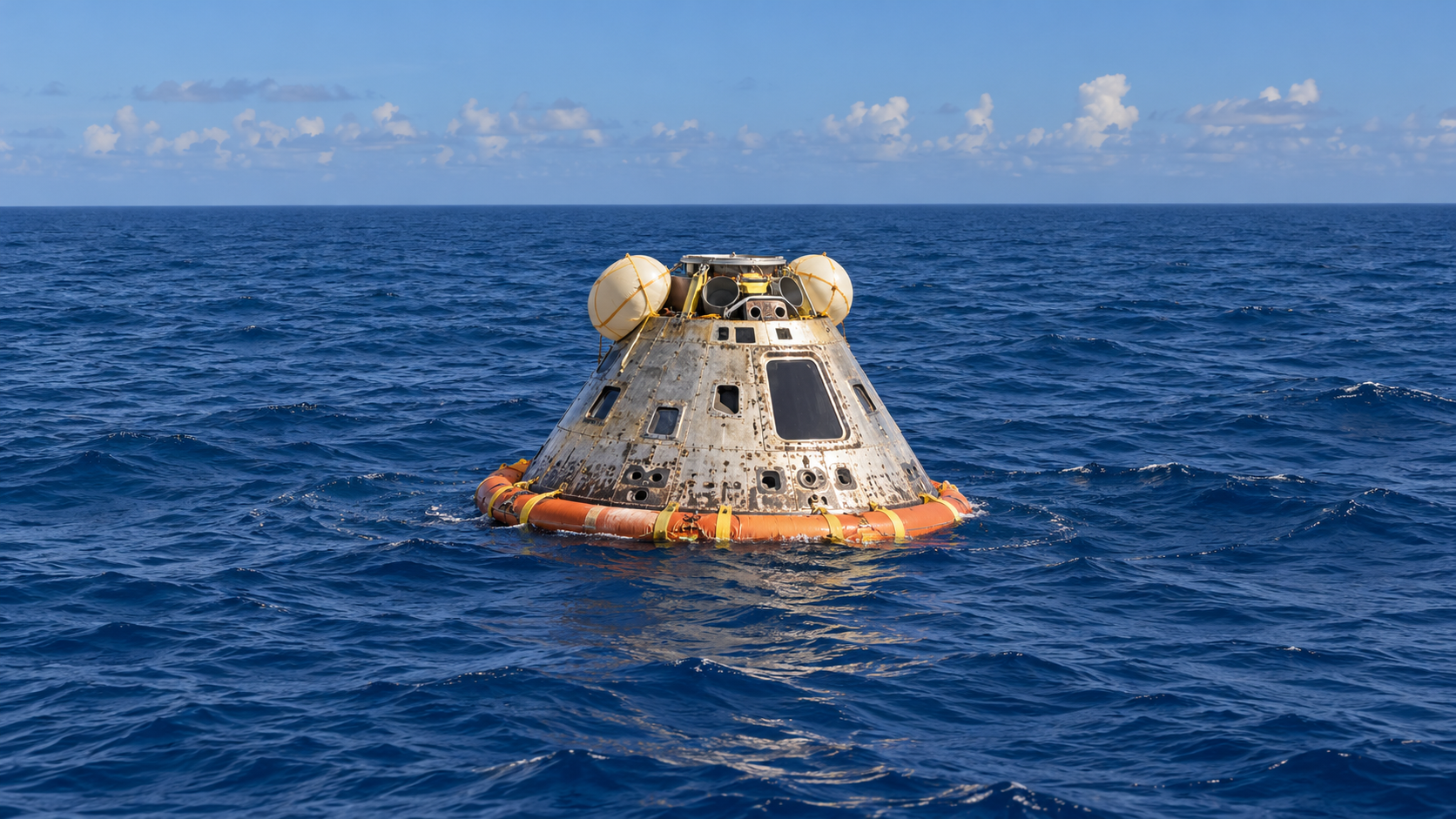
On December 27, 1968, Apollo 8 splashed down in the Pacific Ocean, bringing Frank Borman, James Lovell, and William Anders home from the first crewed mission to orbit the Moon. The astronauts had launched six days earlier and completed ten lunar orbits before beginning their return. Recovery forces from the aircraft carrier USS Yorktown stood ready near the landing area. Reaching the Moon had been a remarkable achievement, but a successful mission also required the crew to survive the high-speed return through Earth’s atmosphere and leave the spacecraft safely after it reached the water.
The journey home began with a precisely timed firing of the service module’s main engine. That maneuver sent the spacecraft away from lunar orbit and onto an Earth-return trajectory. During the coast, the crew and ground controllers continued navigation checks and made a course correction to refine the approach. The entry path had to fall within an acceptable corridor: arriving at the atmosphere was not enough if the angle was wrong. Spaceflight navigation therefore connected observations, calculations, communications, and propulsion across a journey in which a small adjustment far from Earth could influence the conditions encountered at the end.
Shortly before atmospheric entry, the command module separated from the service module and oriented its heat shield toward the direction of travel. Only the capsule containing the crew would return intact. Atmospheric drag removed speed while the shield protected the cabin from intense heating. Ionized gas around the vehicle briefly interrupted radio communications, leaving controllers waiting for contact to resume. After the most demanding part of entry, drogue parachutes and then three main parachutes slowed the descent toward the ocean. Each phase depended on the previous one: the parachutes were not intended to absorb the energy of a spacecraft still traveling at lunar-return speed.
The capsule initially floated upside down, then righted itself using its flotation system. Because splashdown occurred before local sunrise, the planned recovery sequence waited for daylight before swimmers and helicopters completed the crew’s transfer to Yorktown. The operation demonstrated that returning astronauts required an extensive support system beyond the spacecraft itself. Apollo 8’s safe arrival validated experience with lunar navigation, propulsion, communications, entry protection, parachutes, and ocean recovery. December 27 marks the completion of that full journey, not merely its dramatic final impact with the sea. The mission’s engineering achievement was bringing people home after operating far beyond the familiar environment of Earth orbit.
Apollo 8 completed ten lunar orbits before returning. Its December 27 splashdown was a different milestone from the December 21 launch.
The service module engine established the route home. Navigation checks and a correction refined the spacecraft's atmospheric entry conditions.
The service module was discarded before entry. The crew returned inside the smaller command module with its protective heat shield.
Atmospheric drag removed most of the return speed. Drogue and main parachutes operated later in the descent sequence.
The capsule's flotation system righted it after an upside-down splashdown. Ocean stability was part of the spacecraft's design problem.
Recovery involved USS Yorktown, helicopters, swimmers, and daylight procedures. A safe mission required support well beyond the capsule.
Explore more of "On This Day ..."
Discover more events from the same date across news, politics, technology, sports, and other fields. Each link highlights significant moments that shaped history on different fronts.