

On This Day in Tech: December 28, 1895
On December 28, 1895, a paying audience gathered at the Salon Indien of the Grand Café in Paris to watch films projected with the Lumière Cinématographe. The program associated with Auguste and Louis Lumière included ten short films rather than a single feature-length story. This commercial presentation became a landmark in the emergence of cinema as a shared public experience. It was not the first occasion on which anyone had seen moving images, nor the first demonstration of the Lumière apparatus. Earlier presentations had already taken place during 1895. The December event matters because it brought the technology into an admission-paying public setting.
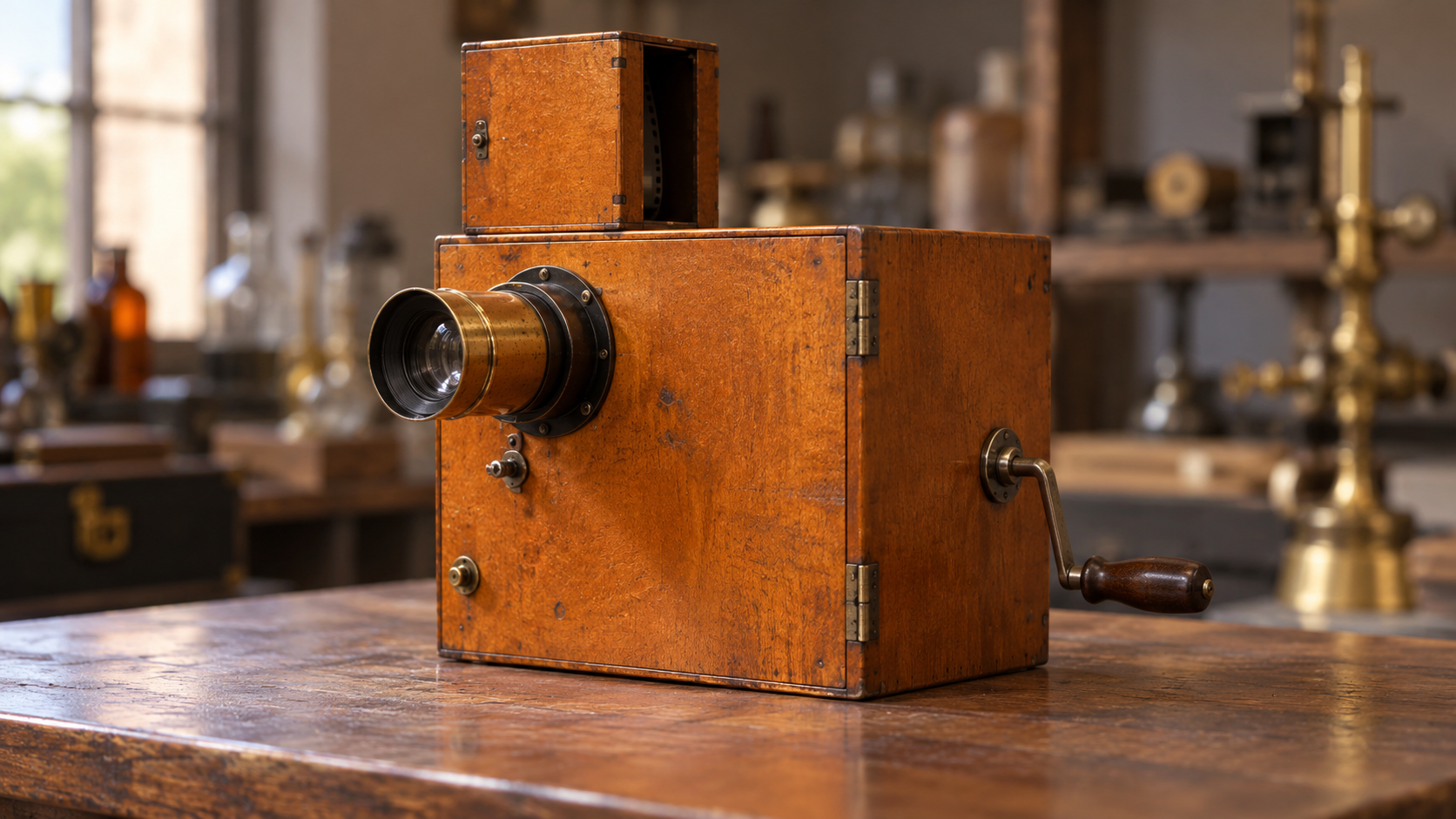
The Cinématographe combined functions that would later often be associated with separate machines. It could record motion-picture negatives, help produce positive copies, and project moving pictures for an audience. Its compact wooden housing contained a carefully controlled mechanical process rather than a miniature version of a modern digital video system. A hand crank supplied motion, while the film passed through the mechanism in a sequence of short advances and pauses. This intermittent movement was essential: each frame had to remain sufficiently still while it was exposed in the camera or illuminated during projection, then move onward for the next image.
Perforations along the film gave the mechanism a way to engage and position the strip. The relationship among transport, shutter, lens, and illumination determined whether viewers saw a stable, recognizable moving scene. Simply pulling film continuously past a light source would not produce the same result. The apparatus also had to handle the material without damaging it, and operators needed to maintain an appropriate rhythm when turning the crank. The Lumière system made these requirements practical in portable equipment, helping operators carry the technology beyond one laboratory or theater. Projection transformed a sequence of individual photographs into something an assembled audience could watch together.
The commercial screening was therefore both a technical demonstration and an experiment in how people would encounter the result. Short views of everyday activity could become an attraction when enlarged on a screen and presented in a room with other spectators. Later cinema would add many developments, including more elaborate editing, longer narratives, synchronized sound, and different production and exhibition systems. Those changes should not be read back into the Grand Café program. December 28 marks a specific early meeting of mechanism, projected images, and paying viewers. The anniversary shows how an invention can gain influence through the experience it makes possible, not only through the machinery inside its case.
The Grand Café program took place on December 28, 1895. It followed earlier Lumière demonstrations rather than revealing moving images for the first time.
Ten short films formed the program. A modern feature-length movie would be the wrong model for imagining the event.
The Cinématographe could serve as camera, printer, and projector. Its versatility helped a compact apparatus support several stages of film work.
Film advanced intermittently and paused for each frame. Controlled movement was necessary for clear recording and projection.
A hand crank drove the mechanism. Operator technique, film handling, optics, and illumination all affected the visible result.
The public event created a collective viewing experience. Claims that this was the first moving image of any kind erase important earlier work.
Explore more of "On This Day ..."
Discover more events from the same date across news, politics, technology, sports, and other fields. Each link highlights significant moments that shaped history on different fronts.