

On This Day in Tech: December 31, 1879
On December 31, 1879, Thomas Edison gave the public a demonstration of his incandescent electric lighting system at Menlo Park, New Jersey. Visitors saw buildings and grounds illuminated by electric lamps, turning a laboratory development into an experience people could judge for themselves. The event was not the first appearance of electric light, and Edison had not begun the subject from nothing. Other inventors had worked on incandescent lighting for decades. The significance of this demonstration lay in presenting his team’s developing system: lamps connected to the equipment needed to supply and distribute electricity, rather than an isolated glowing object.
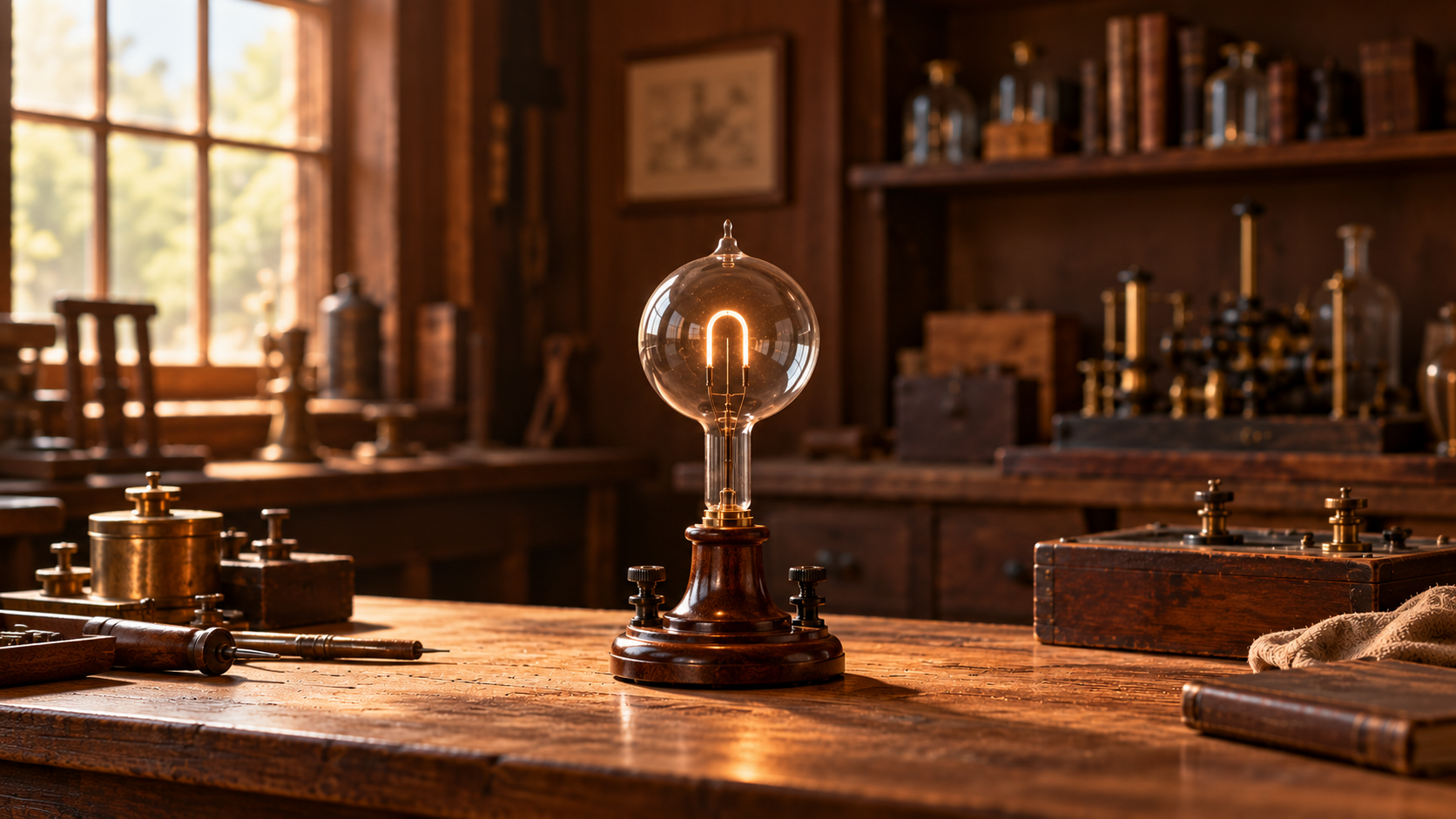
Inside an incandescent lamp, an electric current heats a filament until it emits light. The material must become hot without quickly melting or burning away. Edison and his assistants investigated both the filament and its surroundings, improving vacuum techniques while testing candidate materials. Successful experiments with carbonized thread preceded the public demonstration, and Bristol board was among the materials used for the New Year’s lamps. The glass envelope protected the hot carbon from air. Making the lamp useful therefore required coordinated progress in materials, glassworking, sealing, electrical connections, and the removal of gases, not simply a decision to put a wire inside a bottle.
The wider system mattered just as much. A practical lighting network needed generators, conductors, suitable circuit arrangements, and lamps that could operate together. Edison favored high-resistance lamps, which reduced the current required and affected the amount of copper needed for distribution. Parallel circuits allowed individual lamps to be controlled without extinguishing others along the line. These were choices about how a service would work for many users, not merely improvements to the appearance of a bulb. The Menlo Park display gave visitors a visible result while much of the enabling engineering remained in machinery, wiring, and the relationships among electrical components.
Further development followed the demonstration. Improved commercial lamps and manufacturing methods were still needed, and the Pearl Street power station began serving part of lower Manhattan in 1882, not in December 1879. The movement from a laboratory display to an electrical industry required investment, production, installation, maintenance, and continuing technical changes. December 31 marks an influential public demonstration within that longer process. Its enduring lesson is that a successful invention may be a system rather than a single artifact. The familiar image of Edison’s lamp becomes more informative when seen alongside the experimental team, power equipment, circuit design, and practical organization required to make electric lighting usable beyond the laboratory.
The December 31 event demonstrated Edison's developing lighting system. It was not the invention of electric light from scratch.
Carbon filaments needed protection from air. Improved vacuum methods and glass seals were essential to keeping a hot filament intact.
Bristol board was used for New Year's demonstration lamps. Later bamboo and tungsten designs should not be substituted without checking their dates.
High-resistance lamps influenced the current and copper required by the network. A bulb's design affected the economics of the larger system.
Parallel circuits allowed lamps to operate independently. The usefulness of electric lighting depended on circuit arrangements as well as the light source.
Pearl Street began operation in 1882. The Menlo Park demonstration preceded the later work of building a commercial electrical service.
Explore more of "On This Day ..."
Discover more events from the same date across news, politics, technology, sports, and other fields. Each link highlights significant moments that shaped history on different fronts.