

Household Circuit Breaker Explainer
A household circuit breaker is a reusable safety switch that opens an electrical circuit when current becomes unsafe for the wiring it protects. Current flowing through resistance produces heat. If too many loads draw power on one branch circuit, the conductors can overheat and damage insulation before an ordinary wall switch or appliance notices. The breaker is selected to match the wire size and circuit design. When its trip mechanism releases, spring-loaded contacts separate, interrupting current and reducing the chance that an overload or short circuit will start a fire.
Most common residential breakers combine two sensing methods. A thermal element, often a bimetal strip, warms and bends when moderate overcurrent continues. Its delayed action tolerates brief starting currents from motors but trips when excess current lasts long enough to threaten wiring. A magnetic element responds to a sudden, very large current such as a short circuit. The magnetic field pulls a latch almost immediately. The exact time-current response is engineered and tested; a breaker is not simply an on-off switch that trips at one perfectly fixed instant.
Opening a loaded circuit creates an electrical arc between the separating contacts. The breaker contains an arc chute made of insulated plates or metal separators that lengthen, divide, cool, and extinguish that arc. The handle moves to an off or intermediate trip position, but the internal contacts are held open by the mechanism. Resetting usually requires moving the handle fully to off and then back to on. That should happen only after the cause has been found. Repeatedly resetting a breaker without investigating can conceal an overload, damaged cord, failed appliance, or wiring fault.
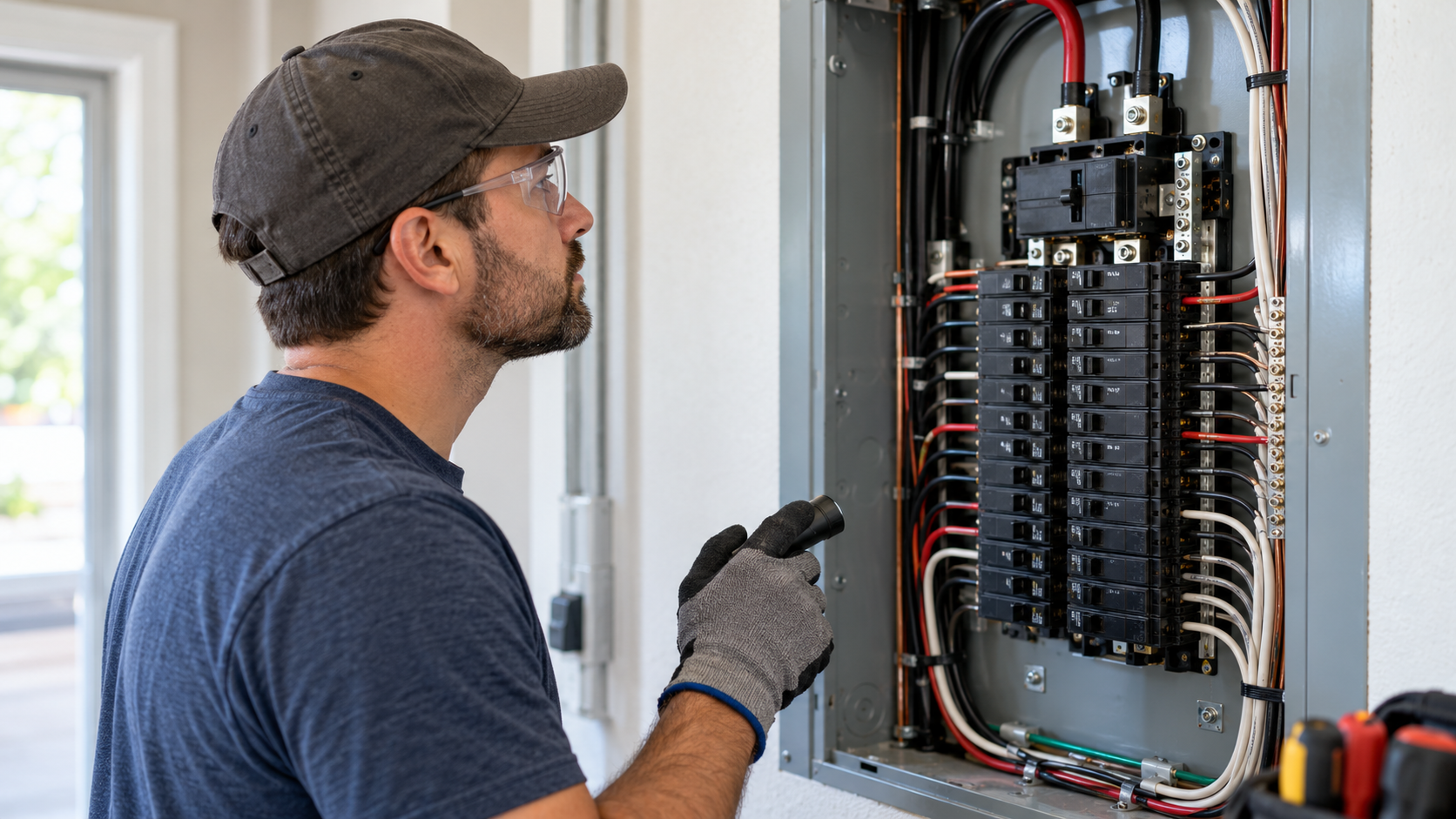
The amperage marking is intended to protect the branch wiring, not to describe how much power a homeowner should routinely demand from every receptacle. Replacing a breaker with a larger rating can allow conductors to overheat and is not a solution for nuisance trips. Some large appliances use double-pole breakers that disconnect both energized conductors together. The panel also includes a main disconnect and bus bars that distribute power. Removing the cover exposes hazardous energized parts even when individual branch breakers are off, so panel work belongs to qualified people.
Standard overcurrent protection is only one layer. A ground-fault circuit interrupter compares current leaving on the hot conductor with current returning on neutral and opens quickly when an imbalance suggests leakage through an unintended path. An arc-fault circuit interrupter looks for electrical signatures associated with hazardous arcing. Modern breakers may combine these functions. They do not make electricity harmless, and each device has a specific test procedure. A standard breaker can protect wiring from overcurrent without reacting to every small current that could seriously injure a person.
When a breaker trips, first unplug or switch off loads on the affected circuit and look for obvious damage, heat, odor, moisture, or a recently added high-power appliance. A single known overload may be corrected by reducing the load. A breaker that will not reset, trips immediately, feels hot, or trips repeatedly needs professional diagnosis. The protective action is deliberately inconvenient: it stops power before wiring conditions become more dangerous. The safe response is to treat the trip as information about the circuit, not as an obstacle to defeat.
A breaker opens spring-loaded contacts when a thermal element senses sustained overload or a magnetic element senses a sharp short-circuit current. Key terms include branch circuit, overcurrent, bimetal, magnetic trip, contacts, arc chute, rating, GFCI, and AFCI.
Many mechanisms latch internally in a trip position. Moving the handle fully off resets that latch; only then can the contacts be closed again after the fault is addressed.
No. The breaker rating is coordinated with the wiring. Increasing it without a properly engineered circuit can allow conductors to overheat and create a fire hazard.
Explore more "Explainers"
Discover additional explainers across politics, science, business, technology, and other fields. Each explainer breaks down a complex idea into clear, everyday language—helping you better understand how major concepts, systems, and debates shape the world around us.