

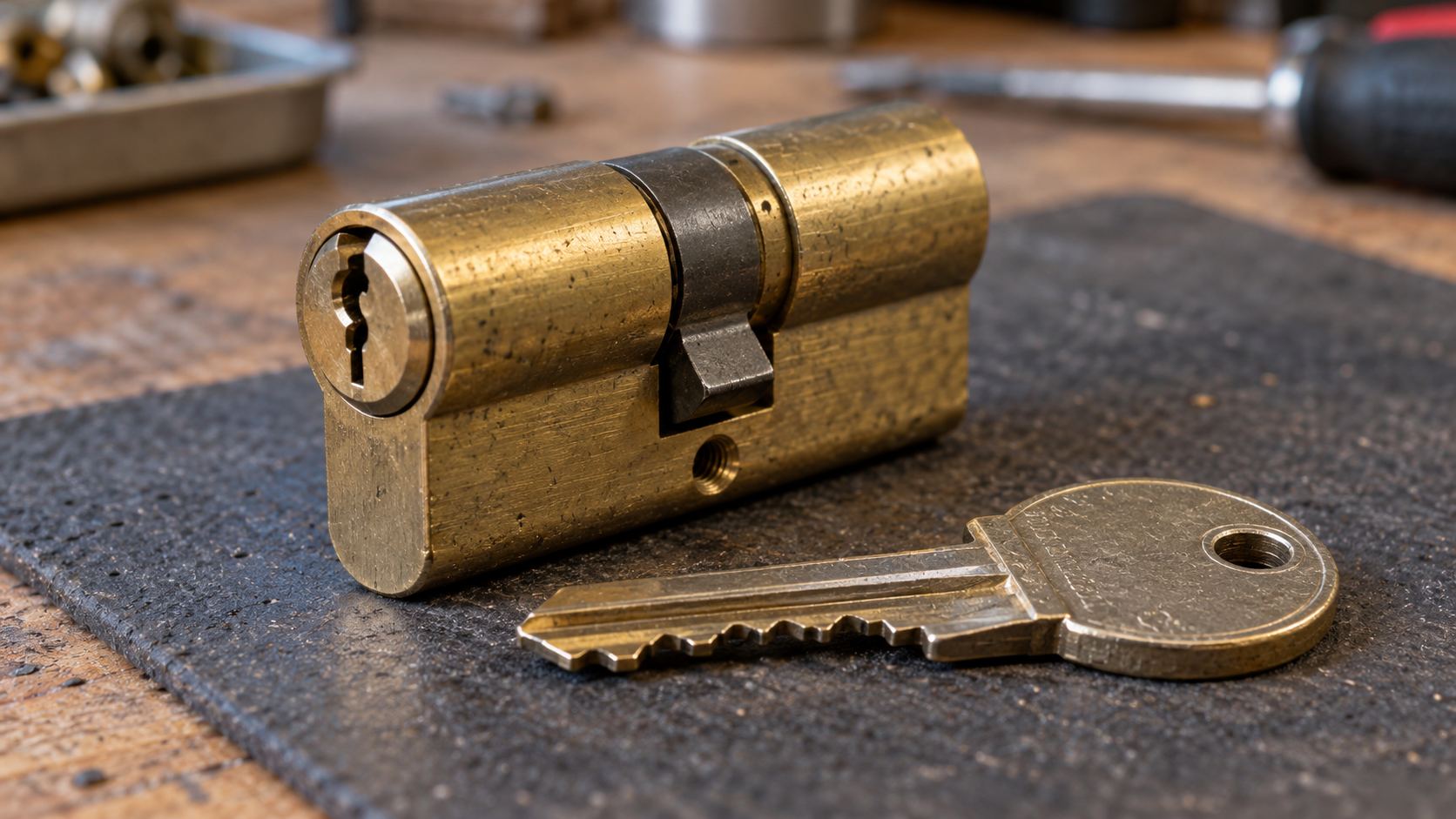
Pin-Tumbler Lock Explainer
A pin-tumbler lock opens when the correct key positions several stacks of pins so a cylindrical plug can rotate inside its housing. Each stack normally contains a lower key pin and an upper driver pin pushed downward by a spring. With no key inserted, at least one driver pin crosses the boundary between the plug and the outer cylinder. That boundary is called the shear line. A pin crossing it physically blocks rotation, so the plug and the cam or tailpiece connected to it cannot move the latch or bolt.
The keyway guides the key into the plug. Along the key blade, high and low cuts lift the key pins by different amounts. Each lock is assembled with key pins whose lengths correspond to those cuts. When the correct key is fully inserted, the top of every key pin and the bottom of every driver pin meet at the shear line. No solid pin then bridges the rotating and stationary parts. Turning the key rotates the plug, which turns a cam, spindle, or other actuator that retracts or releases the door hardware.
A different key usually raises at least one stack too high or not high enough. In the first case, a key pin crosses the shear line; in the second, a driver pin still crosses it. Either condition blocks rotation. The mechanism therefore converts the key’s physical profile into several simultaneous height checks. Keyway shape adds another compatibility check by controlling which blade profiles can enter. Locks vary in pin count, tolerances, materials, and added features, so the basic diagram explains the principle without implying that every cylinder has identical construction or security.
The springs return pins when the key is removed, scrambling the shear line again. The plug must usually be in its normal removal position so the pin chambers line up and let the key slide out. Lubrication, clearances, and smooth pin surfaces matter because the parts move only small distances. Dirt, corrosion, a bent key, worn cuts, a loose cylinder, or a misaligned door can make turning difficult. Forcing a key risks breaking it. A lubricant specified by the lock manufacturer and correction of door alignment are safer than adding household oil indiscriminately.
Some systems use master pin wafers to create more than one valid shear line in selected chambers, allowing both an individual key and a master key to operate a cylinder. Other products add shaped security pins, sidebars, rotating elements, electronic credentials, or restricted keyways. These features change resistance to manipulation or unauthorized duplication but do not change the ordinary user’s task: insert an authorized key fully and turn without excessive force. A lock’s real protection also depends on the strike, door, frame, fasteners, key control, and installation.
The useful insight is that the key does not push a bolt directly. It first creates permission for the plug to rotate by aligning several tiny mechanical boundaries at once. The rotating plug then transfers hand force through the tailpiece to the latch or deadbolt mechanism. This separation allows a compact cylinder to recognize many key combinations while operating larger door hardware. It also explains why replacing only a damaged key may solve one problem, while binding caused by the door, latch, or cylinder requires a different diagnosis by a qualified locksmith.
A correct key lifts every key-pin and driver-pin boundary to the plug’s shear line, allowing the plug to rotate and operate the latch. Key terms include keyway, plug, cylinder, key pin, driver pin, spring, shear line, cam, and tailpiece.
At least one pin remains across the shear line or rises through it. That solid pin bridges the moving plug and stationary housing, physically preventing the plug from turning.
No. The key aligns the pin stacks and turns the plug. A cam, spindle, or tailpiece behind the cylinder transfers that rotation to the latch or bolt hardware.
Explore more "Explainers"
Discover additional explainers across politics, science, business, technology, and other fields. Each explainer breaks down a complex idea into clear, everyday language—helping you better understand how major concepts, systems, and debates shape the world around us.