

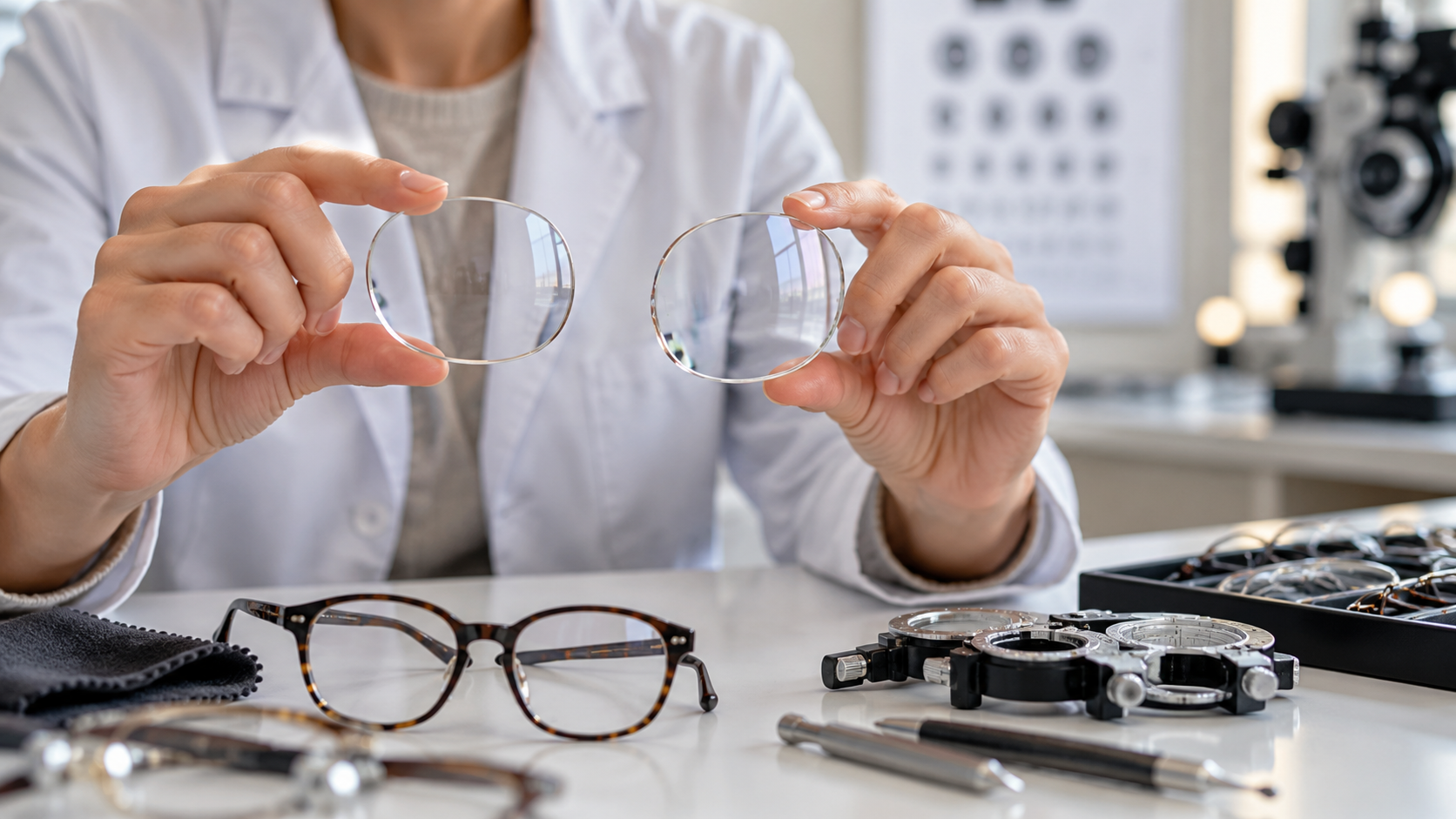
Eyeglass Lens Correction Explainer
Eyeglass lenses correct blurry vision by changing the direction of light before it enters the eye. The cornea and the natural lens normally bend incoming rays so they converge on the retina, the light-sensitive tissue at the back of the eye. A refractive error occurs when the optical power and the eye’s length or shape do not match. The image would focus in front of, behind, or unevenly across the retina. A prescribed eyeglass lens adds precisely controlled optical power so the combined system brings light closer to the proper focus.
Nearsightedness, or myopia, usually means distant light focuses in front of the retina. A minus-power lens is thinner in the center and causes rays to diverge slightly before the eye focuses them. Farsightedness, or hyperopia, can require a plus-power lens that is thicker in the center and begins converging the rays. Presbyopia is the age-related loss of the eye’s ability to focus up close; reading additions provide extra plus power for near work. These lenses improve focus while worn but do not weaken, strengthen, or permanently reshape the eye.
Astigmatism occurs when different meridians of the eye have different focusing power, often because the cornea or natural lens is not equally curved in every direction. A cylindrical lens adds power primarily along a specified orientation. A prescription records that amount as cylinder and gives an axis indicating its direction. The sphere value handles the eye’s general near- or farsighted component. Because orientation matters, a lens with astigmatism correction must be mounted accurately in the frame and remain aligned in front of the eye.
Multifocal lenses supply different powers for different viewing distances. A bifocal places a distinct near segment below the distance area. A progressive lens changes power gradually from distance through intermediate to near zones, avoiding a visible dividing line but creating narrower side regions and more sensitivity to frame fit. The wearer points the eyes through the appropriate part of the lens and may need time to adapt. No design gives every distance the entire lens area, so the choice balances task, posture, field of view, and appearance.
The prescription is only part of the finished optical system. Pupillary distance and fitting height position each lens’s optical center relative to the eyes. Frame tilt, wrap, and distance from the cornea can matter, especially with stronger powers. Lens material affects thickness, weight, impact resistance, and optical behavior. Anti-reflective coatings reduce surface reflections; scratch-resistant and ultraviolet treatments serve different functions. A thin high-index lens can improve appearance but does not change the underlying prescription, and every material has tradeoffs in cost and optical characteristics.
Clear vision also depends on eye health, not just refraction. A current examination can distinguish an ordinary focus problem from cataract, retinal disease, corneal disorder, medication effects, or other causes of visual change. Ready-made reading glasses provide the same power in both eyes and do not correct astigmatism, unequal prescriptions, or distance problems. Proper glasses are therefore a measured optical correction, not a generic magnifier. They redirect light in a predictable way so the eye can form a sharper retinal image with less compensating effort.
Eyeglass lenses add optical power that bends light toward the retina. Key terms include refraction, retina, myopia, hyperopia, presbyopia, astigmatism, sphere, cylinder, axis, optical center, and progressive lens.
No. Glasses improve focus while they are worn but do not weaken the eyes. A changing prescription usually reflects changes in the eye, not dependence caused by the lenses.
The optical center and any cylindrical or progressive zones must align with the wearer’s pupils and frame position. Misalignment can reduce clarity or create discomfort.
Explore more "Explainers"
Discover additional explainers across politics, science, business, technology, and other fields. Each explainer breaks down a complex idea into clear, everyday language—helping you better understand how major concepts, systems, and debates shape the world around us.