

Food Thermometer Measurement Explainer
A food thermometer measures temperature by using a material whose physical or electrical behavior changes predictably as it warms or cools. The probe reaches into the food, and the sensing element converts local temperature into movement or an electrical signal. A display or dial translates that response into degrees. The instrument does not directly detect whether bacteria are present or whether food looks done. It measures temperature at the sensor, which is why the type of thermometer, insertion depth, response time, and exact placement determine whether the reading represents the food’s coldest important area.
Digital instant-read thermometers commonly use a thermistor or thermocouple. A thermistor changes electrical resistance with temperature; electronics measure that resistance and calculate a value. A thermocouple joins two different metals and produces a small voltage related to the temperature difference, allowing a very small tip and fast response. Dial bimetal thermometers bond two metals that expand at different rates. As the probe warms, the bonded strip or coil bends and turns a pointer. Because its sensing region may extend several centimeters up the stem, it is less suitable for thin foods.
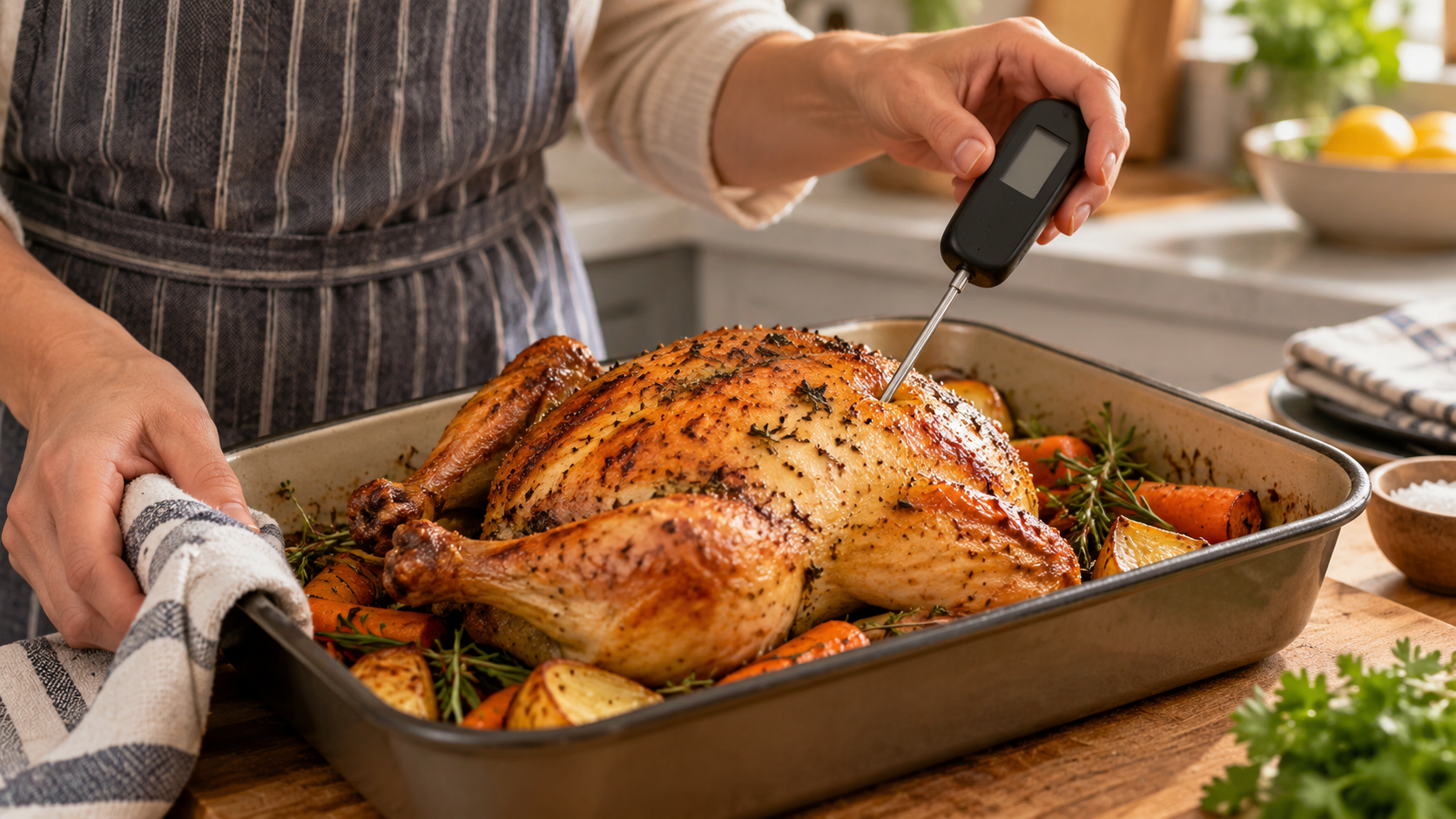
Correct placement is as important as the technology. The sensor should reach the thickest part of meat, poultry, casseroles, or other food without touching bone, a pan, or a large pocket of fat. Thin items may need a side insertion so the sensing area lies in the center. Large or irregular foods should be checked in several locations, and separate pieces can heat at different rates. For a digital probe, the instructions identify how much of the tip must enter; for a bimetal dial, a dimple often marks the end of its longer sensing zone.
A reading takes time because the sensor and surrounding food must approach thermal equilibrium. Fast probes may stabilize in a few seconds, while bimetal models can take much longer. Pulling the probe out too soon captures a value that is still changing. Steam, hot pan surfaces, and oven air can also affect exposed parts. Leave-in probes are built to remain during cooking, but ordinary instant-read models may not tolerate oven heat. Likewise, most probes are not microwave-safe unless their instructions explicitly say they are designed for that use.
Calibration checks whether the instrument reads a known reference closely enough. An ice-water slurry provides a convenient low-temperature reference when the sensing area is immersed without touching the container. Boiling water is another reference, but its temperature changes with altitude and atmospheric pressure. Some dial instruments have an adjustment nut, while many digital models offer a calibration function or must be replaced if they are substantially inaccurate. A calibration test does not compensate for poor placement, slow response, a damaged probe, or using the wrong model for the food.
Food-safety guidance assigns minimum internal temperatures to particular foods because heat exposure reduces harmful microorganisms. Color, grill marks, juice clarity, and texture are unreliable substitutes for measurement. The thermometer must be cleaned before and after use as its instructions direct so the probe does not transfer contamination. A useful routine is to check the coldest likely spots near the end of cooking, wait for a stable value, and compare it with current guidance. The tool turns an invisible condition into evidence, but reliable evidence depends on an appropriate sensor used correctly.
Food thermometers translate a predictable sensor change into a temperature reading. Key terms include probe, sensing zone, thermistor, thermocouple, bimetal, resistance, voltage, response time, calibration, and thermal equilibrium.
Food heats unevenly because thickness, shape, fat, bone, and distance from the heat source vary. Check the thickest and coldest likely areas rather than relying on one convenient point.
No. Only models designed as leave-in thermometers should remain during cooking. Many instant-read probes and displays can be damaged by sustained oven or microwave exposure.
Explore more "Explainers"
Discover additional explainers across politics, science, business, technology, and other fields. Each explainer breaks down a complex idea into clear, everyday language—helping you better understand how major concepts, systems, and debates shape the world around us.