

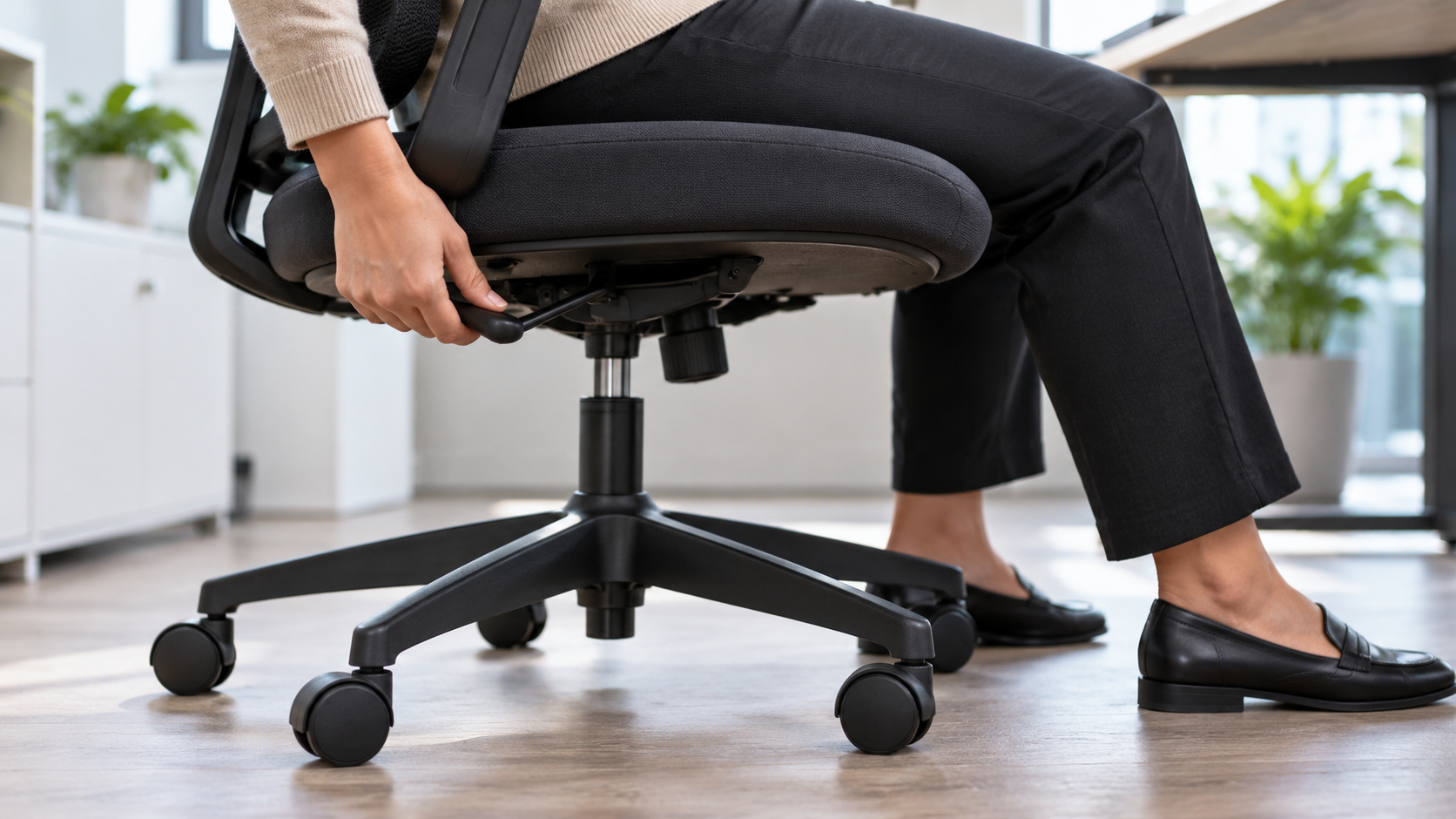
Gas-Lift Chair Height Explainer
A gas-lift office chair changes height through a sealed telescoping cylinder mounted between the base and seat. Inside, compressed gas and a piston provide an upward spring force. The seat lever does not pump new gas into the chair. A linkage presses a small valve pin at the top of the cylinder, connecting internal chambers so the piston can move. If a person’s weight exceeds the upward force and friction, the seat descends. If the seat is unloaded, compressed gas extends the piston and raises it.
Pressure acts across the piston’s effective area, creating force. The relationship is commonly summarized as force equals pressure times area. The user and chair load push downward, while gas pressure pushes the moving rod and seat upward. A small amount of oil may lubricate seals and damp motion, depending on the cylinder design. Because gas compresses, the support has some springiness; because oil moves through restricted passages, movement can be controlled rather than bouncing freely. The exact internal arrangement varies by manufacturer.
Releasing the lever lets the valve close. Trapped gas and oil can no longer redistribute through the control passage, so hydraulic resistance, seals, and the closed valve hold the piston at the chosen extension. The cylinder is not literally locked by an external pin at every height. It is a pressure device with a valve that restricts flow. Rotation usually comes from bearings and the chair’s mounting structure rather than the height valve, and seat tilt uses a separate spring and mechanism under the seat.
The cylinder also contains mechanical end stops and overlapping telescoping sections so the piston cannot extend or collapse indefinitely. The five-star base spreads the load and keeps the combined center of mass within a broad support area. A chair rated for a particular load matches cylinder force, structure, casters, and tilt mechanism to that range. Sitting abruptly, standing on the seat, using missing casters, or exceeding the rating creates loads far beyond ordinary height adjustment and can overturn or damage the chair.
A chair that slowly sinks usually has leakage past an internal seal or valve, not gas that merely needs a casual household refill. A chair that will not move may have a misadjusted actuator, a jammed mechanism, side loading, corrosion, or a failed cylinder. Lubricating exposed chair pivots will not repair a sealed pressure component. Replacement cylinders must match dimensions, taper fittings, stroke, load, and chair design. Separation can be difficult because tapered joints grip tightly after long use.
The cylinder is a pressurized assembly and should not be drilled, punctured, heated, cut, or disassembled. Those actions can release stored energy, oil, or fragments. Repairs should follow the chair maker’s instructions or use a qualified technician, and removed cylinders should be handled through appropriate local disposal channels. In normal use, the mechanism is simple: press the lever to open a valve, unload the seat to rise or remain seated to lower, then release the lever to trap the fluid and hold the selected height.
A gas-lift chair uses a sealed gas spring whose valve is opened by the seat lever. Key terms include compressed gas, pressure, piston, telescoping cylinder, valve pin, actuator, seal, damping, end stop, load rating, and stored energy.
With the valve open and little downward load, internal gas pressure extends the piston. Sitting adds enough weight to move it in the opposite direction.
No. It is a sealed pressurized component. Drilling, heating, or dismantling can release stored energy dangerously; use a compatible replacement and approved service method.
Explore more "Explainers"
Discover additional explainers across politics, science, business, technology, and other fields. Each explainer breaks down a complex idea into clear, everyday language—helping you better understand how major concepts, systems, and debates shape the world around us.