

Hook-and-Loop Fastener Explainer
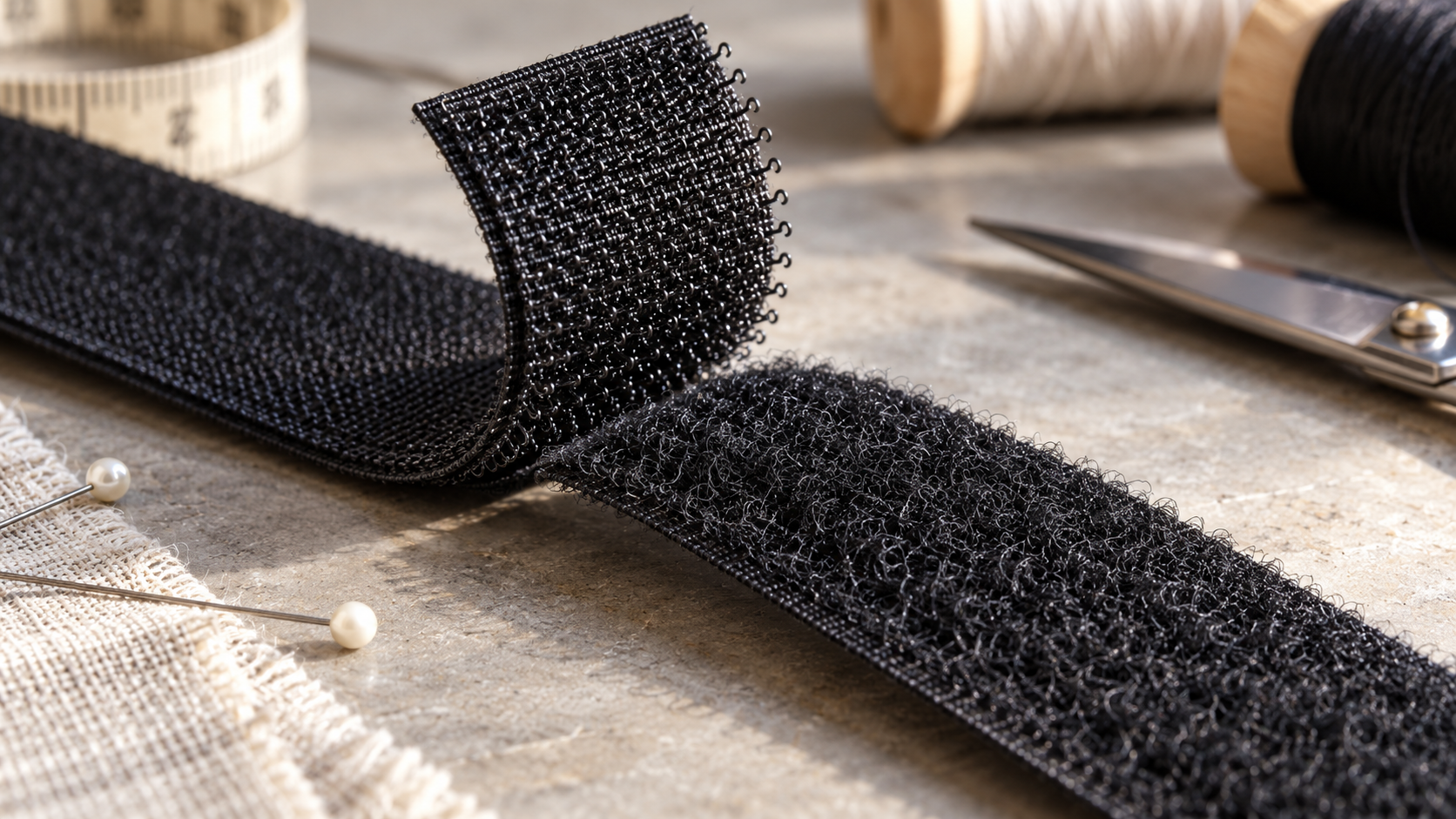
A hook-and-loop fastener uses two different textile surfaces. One side carries many small stiff hooks; the other presents a dense field of soft loops. Pressing the surfaces together pushes hooks into the loop field. As the parts settle, individual hooks catch individual loops. Any one connection is weak, but thousands can engage at once and share the applied load. The result holds ordinary clothing, straps, panels, and organizers while remaining intentionally reusable.
The direction of force changes how strong the closure feels. Pulling the surfaces sideways places many engaged hooks in shear at the same time, so a broad area resists movement. Peeling from one edge concentrates force along a narrow moving line. Only a small group of hooks releases at each moment, making separation much easier and producing the familiar ripping sound. Designers exploit this difference by orienting closures so service loads act mostly in shear while a user opens them by peeling.
Hooks can be woven, molded, or formed from monofilament. Their shape, stiffness, height, density, and material determine how deeply they enter the loop pile and how much force bends them free. Loops may be continuous, brushed, knitted, or nonwoven. Fine hooks work with low-profile fabric; larger hooks tolerate coarser loops and debris but can feel harsher. Flexible backing lets the fastener follow clothing, while rigid backing supports panels and equipment.
Pressing matters because hooks must physically enter the loop field. A closure touched lightly or joined at an angle engages fewer points than one pressed across its full area. Curvature, seams, dirt, and tension can reduce contact. The system also has separate ratings for peel, shear, and repeated cycling, so a product described as strong in one direction may not suit another. Adhesive backing attaches the fastener to a surface but is a different interface with its own temperature and cleaning limits.
Repeated opening gradually bends hooks, breaks loops, and leaves loose fibers. Lint and hair occupy the same spaces that hooks need, lowering engagement. Debris can often be removed gently with a fine comb or tweezers after the item is detached, while laundering follows the product instructions with the closure joined to reduce snagging. Heat can deform plastic hooks, and cutting through a strip may release woven edges unless they are finished.
The fastener’s success comes from multiplication and geometry rather than a powerful adhesive. Many microscopic mechanical catches provide a large combined resistance, yet edge peeling releases them sequentially without destroying the whole surface. That also explains its limits: a closure can rattle under vibration, clog with debris, wear after cycles, or open when the load creates peeling. Selecting the correct type and area means matching how the real object will pull, bend, wash, and age.
Thousands of tiny hooks catch flexible loops when the two surfaces are pressed together. Key terms include hook field, loop pile, engagement, shear, peel, cycle life, backing, and adhesive.
Peeling releases only a narrow row of hooks at a time. Sliding loads many connections across the entire area simultaneously, creating much greater resistance.
Hooks bend, loops break, and lint occupies engagement space. Heat, poor alignment, and repeated cycling can all reduce the number of active connections.
Explore more "Explainers"
Discover additional explainers across politics, science, business, technology, and other fields. Each explainer breaks down a complex idea into clear, everyday language—helping you better understand how major concepts, systems, and debates shape the world around us.