

Elevator Counterweight Explainer
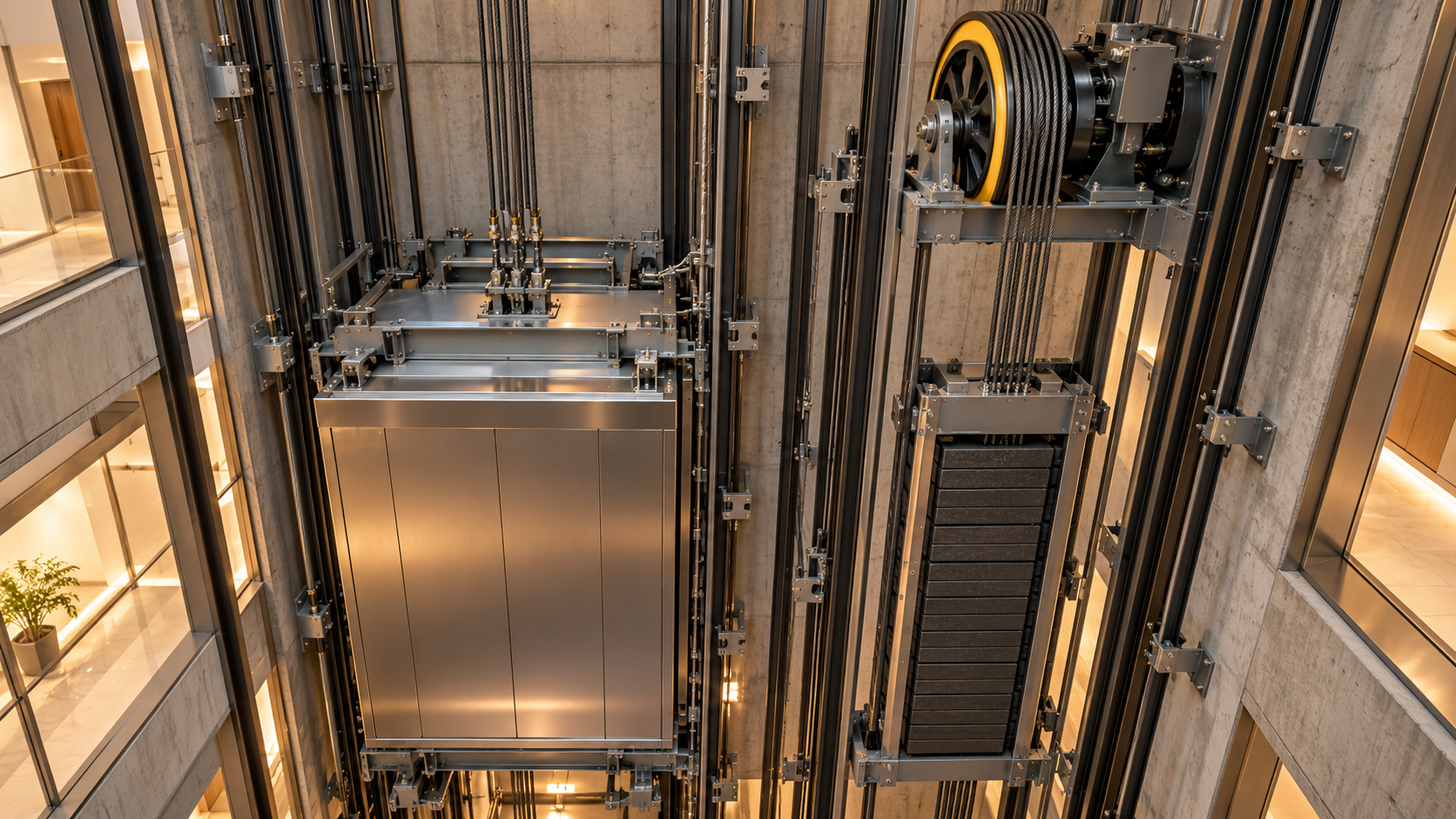
In a traction elevator, steel ropes or coated belts pass over a powered sheave with the car on one side and a counterweight on the other. The counterweight is commonly sized to balance the empty car plus a portion of the rated passenger load. When the car rises, the counterweight descends, and vice versa. The motor therefore does not repeatedly lift the entire car from rest; it mainly overcomes the imbalance between the two sides, friction, and acceleration.
The drive sheave grips the suspension members through traction rather than winding all of the rope onto a drum. Turning the sheave moves both car and counterweight in opposite directions. Guide rails keep each mass on a controlled vertical path. If the car is lightly loaded, the counterweight side may be heavier and the motor restrains or drives accordingly. With a heavily loaded car, the car side may be heavier. Modern drives can sometimes regenerate energy during favorable motion.
Balancing cannot be exact for every trip because passenger load changes. Designers choose a counterweight fraction that reduces average energy and motor size without creating excessive imbalance at either extreme. Rope arrangements may provide a one-to-one or two-to-one relationship between sheave movement and car travel. Compensation ropes or chains can offset the changing weight of long suspension ropes in tall buildings, where many meters shift from one side of the sheave to the other.
The counterweight does not make the car float freely. A brake on the machine holds the system at a landing, and the controller applies torque to start, accelerate, cruise, decelerate, and level. Door interlocks prevent ordinary travel with an unsafe opening. An overspeed governor can trigger safety gear that grips the guide rails if car speed exceeds a limit. Buffers at the pit provide another protective layer. Each device has a distinct role beyond the energy-balancing function.
Elevator hoistways and machinery are not user-serviceable spaces. Counterweights, ropes, stored gravitational energy, and automatic controls create severe hazards even when a car appears parked. Inspection, rescue, and repair belong to trained personnel following lockout and code requirements. Passengers should use the alarm or communication system if stranded and never force doors or climb out without authorized assistance. Unusual leveling, noise, or motion should be reported promptly.
The counterweight is best understood as an energy partner. As one mass gains gravitational potential energy, the other gives some up, so the motor handles the difference rather than the full car weight. The sheave converts motor torque into coordinated opposite travel, and controls shape that travel safely. This balance improves efficiency and ride performance, but it works only as one part of a layered system of suspension, guidance, braking, sensing, and maintenance.
The counterweight balances the car plus part of its expected load, so the motor mainly moves the difference between the two sides. Key terms include traction sheave, suspension rope, counterweight, imbalance, guide rail, brake, governor, and regeneration.
Usually it equals the car plus a selected fraction of rated load, which reduces average energy even though passenger weight changes from trip to trip.
A machine brake holds the drive when stopped. The counterweight reduces imbalance but is not the parking or emergency brake.
Explore more "Explainers"
Discover additional explainers across politics, science, business, technology, and other fields. Each explainer breaks down a complex idea into clear, everyday language—helping you better understand how major concepts, systems, and debates shape the world around us.