

Cat Whisker Sensory System Explainer
A cat’s whiskers, or vibrissae, are specialized tactile hairs much thicker and stiffer than ordinary fur. The exposed shaft itself is keratin and has no nerves, but it sits deeply in a follicle surrounded by blood-filled tissue and many sensory nerve endings. When the shaft touches an object or bends with movement, force reaches that sensitive base. Nerve signals tell the brain about direction, timing, and degree of deflection near the face.
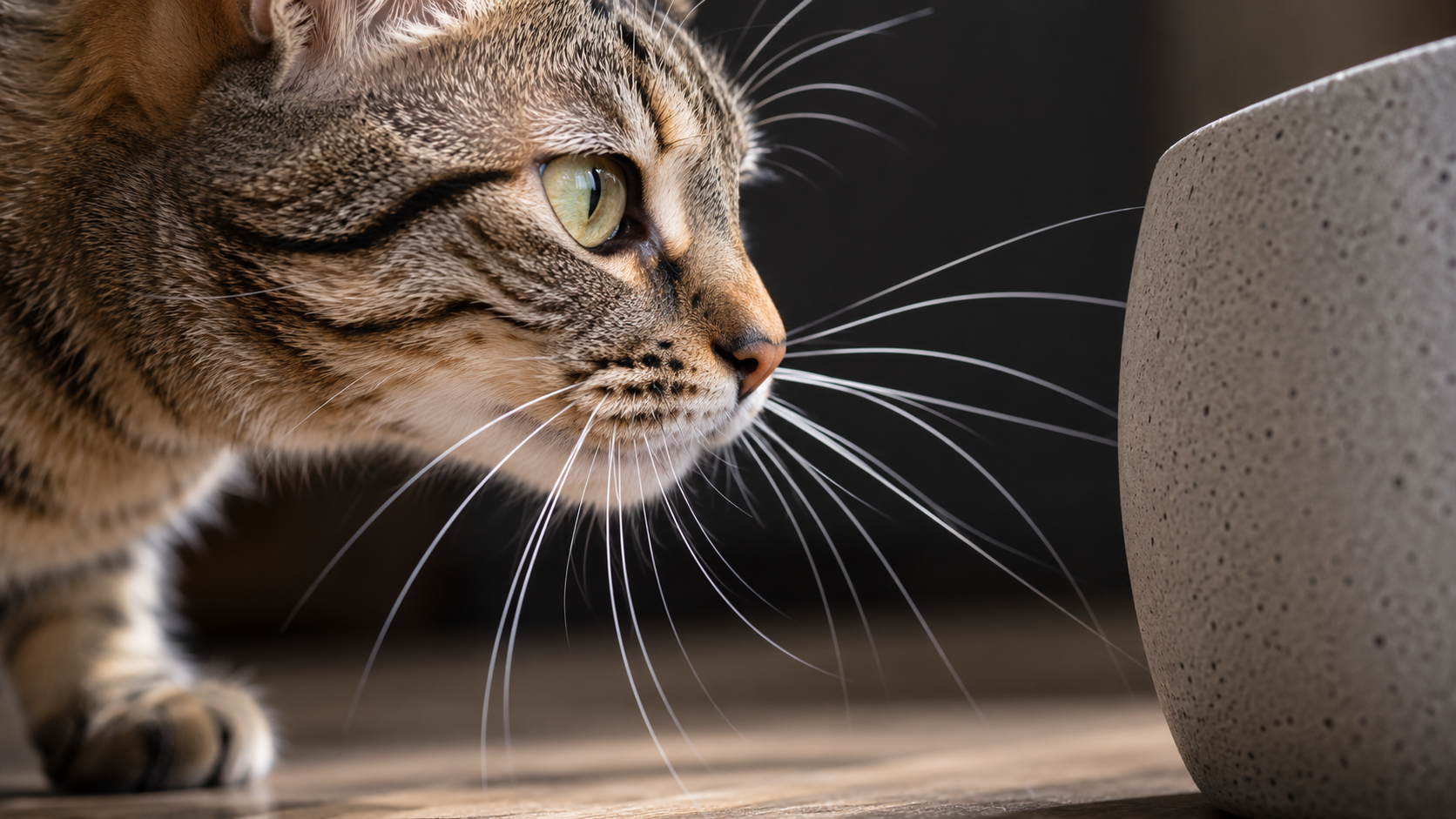
The longest facial whiskers project beyond the muzzle, forming an early-contact zone in front of the eyes and nose. Whiskers above the eyes, on the cheeks, under the chin, and on the backs of the forelegs contribute information in different areas. Small muscles can move many facial whiskers forward or backward. The brain combines those signals with hearing, vision, body position, and movement rather than using whiskers as a simple tape measure.
Air motion can bend whiskers, but popular claims that they precisely map every room through air currents are often overstated. Their established role is tactile sensing at close range, including contact with surfaces, prey, and obstacles. They help protect vulnerable facial structures and support orientation where vision is limited. A cat approaching an opening may gain useful information when whiskers or fur touch the boundaries, but body width and flexibility cannot be inferred from one fixed whisker span alone.
Whisker position also reflects behavior. Forward, spread vibrissae may accompany focused investigation or hunting, while whiskers drawn back can appear with fear, defensive arousal, or efforts to protect the face. The meaning depends on ears, eyes, posture, tail, and context. A relaxed cat may hold its whiskers neutrally to the sides. Reading one feature in isolation can mislabel a normal expression or miss discomfort indicated by the whole body.
Whiskers should not be trimmed for appearance. Cutting removes the functioning length until the hair regrows and can reduce close-range tactile information, even though the cut shaft itself does not hurt like living tissue. A whisker that sheds naturally may be normal, but sudden widespread loss, broken whiskers with skin disease, swelling, or facial pain deserves veterinary attention. Bowls and carriers should allow comfortable access without unnecessarily pressing sensitive whisker bases.
The sensory system works as a lever connected to a biological detector. A distant touch bends the long shaft, the deep follicle amplifies and encodes that motion, and nerves send the result into brain networks that integrate several senses. Whiskers do not grant supernatural navigation, yet they provide fast, local information exactly where a cat’s eyes cannot focus well. Preserving them and observing their position respectfully supports both normal movement and communication.
A stiff whisker shaft acts as a lever; when it bends, movement reaches a deep follicle rich in sensory nerves. Key terms include vibrissa, keratin, follicle, mechanoreceptor, deflection, tactile sensing, proprioception, and arousal.
The exposed hair shaft has no nerves, but its deeply rooted follicle is richly innervated and sensitive to bending and pressure.
No. Trimming removes useful tactile reach until regrowth and can disrupt close-range information even though cutting the keratin shaft is not like cutting skin.
Explore more "Explainers"
Discover additional explainers across politics, science, business, technology, and other fields. Each explainer breaks down a complex idea into clear, everyday language—helping you better understand how major concepts, systems, and debates shape the world around us.