

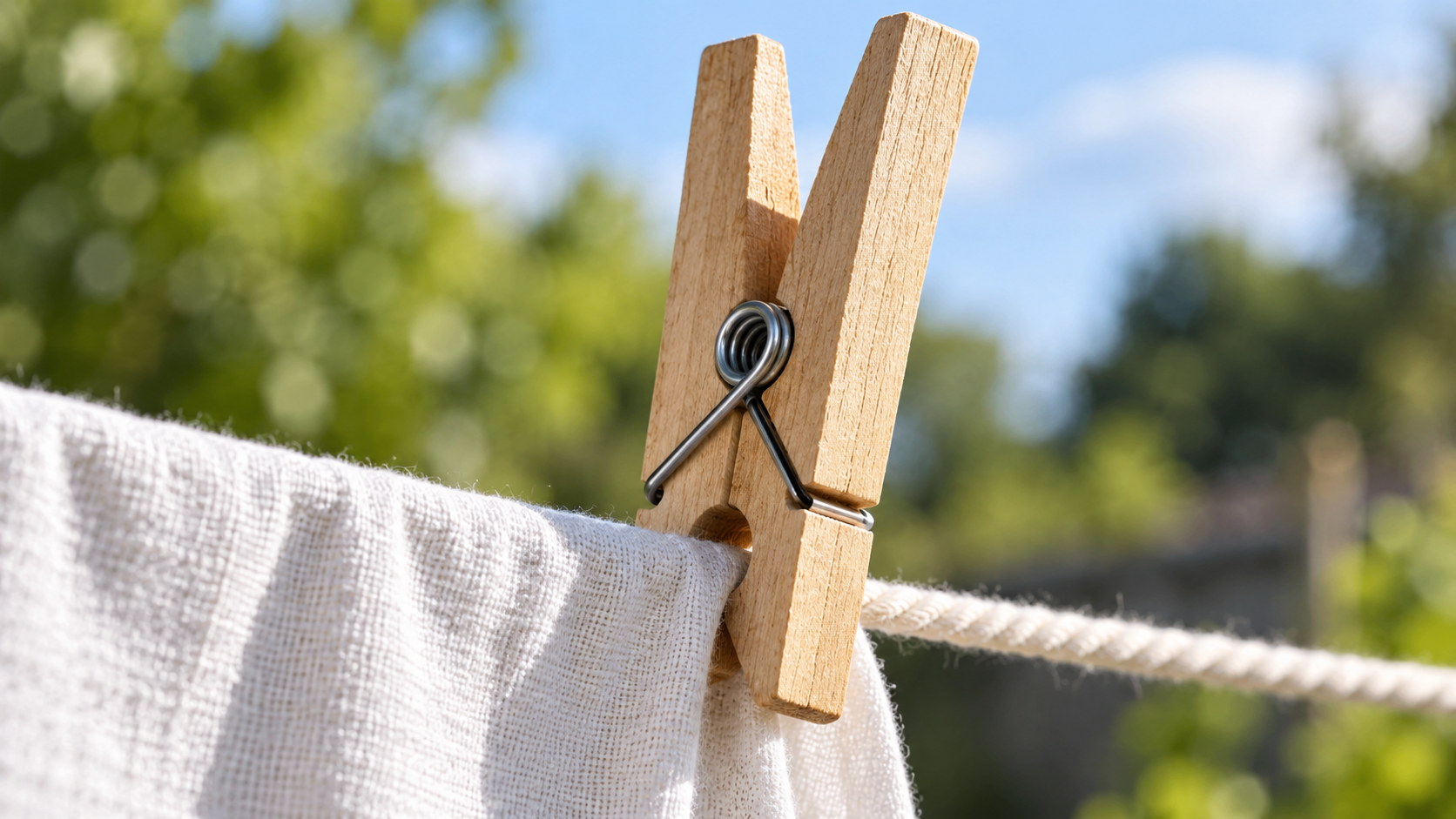
Spring Clothespin Explainer
A spring clothespin consists of two matching lever halves arranged around a coiled metal spring. The coil sits near the middle and acts as both pivot and energy store. Its two wire legs press against opposite halves, biasing the jaw ends together. When a user squeezes the handles, the halves rotate around the spring coil, the jaws separate, and the spring twists farther from its relaxed position. Releasing the handles lets stored torsional energy close the jaws again.
The handle ends are longer than the distance from the pivot to the jaw contact, giving the fingers useful leverage. A moderate squeeze at the handles can overcome spring torque and open the shorter jaw end. When closed, the spring applies normal force to fabric and clothesline. Friction at those contacts resists sliding, while curved grooves cradle the line and reduce the chance that a thin cord will escape sideways. Surface texture can improve grip without requiring extreme spring force.
The two wooden or plastic halves also guide one another. Grooves around the coil hold the spring in position, and shoulders prevent it from walking along the pivot. The wire legs must sit in the correct notches so their torque closes rather than opens the jaws. Because the coil itself bears against the halves, wear or swelling around this area can make movement rough. Identical mirrored parts make the classic design inexpensive to assemble and replace.
Grip depends on spring stiffness, lever geometry, jaw shape, and the thickness being clamped. A bulky folded towel holds the jaws farther apart and changes spring torque, while a very thin slick fabric offers little friction. Wind adds alternating load, and wet fabric is heavier than dry fabric. Spacing multiple pins shares load and limits flapping. Overstretching a pin around an object larger than its designed opening can permanently bend the spring or split the body.
Outdoor exposure affects every material. Steel springs can corrode, wood can swell or split, and ultraviolet light can embrittle plastic. Pins last longer when dried and stored out of weather between uses. Rust that stains fabric, sharp splinters, cracked plastic, or a spring that has slipped from its seat are reasons to discard the pin. The spring can snap free during disassembly, so repair attempts require eye protection and are rarely worthwhile for an ordinary household pin.
The clothespin is a small torsion-spring clamp operated through two first-class levers. Finger force opens the jaws and adds energy to the spring; releasing the handles returns that energy as clamping force. Jaw pressure alone is not enough—the fabric, line, grooves, and surface friction complete the hold. Its everyday usefulness comes from reversible mechanical advantage: easy one-handed opening, automatic closing, and a grip that remains without the user continuing to squeeze.
Two lever halves pivot around a coiled torsion spring. Squeezing the handles twists the spring and opens the jaws; releasing them restores clamping force. Key terms include lever, pivot, torsion spring, spring leg, jaw, normal force, friction, and mechanical advantage.
The longer handle arms provide leverage, so modest finger force can create enough torque to overcome the spring and separate the shorter jaw ends.
The grooves cradle the clothesline, increase contact, and help keep fabric and line centered instead of slipping sideways.
Explore more "Explainers"
Discover additional explainers across politics, science, business, technology, and other fields. Each explainer breaks down a complex idea into clear, everyday language—helping you better understand how major concepts, systems, and debates shape the world around us.