

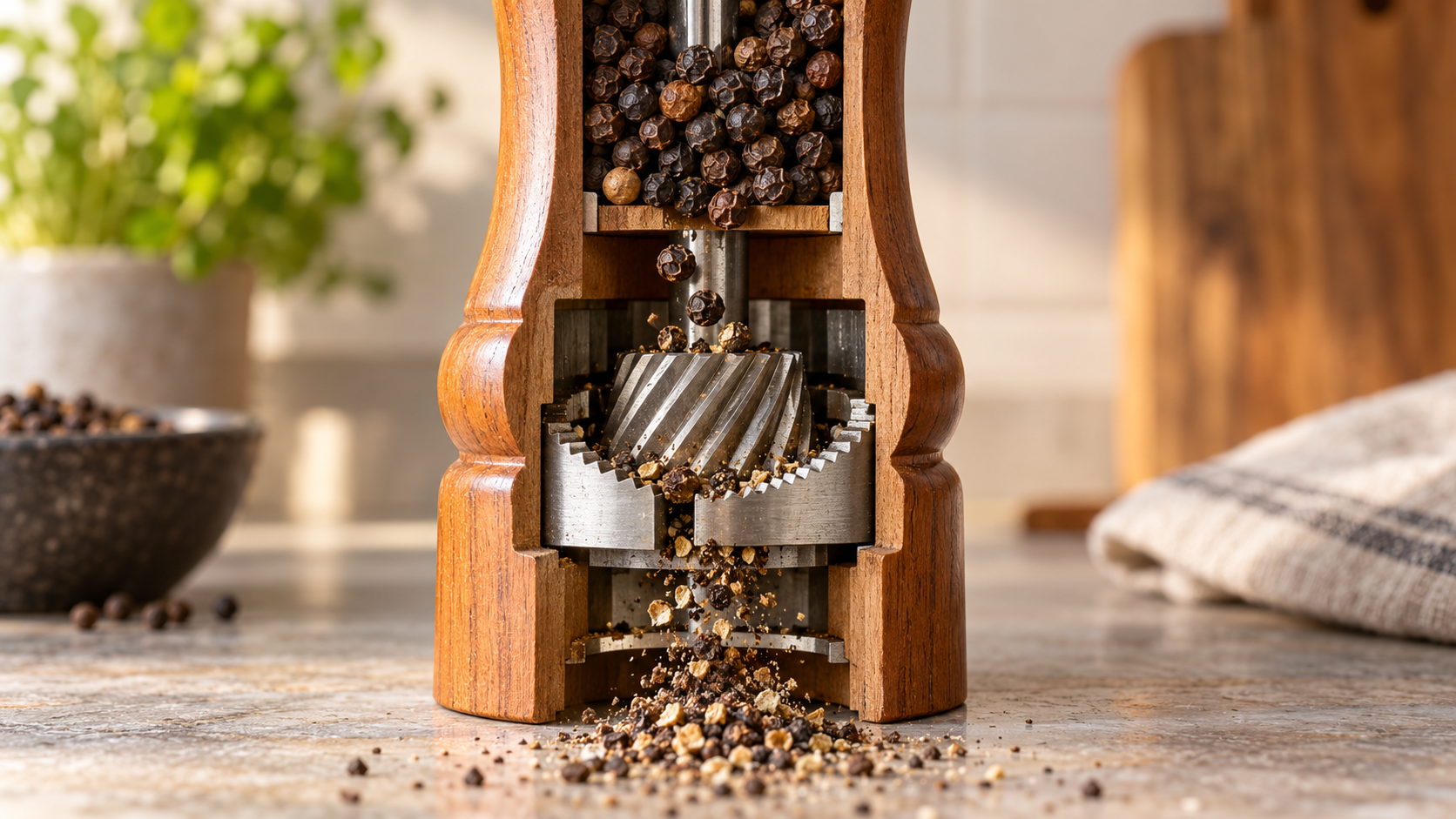
Pepper Mill Grinding Mechanism Explainer
A traditional pepper mill stores whole peppercorns above a pair of hard grinding surfaces. Turning the top rotates a central shaft connected to an inner burr, while an outer ring stays fixed in the mill body. Gravity feeds peppercorns into the narrowing gap between them. Raised teeth catch the rounded seeds, crack their outer shells, and pull the pieces farther into the mechanism.
The grinding gap becomes smaller toward the outlet. Large teeth near the entrance provide bite and coarse fracture; finer edges below crush and shear the fragments again. Pieces small enough to fit through the final clearance fall from the bottom. Because the burr works around its circumference, each turn presents many cutting contacts and processes several peppercorns rather than slicing one at a time.
An adjustment knob or collar changes the distance between the burrs. A wider final gap releases larger fragments for a coarse grind. A narrower gap keeps pieces inside for more repeated fracture and produces finer pepper, though it also requires more torque. The shaft must remain centered so clearance is reasonably even. Springs or shoulders keep the rotating burr seated while still allowing adjustment.
Burr material affects durability and feel. Hardened steel is tough and sharp; ceramic resists corrosion and is common in mills also intended for salt. Soft metal, plastic, or worn teeth may crush irregularly or slip on hard peppercorns. The body should keep moisture away from the spice because damp pepper can swell, cling to the feed path, and encourage corrosion or microbial growth.
Turning backward may not feed correctly unless the mill is designed for both directions. Overfilling, forcing the knob extremely tight, or grinding foreign objects can jam the burr or bend the shaft. Cleaning follows the manufacturer’s directions; soaking a wooden or metal mechanism can cause damage. If the mill becomes hard to turn, it should be emptied and inspected rather than driven with excessive force.
The pepper mill is a gravity-fed burr crusher. The hand supplies torque, the top and shaft carry it to the inner burr, and opposing teeth convert rotation into concentrated compressive and shear forces. The tapered gap sorts particles by size as they move downward. Adjustment changes that final opening, letting one compact mechanism produce anything from cracked pepper to a relatively fine seasoning.
A rotating inner burr pulls peppercorns against a fixed toothed ring, cracking them repeatedly until particles fit through the adjustable lower gap. Key terms include burr, ring, shaft, torque, feed, shear, clearance, and grind size.
It changes the spacing between the burrs near the outlet. A wider gap releases larger pieces, while a narrow gap keeps them grinding longer.
Moisture makes particles cling and can swell plant material, restricting gravity feed and packing the small spaces between burr teeth.
Explore more "Explainers"
Discover additional explainers across politics, science, business, technology, and other fields. Each explainer breaks down a complex idea into clear, everyday language—helping you better understand how major concepts, systems, and debates shape the world around us.