

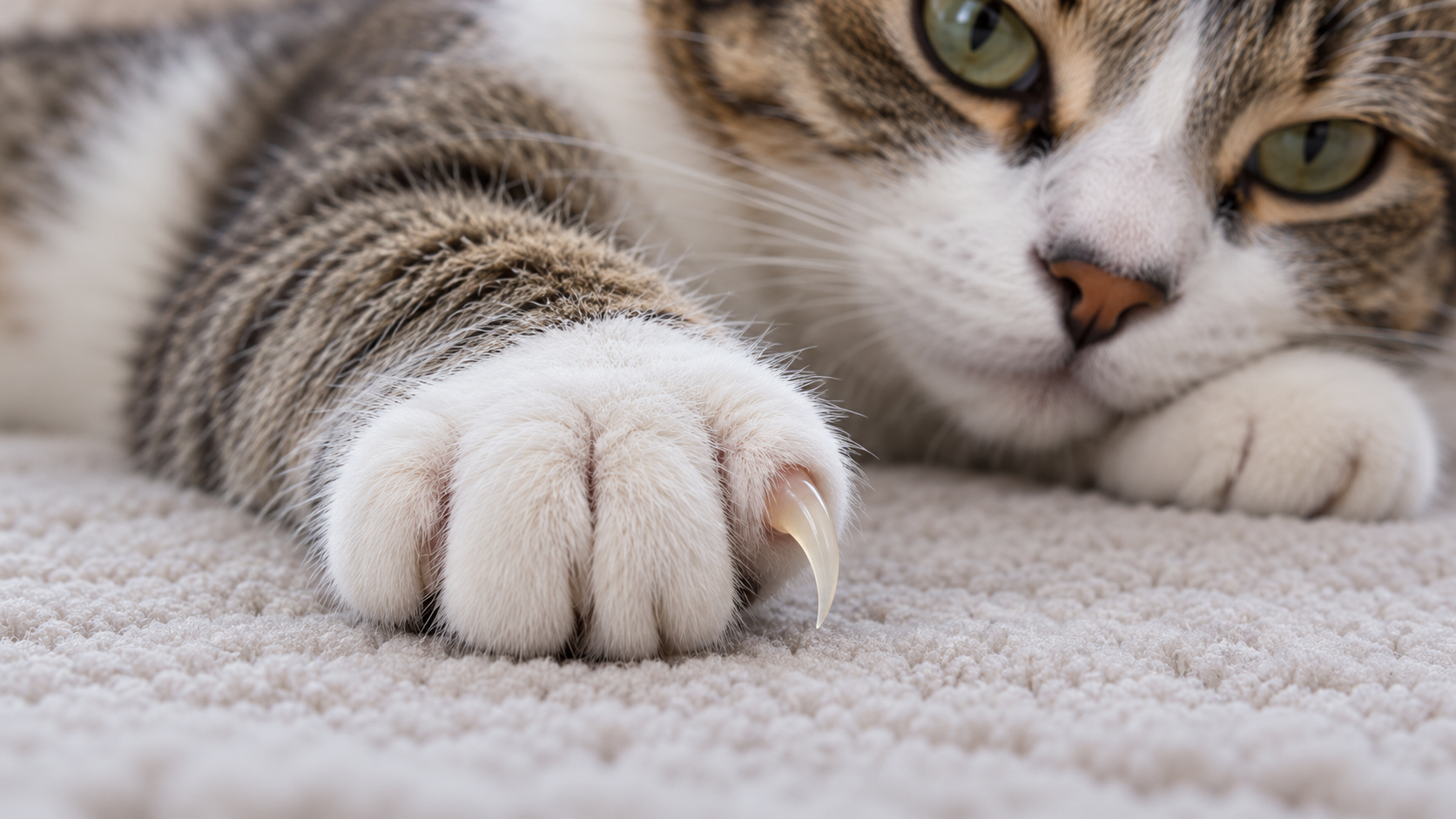
Cat Claw Retraction Explainer
A cat’s claw grows from the last bone of each toe, called the distal or ungual phalanx. In the relaxed paw, that bone is rotated to the side and upward relative to the middle phalanx, placing the claw in a protective retracted position beside the toe. The claw is not pulled straight backward into a hollow tube; the entire terminal bone pivots around its joint.
Elastic ligaments help hold the distal phalanx in its resting orientation. When the cat activates digital flexor muscles, tendons running along the underside of the paw pull on the terminal bones. Tendon tension overcomes the elastic restraint and rotates the claws forward and downward. Relaxing those muscles lets the ligaments return the bones toward the retracted position.
Retraction reduces contact with the ground during ordinary walking, helping preserve a sharp tip and quiet footfall. Cats extend claws for traction, climbing, catching, defense, stretching, and scratching. The dewclaw and the exact mechanics vary by digit. Cheetahs and some other felids have less complete retraction, showing that the familiar domestic-cat arrangement is one version within a broader anatomical range.
The visible claw is keratin, not bone. New material grows from living tissue near its base, and outer layers form curved sheaths. Scratching helps remove loose outer sheaths and conditions the claws while also serving stretching and communication behaviors. Finding a hollow-looking shed sheath is therefore normal; it is not usually the whole claw. The living quick inside a claw contains nerves and blood vessels.
Claws can become overgrown, split, infected, or caught, particularly in older cats that scratch less. Trimming should remove only the clear hooked tip and avoid the quick, using appropriate tools and calm handling. Declawing is not ordinary trimming; it removes the terminal toe bones and is a major surgical procedure. Veterinary guidance is appropriate for pain, bleeding, swelling, altered gait, or uncertain anatomy.
Retraction is a tendon-and-spring system built around a rotating bone. Muscles provide the active pull that presents the claw, ligaments provide passive return, and joint geometry tucks the resting claw away from the walking surface. This arrangement protects a renewable keratin tool without disconnecting it from the skeleton that supports force during a climb, grasp, or scratch.
Flexor tendons rotate the claw-bearing terminal toe bone forward; elastic ligaments return it to a retracted position when the muscles relax. Key terms include distal phalanx, ungual phalanx, tendon, ligament, flexor, joint, sheath, keratin, and quick.
No. The terminal bone pivots so the claw rests beside and above the toe, partly covered by skin and fur rather than telescoping backward.
They are usually shed outer keratin sheaths. Scratching helps loosen these old layers as the claw continues growing from its base.
Explore more "Explainers"
Discover additional explainers across politics, science, business, technology, and other fields. Each explainer breaks down a complex idea into clear, everyday language—helping you better understand how major concepts, systems, and debates shape the world around us.