

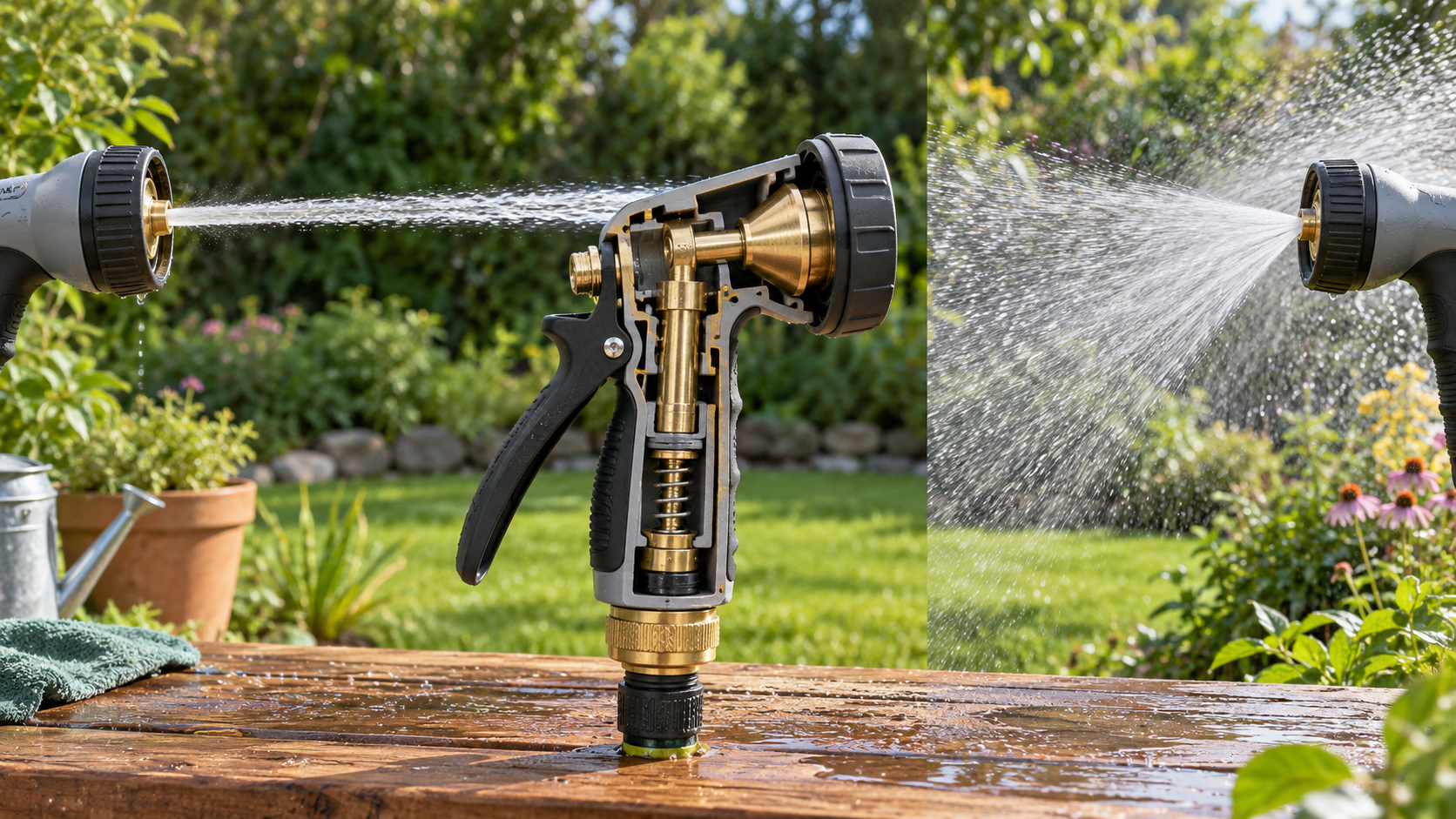
Adjustable Garden Hose Nozzle Explainer
An adjustable garden hose nozzle changes a pressurized flow into different patterns by altering the passage that water follows near the outlet. Water arrives through the handle and passes a shutoff or throttling valve. At the front, a rotating sleeve, movable cone, or indexed pattern plate changes the opening and the surface that the stream strikes. The same supply can therefore leave as a concentrated jet, broad fan, hollow cone, or scattered shower.
A narrow jet forms when water is directed through a relatively small, aligned opening. The restricted cross-section increases exit speed for a given flow and keeps the stream together over a useful distance. Moving a cone-shaped deflector closer to that opening forces the water outward into a thin sheet. As the sheet spreads and breaks into droplets, the pattern becomes wider and gentler. Multiple small holes can divide the flow into a shower instead.
The trigger usually operates a separate valve rather than selecting the pattern by itself. Squeezing the trigger moves a valve stem or plug away from a seat, increasing the area available for flow. A spring closes the valve when the hand releases it. Some nozzles include a clip or ratchet that holds a selected trigger position. That changes the amount of water, while the front adjustment primarily changes its distribution and direction.
Pressure and flow are related but not identical. A household hose supplies water at a pressure set by the plumbing system, yet long hoses, small fittings, and partially closed valves reduce the pressure available at the nozzle. A fine mist or long jet may collapse when flow is too low. Excessive pressure can make a narrow setting harsh and increase leakage, which is why washers, valve seats, and threaded connections must remain intact.
Mineral deposits and grit often cause uneven spray. Debris can block small passages, scratch a valve seat, or keep the rotating parts from reaching their intended position. Cleaning follows the nozzle maker’s instructions, with the water shut off and pressure relieved. Freezing water trapped inside can expand and crack the body. A nozzle should not be aimed at people, animals, fragile plants, windows, or electrical equipment merely because the pattern appears soft.
The nozzle is a small fluid-shaping machine. Its inlet accepts the hose flow, its trigger meters that flow, and its front geometry turns one moving column of water into a chosen distribution. Narrow openings favor reach and speed, while deflectors and hole arrays spread the same moving water across a larger area. The useful setting depends on supply pressure, distance, and the surface being watered, so pattern and flow are adjusted together rather than independently.
The nozzle changes outlet geometry: a valve meters flow, while a movable cone, sleeve, or perforated plate redirects water into a jet, fan, cone, or shower. Key terms include pressure, flow, valve seat, orifice, deflector, atomization, trigger, and washer.
No. Pattern width and total flow are different. The trigger valve and supply pressure largely control flow, while the front adjustment shapes the exiting water.
Grit, mineral scale, damaged seals, or low supply pressure can disturb the small passages and prevent a balanced pattern.
Explore more "Explainers"
Discover additional explainers across politics, science, business, technology, and other fields. Each explainer breaks down a complex idea into clear, everyday language—helping you better understand how major concepts, systems, and debates shape the world around us.