

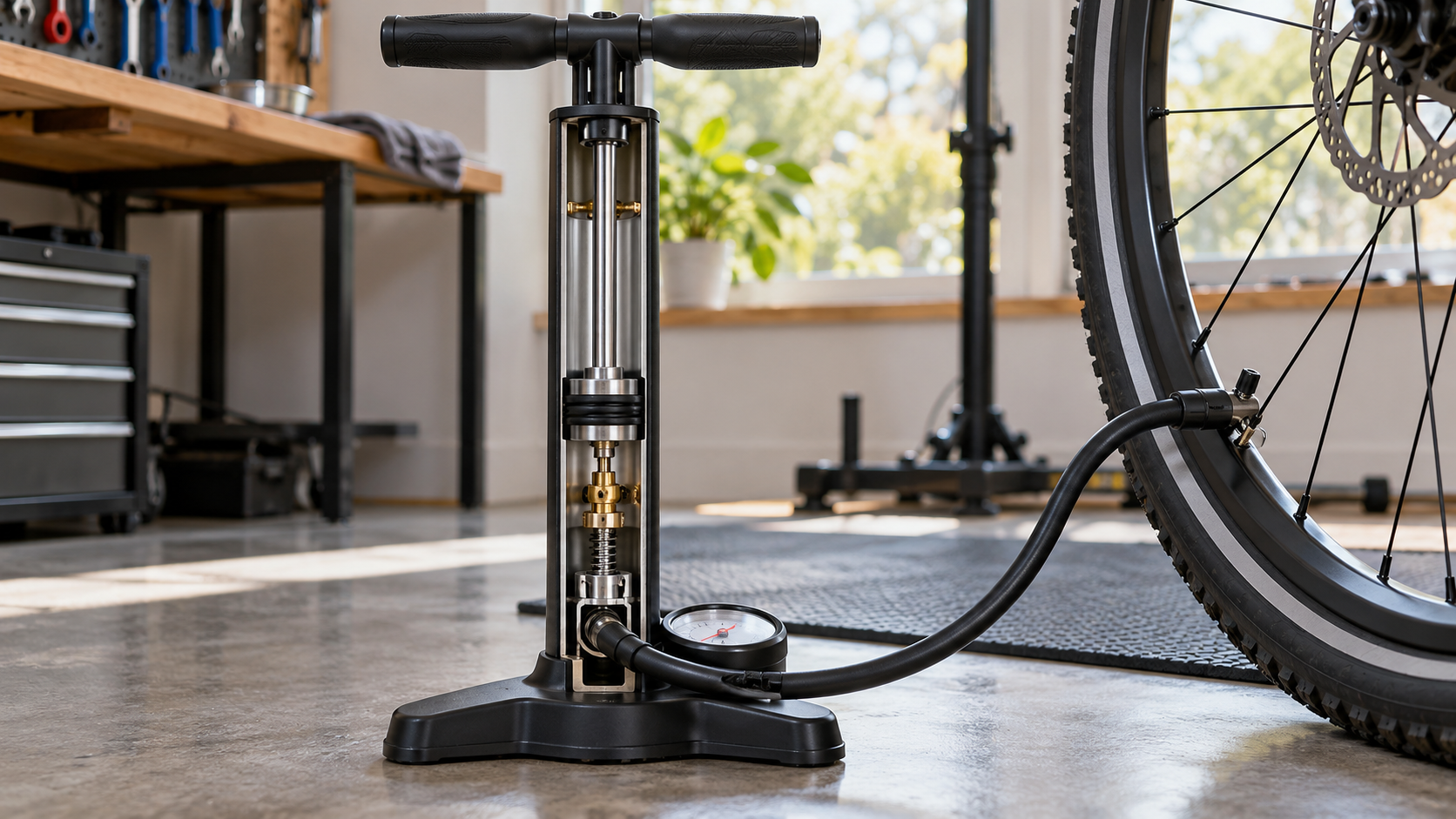
Bicycle Pump Compression Explainer
A bicycle pump is a hand-powered positive-displacement compressor. Pulling the handle raises a piston inside a cylinder and increases the volume beneath it. The resulting pressure drop opens an inlet path and draws room air into the chamber. Pushing the handle down reduces the chamber volume and compresses that trapped air. When its pressure becomes higher than the tire pressure, the outlet path opens and air moves through the hose into the tube or tubeless tire.
One-way valves keep the air moving in the intended sequence. During the intake stroke, the inlet opens while the outlet remains closed so tire air does not flow backward. During compression, the inlet closes and the outlet opens only after the pump chamber exceeds downstream pressure. Some designs use a flexible piston seal that changes shape to serve as part of the valve action. The tire valve itself also closes when pressure is not entering.
As the tire fills, every compression stroke begins against a higher downstream pressure. The handle therefore becomes harder to push, particularly near the bottom where air is compressed into a small space. A narrow pump cylinder moves less air per stroke but can reach high pressure with less handle force; a wider cylinder moves more volume but requires more force at the same pressure. Floor pumps use a stable base and long stroke for efficiency.
The chuck makes an airtight connection to a Presta, Schrader, or other compatible valve. Its gasket must seal around the valve without bending the stem. A gauge measures pressure in the connected system, although placement, friction, and calibration introduce some error. Tire pressure is checked cold against the bicycle and tire guidance, using the appropriate range for tire size, load, surface, and construction rather than automatically inflating to the maximum sidewall marking.
Heat and dead space affect the reading. Repeated compression warms the air in the pump and hose, and warm air pressure falls somewhat as it cools. Air remaining below the piston or in the hose cannot always be delivered, especially at high pressure. Worn seals cause air to bypass the piston, cracked hoses leak, and a dirty chuck can lose its grip. A pump that suddenly offers no resistance may have a valve or seal problem.
Each complete stroke is a controlled transfer of a fixed air volume. Expansion draws air in, compression raises its pressure, and check valves prevent reverse flow. Repetition adds more air molecules to the tire until its internal pressure supports the load and tire shape. The pump does not push pressure as a separate substance; it performs mechanical work on air, and the confined tire stores that work as compressed gas pressing on its walls.
A piston draws air into a cylinder, compresses it, and sends it through one-way valves when pump pressure exceeds tire pressure. Key terms include piston, cylinder, seal, check valve, positive displacement, chuck, gauge, and pressure.
The piston must compress air above a progressively higher tire pressure, so the same piston area requires more handle force.
Their smaller piston area reduces the force needed at high pressure, but the smaller cylinder volume displaces less air on each cycle.
Explore more "Explainers"
Discover additional explainers across politics, science, business, technology, and other fields. Each explainer breaks down a complex idea into clear, everyday language—helping you better understand how major concepts, systems, and debates shape the world around us.