

Bicycle Freewheel and Freehub Explainer
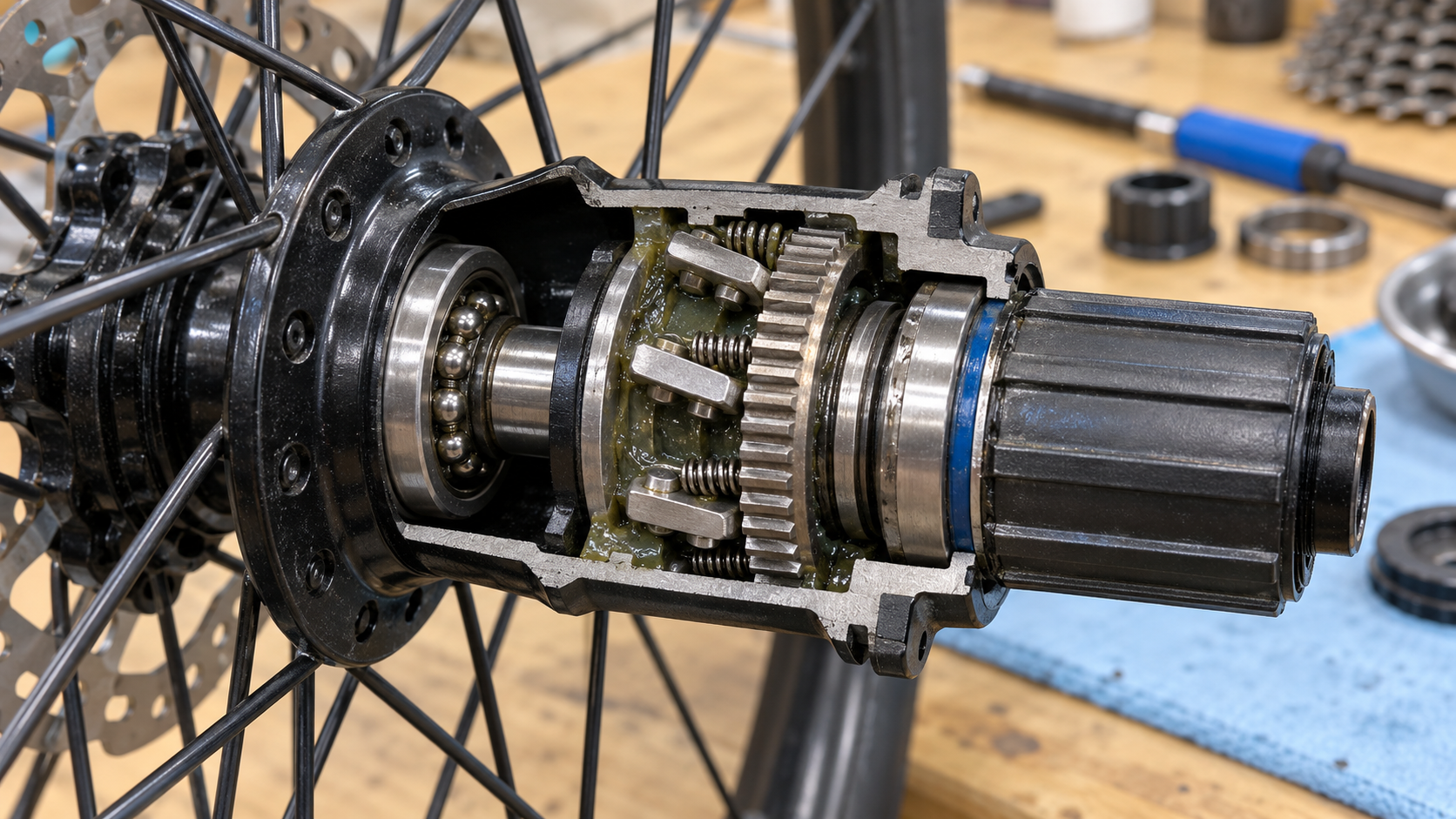
A bicycle can coast because a one-way clutch separates the rear wheel’s forward rotation from the chain when the rider stops pedaling. In a common pawl-and-ratchet design, sprockets turn an outer body connected to several small spring-loaded pawls. Those pawls meet angled teeth in a drive ring. When the chain drives the sprockets forward, the steep faces engage and transmit torque into the hub and rear wheel.
During coasting, the wheel and hub rotate faster than the sprockets are being driven. Relative motion now carries the sloped sides of the ratchet teeth beneath the pawls. Each tooth pushes a pawl inward against its spring, then the spring snaps it outward into the next gap. The repeated motion produces the familiar clicking or buzzing sound. The mechanism overruns freely in this direction instead of forcing the chain and pedals to turn.
Traditional thread-on freewheels contain both sprockets and ratchet mechanism in one unit screwed to the hub. Most modern derailleur bicycles instead use a freehub body attached to the hub, with a cassette of sprockets fitted over splines. The packaging differs, but the one-way function is similar. Some hubs use paired toothed rings or roller clutches rather than individual pawls, changing sound, engagement angle, load distribution, and service procedures.
Bearings let the relevant bodies rotate concentrically with low friction while coasting. Small springs keep pawls ready to engage, and lubricant controls friction and corrosion without preventing quick movement. The number and arrangement of teeth and pawls determine how far the cranks rotate before a tooth catches, called the angle of engagement. Faster engagement can feel responsive, but tooth size, strength, noise, sealing, and reliability must also be balanced.
A sticky pawl may fail to rise fully because of contamination, corrosion, worn parts, or lubricant that is too heavy for the design. The pedals can then slip forward without driving the wheel, which is unsafe. Rough bearings or persistent binding also require service. Many freehub bodies are not intended for complete home disassembly, so maintenance follows the hub manufacturer’s procedure and may involve flushing, specified lubricant, or replacement of the complete mechanism.
The freewheel acts as an overrunning clutch: it locks when the chain is the faster driving member and releases when the wheel becomes the faster member. Angled teeth make the direction difference mechanical, springs reset the pawls, and bearings support relative rotation. That compact switching function lets a rider pause, reposition the cranks, or descend without continuously moving the pedals, then reconnect power automatically on the next forward pedal stroke.
Pawls catch ratchet teeth when the rider pedals but slide over their sloped backs when the wheel overruns the sprockets. Key terms include freewheel, freehub, pawl, ratchet, drive ring, bearing, engagement angle, and overrunning clutch.
Springs push the pawls into successive gaps after the ratchet teeth briefly press them inward, creating a click at each passing tooth.
Sticky or damaged pawls may not rise into the drive ring, so the sprockets turn without forming the one-way mechanical lock.
Explore more "Explainers"
Discover additional explainers across politics, science, business, technology, and other fields. Each explainer breaks down a complex idea into clear, everyday language—helping you better understand how major concepts, systems, and debates shape the world around us.