

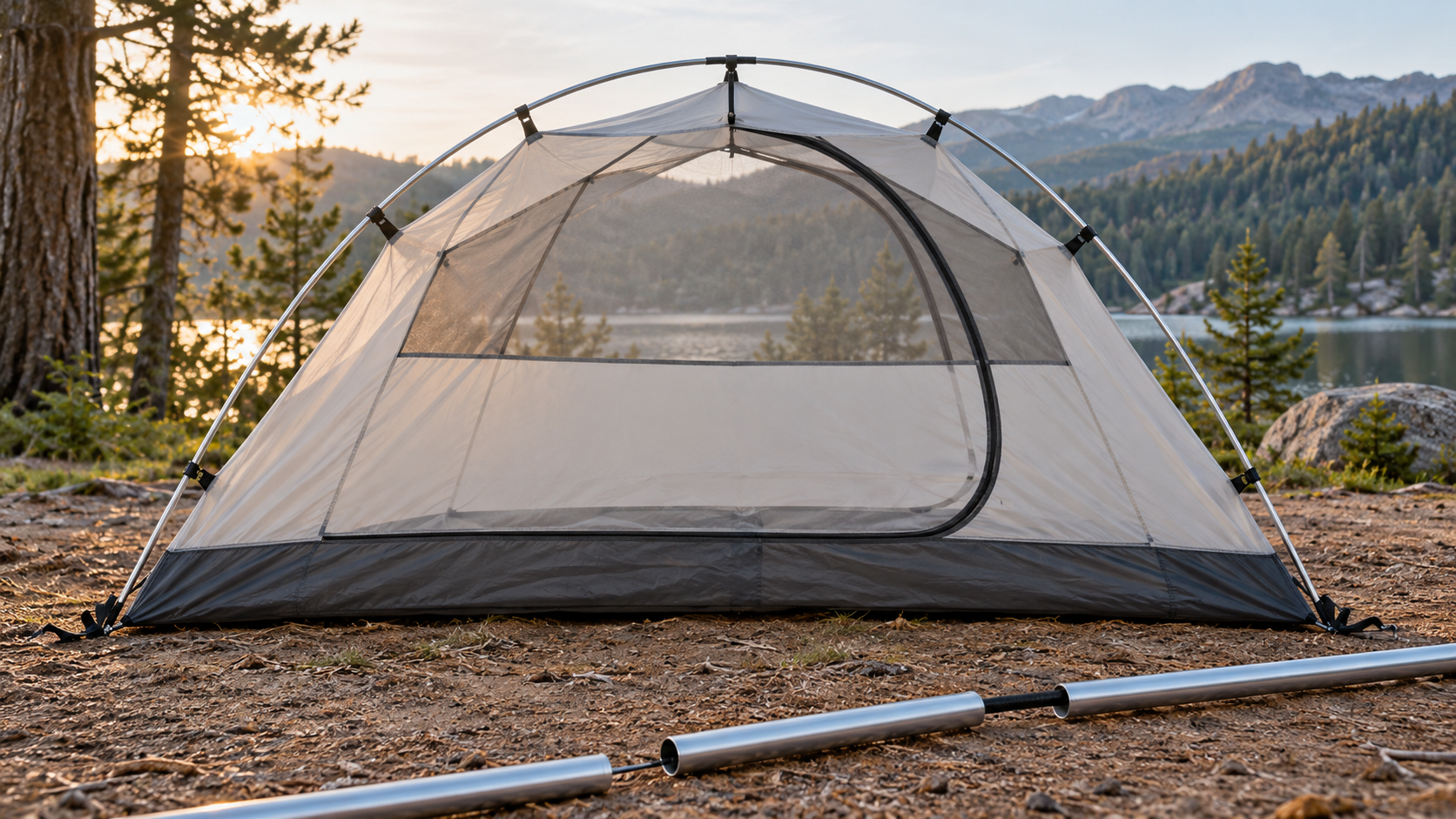
Segmented Tent Pole Flexibility Explainer
A segmented tent pole begins as several short tubes joined end to end by narrower ferrules. When fully seated, the sections behave much like one long beam. Pushing the pole ends toward the tent corners forces that beam into an arc. The metal or fiberglass flexes within its elastic range, so internal stresses develop across the tube wall but the pole returns toward straight when the load is removed.
The pole can bend substantially because curvature is distributed over a long length rather than concentrated at one sharp fold. Hollow tubing places material away from the center, producing useful bending stiffness without the weight of a solid rod. Aluminum alloys generally provide high strength and predictable bends, while fiberglass can be economical but may splinter when damaged. Diameter, wall thickness, alloy, joint design, and pole length all affect behavior.
Ferrules keep neighboring sections aligned and transfer bending forces across each joint. Every section must be fully inserted; a partly seated joint creates a short unsupported edge where stress becomes concentrated and the tube can split. An elastic shock cord running through the pole does not hold up the tent. It keeps the loose sections in order and draws the joints together during assembly, making a long multi-piece structure quicker to handle.
Clips or sleeves attach the tent body to the arched poles. The fabric pulls on many points and helps establish the final three-dimensional geometry. Crossed poles brace one another, while stakes anchor the perimeter and guy lines carry wind loads outward to the ground. A rainfly may add tension and aerodynamic shape. The shelter remains stable because loads are shared among poles, fabric, connectors, stakes, and soil rather than carried by one tube alone.
Wind, improper assembly, corrosion, abrasion, and a forced sharp bend can exceed the elastic range. A pole may take a permanent set, crack near a ferrule, or buckle where the tube wall is dented. Setup avoids dragging joints through grit and confirms that every connection is fully seated before bending. Guy lines are adjusted for conditions, and damaged sections are splinted only as an emergency measure before proper replacement according to the tent maker.
The familiar dome is therefore a controlled elastic structure. Straight tube segments become a continuous beam at the ferrules, stored bending energy presses the ends into their anchors, and the tent fabric organizes the arcs into a stable frame. Flexibility lets the pole absorb moderate movement, but stability comes from geometry and distributed tension. Smooth curvature, complete joints, sound material, and well-placed anchors keep the stresses below the point of permanent damage.
Fully joined tube sections act as a long elastic beam, spreading bending through a smooth arc while fabric and anchors stabilize the shape. Key terms include segment, ferrule, shock cord, elastic range, bending stiffness, sleeve, guy line, and stake.
No. It organizes sections and pulls joints together. The tubes, ferrules, fabric, pole anchors, stakes, and guy lines carry the structural loads.
A shallow ferrule connection concentrates bending at the exposed tube edge instead of transferring it smoothly through an overlapping joint.
Explore more "Explainers"
Discover additional explainers across politics, science, business, technology, and other fields. Each explainer breaks down a complex idea into clear, everyday language—helping you better understand how major concepts, systems, and debates shape the world around us.