

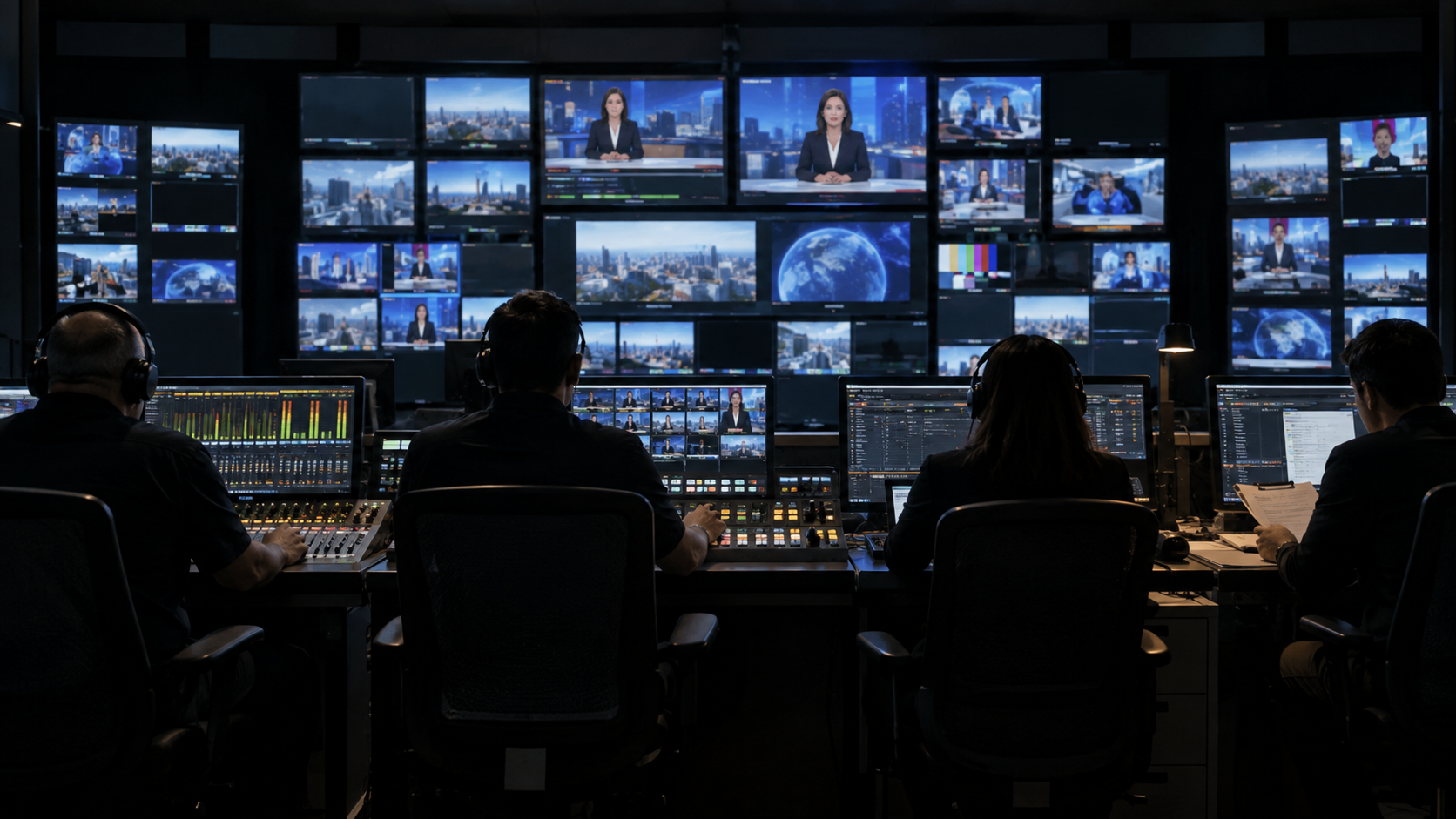
Television News Control Room Explainer
A television news control room is the production hub where the separate parts of a newscast are combined for viewers. Staff watch studio cameras, field feeds, recorded stories, graphics, clocks, and audio meters across a wall of monitors. The room is separate from the newsroom that reports and writes stories, although the two stay in constant contact before and during the broadcast.
The producer is responsible for the rundown and editorial flow. The director calls camera shots and cues technical changes. A technical director operates the production switcher, while audio staff open microphones and balance sources. Graphics and playback operators prepare names, maps, clips, and packages. At some stations automation combines several jobs, but every function still needs monitoring and a person responsible for correcting problems.
During the show, the team follows the rundown while adapting to reality. A live report may be late, a package may run long, or breaking news may replace a planned story. The producer adjusts timing and copy, the director communicates cues, and operators confirm that the next source is ready. Short, standardized commands reduce confusion when several changes happen within seconds.
The control room also protects accuracy. Staff confirm that the correct video, graphic, name, and microphone are taken to air. A technically smooth transition can still be editorially wrong if it identifies the wrong person or uses unrelated footage. Team members are expected to speak up when they see a mismatch, privacy concern, graphic image, or unverified feed rather than assuming someone else noticed.
Viewers see one continuous program, but that continuity is the result of coordinated choices. The control room translates the producer’s plan into a timed sequence of pictures and sound while keeping backup sources available. When the crew communicates well, technical decisions support the journalism instead of distracting from it, and unexpected events can be handled without losing clarity or control.
The producer leads editorial decisions, while the director calls the technical execution of the show.
The technical director operates the switcher to select cameras, video, and other visual sources.
Some functions can be automated, but people still monitor timing, accuracy, failures, and editorial changes.
Explore more "Explainers"
Discover additional explainers across politics, science, business, technology, and other fields. Each explainer breaks down a complex idea into clear, everyday language—helping you better understand how major concepts, systems, and debates shape the world around us.