

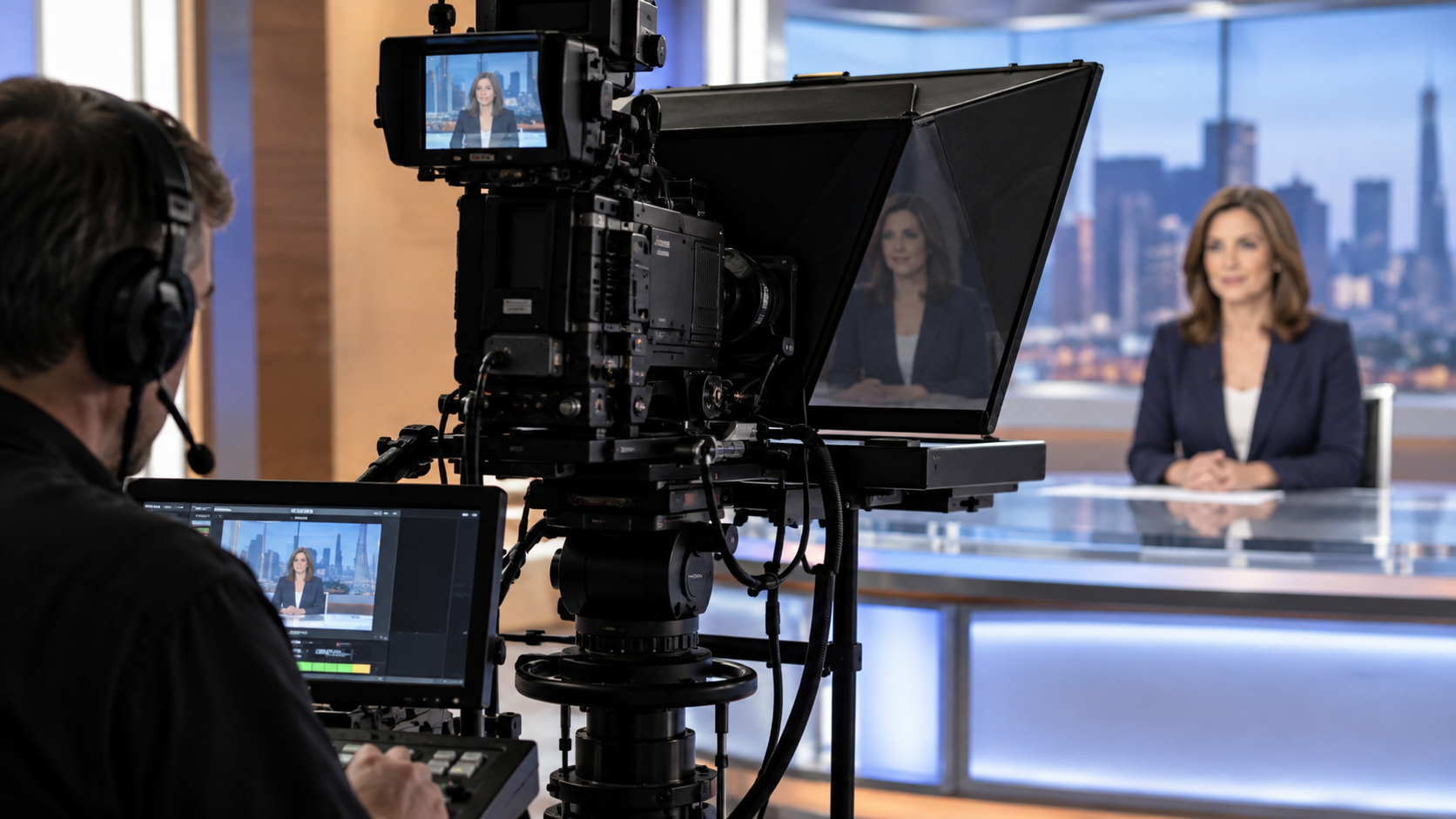
Teleprompter Explainer
A television teleprompter displays a script so an anchor can read while looking toward the camera lens. A monitor sends text to a piece of angled, partially reflective glass mounted in front of the lens. The anchor sees the reflected words, but the camera records through the glass. To viewers, the presenter appears to maintain eye contact rather than looking down at notes.
The script usually comes from the newsroom computer system. As producers update copy, the teleprompter operator loads the current rundown and scrolls at the anchor’s speaking pace. The operator watches for pauses, ad-libs, skipped lines, and changes in delivery. Some anchors control their own speed, while automated studios may link prompting to other systems, but a human still checks that the correct story and version are ready.
Prompter copy must be written for speech. Short sentences, clear punctuation, phonetic spellings, and line breaks help the anchor deliver unfamiliar names and numbers accurately. Last-second edits should be communicated, not silently inserted while the anchor is reading. The presenter reviews scripts beforehand so the words make sense and does not depend on the screen to supply judgment or understanding.
Failures are expected and rehearsed. Text can freeze, jump to the wrong story, disappear, or lag behind. Anchors keep printed or digital backup scripts, listen to control-room cues, and know the main facts well enough to continue briefly. If a serious correction is required, slowing down or stopping is better than confidently reading the wrong information.
A teleprompter is not meant to hide reporting or turn the anchor into a machine. It is a presentation tool that helps deliver carefully edited copy consistently while allowing natural eye contact. The best use combines reliable hardware, organized scripts, a responsive operator, and a prepared anchor who can look away, listen, and adapt when live news changes faster than the text.
No. The glass reflects text toward the anchor while allowing the camera to record through it.
An operator often matches the anchor’s pace, though some studios use anchor controls or automation.
Anchors use backup scripts, control-room cues, and their knowledge of the story to continue or pause safely.
Explore more "Explainers"
Discover additional explainers across politics, science, business, technology, and other fields. Each explainer breaks down a complex idea into clear, everyday language—helping you better understand how major concepts, systems, and debates shape the world around us.